
Compare Helicopter and Crane Costs Before Committing to Your Project's Lift Strategy
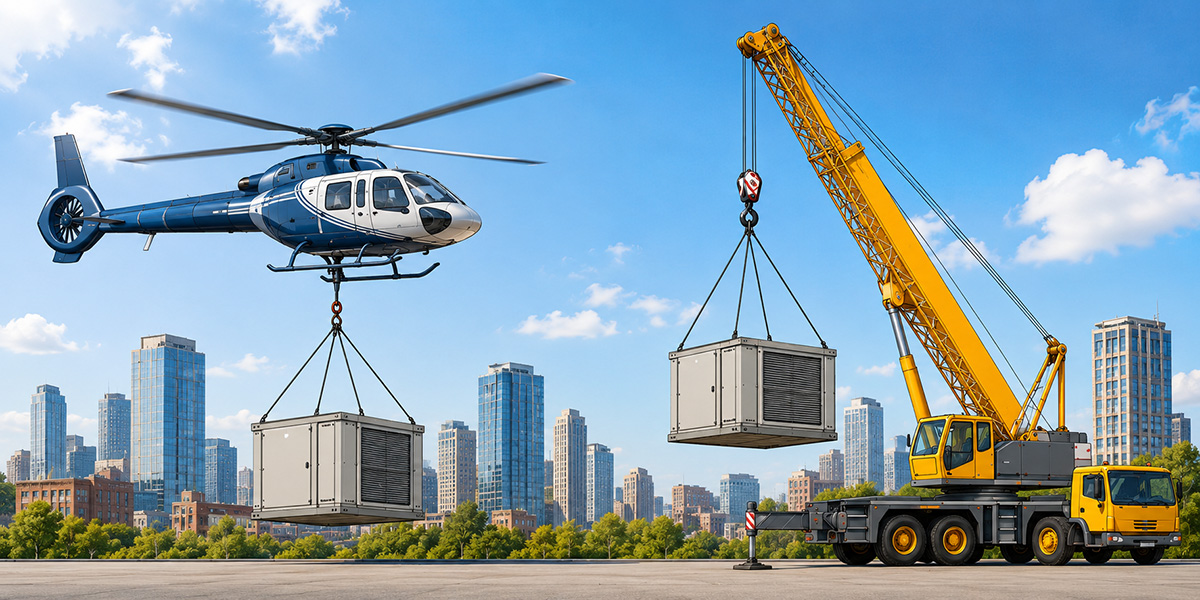
How much does a helicopter lift cost? The honest answer is a range, because it depends on the aircraft, the number of picks, the distance, and how far the helicopter has to travel to reach you. Starting hourly rates run from roughly $1,000 for the lightest aircraft to about $23,500 for the largest heavy-lift Skycrane. On a per-pick basis, when each hour is fully used and the work stays on site, most picks land somewhere between about $40 and $2,350 apiece. Use that time inefficiently, or barely touch the minimum once the aircraft is on site, and a single pick can run anywhere from $1,000 to $23,500. The biggest swing factor is almost always mobilization, the cost of getting the aircraft to you, which is why timing and an asset's current location matter so much. We can often turn a quote around the same day.
But those ranges are the least useful numbers on this page. The question that actually saves contractors money isn't what a helicopter costs. It's whether a helicopter beats a crane, and on which jobs, because the reflex to default to a ground crane is wrong more often than the industry admits, lift after lift.
This guide breaks down what lifts really cost, how a helicopter, sometimes called an aerial crane or helicopter crane, compares to a traditional ground crane, and how to choose between them. By the end you'll know what actually moves the price, when a helicopter quietly beats a crane, and how the choices you make before you ever call decide what the job costs.
What's Ahead in This Guide
Here's the whole guide, section by section. Each one is a piece of the planning a quote never shows you.
- The Lift Planning Reality Check.
Why "crane or helicopter?" has dozens of moving parts that never reach the quote, and why you don't have to weigh them alone. - The Economics: Cost, Speed & Bidding.
What's actually on a crane or helicopter quote, the line items that catch people off guard, where overages come from, and how to bid a job so you win it. - Mobilization & Logistics.
Why the closest asset usually isn't the lowest cost, how bundling collapses cost, and the fire-season window almost everyone misses. - Equipment Specs: Weight, Reach & Limitations.
The capacity ladder, why a 300-ton crane isn't 300 tons of capacity where your load actually sits, and how the right move can drop you a whole class. - Site Restrictions & the Surrounding Environment.
Ground that can't bear a crane, the real footprint of road and building closures, and why a helicopter sometimes wins in the middle of a city. - Safety, Regulations & Rigging.
The rules that are genuinely required, the "rules" that turn out to be folklore, and the rigging tempo that quietly decides your cost. - The Hybrid Approach.
When using a crane and a helicopter together beats either one alone, and when it's just paying to mobilize twice. - Types of Lifts & Case Studies.
From rooftop units to spacecraft drop tests, the full range of what flies on a line and what makes each one hard. - The Steps of Planning a Lift.
The full sequence between your first call and a clean set on the roof, and how much of it happens before anything leaves the ground. - Myths, Busted.
Every belief this guide takes apart, collected in one place. - Frequently Asked Questions.
Straight answers on cost, permitting, timing, and what can fly. - The Bottom Line.
Why the number on a quote is the smallest part of the story.
The Lift Planning Reality Check
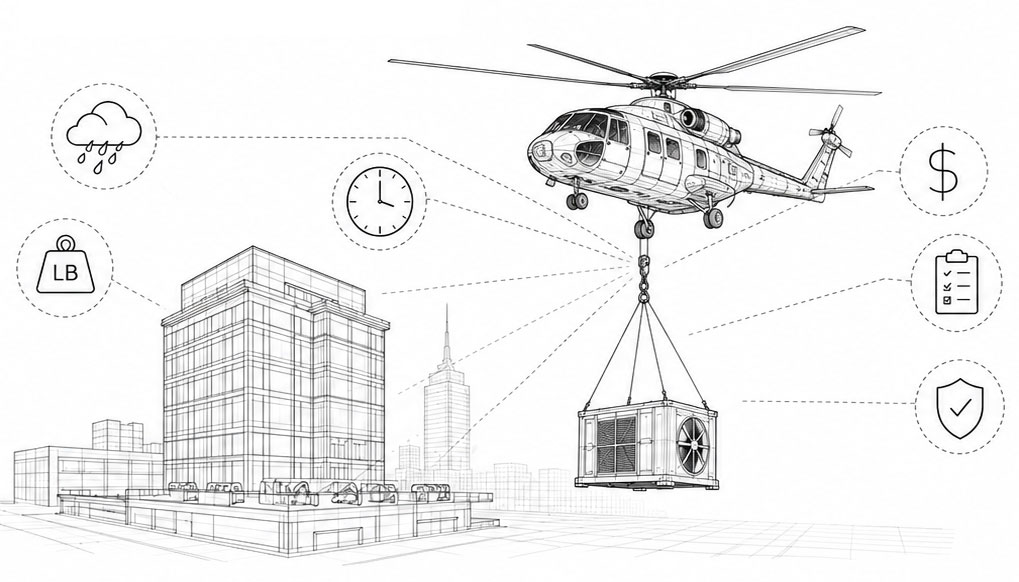
From the outside, deciding how to lift something looks like a single question: crane or helicopter? Get a couple of quotes, take the lower one, done. That assumption is wrong often enough that it quietly costs contractors money on job after job, not because they're careless, but because the real decision has dozens of moving parts, and almost none of them show up on a quote.
Here's the uncomfortable truth this guide is built around: nearly every contractor picks the right asset sometimes. Almost none pick it right on average. The gap between those two is efficiency, money, and sometimes safety left on the table, lift after lift, and it compounds.
The trap is believing you can weigh it all yourself. Lifting isn't your business; it's a facilitator for your business, something you do a handful of times a year in between everything else. The people on the other side of the call do it every day, and even they, as you're about to see, are usually answering from behind a single set of equipment, not from a clear view of every option. That isn't a knock on their skill; it's the built-in blind spot of owning one fleet, and it's exactly the gap an unbiased planner exists to close. This guide walks through the specifics that actually decide a lift, so you can see for yourself why common sense isn't all that common once a load leaves the ground.
The Right Asset Is a Moving Target
The hard part isn't lifting the thing. It's that the best way to lift it is a moving target. Dozens of assets can do a given job, and they differ constantly in capability, in cost, and in where each one happens to be sitting this week. The right choice for an identical lift can change from one month to the next without a single detail of the project changing. Pinning it down takes an objective look across every option at once, weighed on the merits, which is exactly what's hard to get from anyone tied to a single set of equipment, because a fixed fleet comes with a built-in answer.
It's the difference between an electrician and a general contractor. The electrician is excellent at execution but frames every problem around the tools they own; the general contractor plans the whole job and judges the trades on the merits, answering to the project rather than to any one of them. A crane or helicopter operator is the electrician here: the right hands for the lift, the wrong vantage point for the plan. This guide is written from the general contractor's chair, with every asset on the table, judged without a thumb on the scale.
Two Myths That Cost Real Money
Two beliefs in particular drive most bad lift decisions, and you'll see both taken apart throughout this page:
Myth 1: A ground crane is the default choice for every lift.
Myth 2: A helicopter is only worth considering when a ground crane is physically impossible or flatly cost-prohibitive.
Follow those two rules and you'll misjudge lift after lift. They feel like common sense. They're expensive.
Rules of Thumb That Actually Hold Up
With the standing caveat that every rule of thumb has exceptions, and that what matters is running a consistent planning procedure rather than leaning on any single one of them, these are the ones worth internalizing:
- Below a 100-ton crane, a helicopter generally isn't applicable.
- Past a 100-ton crane, a helicopter must be considered.
- When you're using a helicopter, always check whether that same helicopter can handle every lift on site, even the ones a crane would otherwise take. Mobilization is the dominant cost driver, so once the aircraft is there, added lifts can cost little or nothing.
- Combine as many lifts and projects as you possibly can whenever a helicopter is involved. Greater volume substantially reduces the average cost per lift.
- Outlier weights are a flag that the job may need to be split between a helicopter and a ground crane. They signal that a split is worth weighing; on their own, they don't tell you how to divide the work.
- As the number of lifts climbs, the case for a helicopter over a ground crane climbs with it.
- Past 10 units, a helicopter becomes more likely to win, especially when the crane alternative is still 100 tons or more.
- At a 300-ton crane with at least 10 units, a helicopter is often far and away the best option.
"Must be considered" is the operative phrase, and it's doing precise work. It doesn't mean the helicopter wins. It means most mechanical contractors don't even put one on the table for nearly enough lifts, and that omission is exactly where the money leaks out.
The Economics: Helicopter Cost vs. Crane Cost, Speed & Bidding
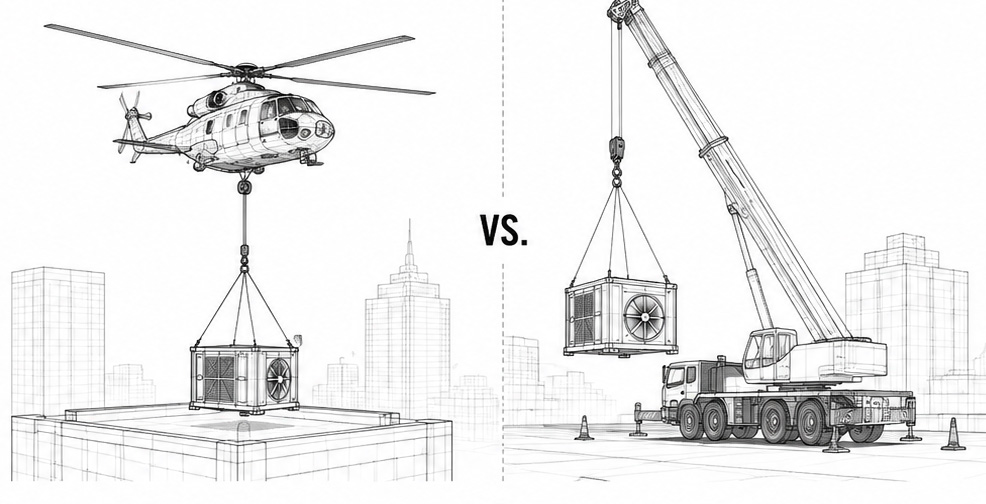
Anyone who has booked a crane or a helicopter knows the grand total at the bottom of the quote isn't the whole story. Your own crew's time, the rigging, the extra hours on site, the overages, none of that is necessarily in the number you were handed, which makes the quoted total something of a mirage. Picking the right asset sets your baseline cost. This section is about everything else that moves your real cost: how fast the work actually goes, how to read and compare quotes that aren't built the same way, and how to bid a job so you actually win it.
Helicopter Lift Cost: Real World Examples
Almost no one in this industry will show you a real number. We will. Below is a sampling of actual jobs we have planned and flown, with the locations and dates stripped off, because the goal is not to hand you a price. Every job is different, and yours will be too. What this does show is how far apart real lifts land, and why, across everything from rooftop units and cooling towers to signage, stadium roofing, and tower sections. Watch one thing as you read: the word RTUs shows up on a job that cost about $339 a pick and on another that cost more than $9,000 a pick. That spread is the whole point.
The volume job: 264 rooftop units, about $89,500 in total, roughly $339 a pick. This is what efficiency looks like. Spread the mobilization and the minimum across 264 picks and the cost per pick collapses. The part that matters most is the comparison. The crane option was actually lower on equipment at $63,900, but it carried twelve full days of crew where the helicopter needed two. Add ten extra days of labor and the lower quote becomes the more expensive job. That is what total delivered cost means in practice.
The heavy job: 17 rooftop units and condensers up to 16,500 lb, about $160,250 in total, roughly $9,426 a pick. The mirror image of the job above. Few picks, heavy units, and a cost per pick more than twenty-five times higher. The same kind of equipment, with completely different economics, because the weight and the pick count moved.
The honest one: 3 custom aluminum picks, $7,550. The client already had a lower crane quote in hand and chose the helicopter anyway. The reason was access, not price. Using the crane would have required closing a road that the helicopter plan, laid out the way we planned it, never had to touch. We are upfront when the crane is the lower number, and here the client simply judged that skipping the road closure was worth the difference.
The outright win: 14 rooftop units, about $17,121 by helicopter against a $19,000 crane quote, finished in roughly an hour. Sometimes there is no math to do. The helicopter is the lower number and the faster option at the same time, and that is the end of the analysis.
The one a crane could not do: cables, towers, and materials over about five weeks, roughly $1.63 million. This was an overseas project, which is most of why the figure is what it is. The mobilization alone was significant, and the work demanded weeks dedicated to this job and nothing else. Note the heaviest load on it, though: only 7,500 lb. It was never about weight. It was about terrain and access no crane could reach. The largest jobs are often the ones where a crane was never an option to begin with.
A wider sampling, sorted by cost, to show the range:
| Job type | Picks | Heaviest load | On-site time | Cost | Crane alternative |
|---|---|---|---|---|---|
| Custom aluminum | 3 | 4,000 lb | under 1 hour | $7,550 | Lower cost, but required a road closure the helicopter avoided |
| Heat pump | 2 | 621 lb | under 1 hour | $8,662 | $13,000 crane |
| RTUs | 14 | 1,453 lb | ~1 hour | $17,121 | $19,000 crane |
| Tower antenna mount | 6 | 1,200 lb | under 1 hour | $25,000 | Not quoted |
| Sign lift | 18 | 1,800 lb | ~1 hour | $38,386 | Not quoted |
| Exhaust fans | 105 | 2,800 lb | ~1 day | $61,675 | Client chose helicopter to limit shutdown |
| Tower sections | 21 | 7,000 lb | ~1 hour | $89,500 | About $100,000 crane |
| RTUs | 264 | 2,600 lb | ~2 days | $89,502 | $63,900 plus 12 days of crew |
| Stadium roofing materials | 90 | 3,000 lb | ~1 day | $99,959 | Tower crane |
| RTUs | 63 | 6,000 lb | ~4 hours | $104,750 | Not quoted |
| Packaged units | 36 | 8,000 lb | ~2 hours | $142,000 | Crane quoted above $200,000 |
| RTUs & condensers | 17 | 16,500 lb | ~2 hours | $160,250 | Not quoted |
| Cooling towers | 56 | 13,000 lb | ~1 day | $318,600 | 600-ton crane or larger |
| Log jacks | n/a | 18,000 lb | ~4 weeks | $1,622,900 | Not possible |
| Cables, towers, materials (overseas) | n/a | 7,500 lb | ~5 weeks | $1,634,198 | Not possible |
Speed Is Money, Specifically Yours
A ground crane averages about 2 picks per hour. A helicopter averages about 15. That gap is the single biggest lever on the cost you don't see on the quote, because slow lifting doesn't necessarily cost the operator, it costs you, in crew days standing around and in a project that can't move forward until the lifts are done.
It's worth being precise about those two numbers, because the frank version is more convincing than the flattering one. The crane's 2 per hour counts only the time it's set up and actively picking, and it does not include the setup, the teardown, or the repositioning, which is where a crane burns most of its clock. The helicopter's 15 per hour already includes every working hour on site (it leaves out only mobilization and demobilization). So this comparison is measured generously to the crane for on-site efficiency. Fold the crane's setup and breakdown days back in, and the real-world throughput gap isn't 2 to 15, it's far wider. (Both figures are approximations that move with reach, radius, crane type, weight, pick-to-drop distance, rigging prep, and how precisely each unit has to be placed.)
How much that gap matters to you depends on a few things: your crew costs, how dependent the rest of the job is on the lifts, and whether the building has to stop earning while the work happens. If every other trade is standing idle until the units are set, lift speed is everything. If the lifts are off on their own with the project humming around them, it matters less. And if the site is a working business, a retail store, a manufacturing line, a shipping hub, a hotel, every hour it's shut down is money lost, which puts an even higher premium on speed. Knowing which situation you're in is part of bidding it right.
Monroe Mechanical: Same Quote, Five Days Apart
A two-unit swap, four total picks, at a five-story, X-shaped office building in Cincinnati, Ohio. The units were a routine 3,000 pounds. The weight was never the problem. The building was.
On an X-shaped structure, rooftop units sit in the crooks of the wings or in the center hub, exactly the spots a ground crane can't get near, because it has to set up far enough back to clear the building's footprint. That long reach, at five stories, is brutal on a crane's capacity: you'd need a 300-ton plus crane just to handle a 3,000-pound unit out at that radius. And parking a 300-ton crane in a tight office-park lot can mean blocking multiple access roads for the duration. Physically possible, but geometrically and financially painful.
We quoted it with a Bell 214 that happened to be transiting the area. At 6,000 lb of capacity it was far more aircraft than a 3,000-pound unit needs, and as a standalone job it never would have penciled out. It won anyway, because its added mobilization was close to zero, the kind of positioning that only comes from planning many projects at once to share the trip, and exactly what a single-asset operator can't replicate. That is why it beat the alternatives, an S-61N and a Bell 205. The whole job can be completed under 20 minutes of actual flight time.
The client's own words said it best: the crane quote was the same cost as the helicopter, but the crane would have needed five days on site to do what the helicopter would have finished in minutes. Identical numbers on paper. Wildly different cost once you count five days of crew and disruption against twenty minutes of flying. That difference is invisible on a quote, and it's the whole game.
Why a Crane Eats Days: Setup & Breakdown
The crane's hidden cost is time on the ground, and it scales hard with size. Setup and teardown happen on site, and unless the job is small, they repeat for every staging area the crane has to move between:
- Around 165 tons and up, expect roughly 1–2 days on site for assembly and disassembly.
- A 300-ton crane runs closer to a day to build and a day to tear down (before you even count mobilization and demobilization).
- 500-ton-plus machines climb into multiple days each way, and every one of those days costs more as the tonnage rises.
This creates a genuine fork: a smaller crane may reach everything but only by relocating and re-setting up several times (cost piles up in on-site time), while a larger crane may reach it all from one spot but bills more per hour and carries bigger minimums. There's no free answer, only the right trade for the job.
Minimums matter here too. Ground cranes typically carry an eight-hour minimum; helicopters typically a three-hour minimum. And here the helicopter has a quiet structural edge: it has no on-site assembly the way a crane does. What preparation it needs, the rigging, the staging, the planning, happens in advance, off the clock that's running over your site. The only real on-site limiter is rigging tempo: the crew has to keep four to five units pre-rigged so they can feed an aircraft turning a pick every two to four minutes, or the helicopter spends the day waiting on them.
Reading the Quote: Line Items & Overages
The reason the total is a mirage is that it's stitched together from a dozen separate charges. Knowing them is how you stop being surprised.
A ground crane quote commonly includes: mobilization, demobilization, per diem, mats, safety crew, the asset's hourly rate, the minimum hours or daily rate, the crew (operator, rigger, oiler, flagman), overtime above an eight-hour shift, premium rate above a twelve-hour shift, fuel surcharge, counterweight freight, rigging equipment (spreader bar, shackles), overages billed in 30-minute increments, and weekend or holiday rates.
A helicopter quote commonly includes: mobilization and demobilization, per-pick or hourly pricing, the daily minimum, rigging and rigging equipment, crew costs, fuel, the congested-area plan or flight plan, per diem, safety crew, a fuel truck where needed, and overages billed in small increments. On multi-day jobs, each additional day carries its own daily minimum, and weekends or holidays may bill higher.
Two things to confirm on any quote before you sign: the overage increments (how finely additional time is billed) and the cancellation terms, both of which vary by operator and by job, and both of which can bite if you assume rather than ask.
One thing the quote won't tell you: helicopters are far less likely to run into overages in the first place. The efficiency is part of it, and so is the fact that most jobs don't perfectly fill the capacity that fits inside the helicopter's minimum, which leaves a cushion of paid-for time. When overages do happen, they usually trace back to inaccurate information from the client, too little rigging to keep the aircraft fed, or last-minute additions to the workload, not to the aircraft itself. That lower overage risk is one more cost comparison that never shows up on the page of a quote.
You Can't Compare Two Quotes Side by Side
Here's the mistake that follows naturally from all of the above: laying a crane quote next to a helicopter quote and picking the smaller number. You can't, because they aren't built the same way: different minimums (eight hours vs. three), different structure (a crane bills by the hour or day, while a helicopter may be priced per pick or by the hour), and a mobilization line that's a much larger share of a helicopter quote than a crane quote (a gap that sometimes shrinks as cranes get bigger).
What you actually compare is total delivered cost: the lift quote, plus your crew days, plus the project disruption, plus the realistic risk of overages. Monroe is the proof: two quotes at the same number, and a difference of five days versus twenty minutes in what the job would have cost the client. And the saved days aren't only lower crew cost; they free up the calendar to take on more work, which lifts both top-line revenue and bottom-line profit. The quote is the down payment on the real number, not the real number.
One practical note: helicopters can often turn a same-day quote, while a crane quote may take several days or more, which matters when you're racing a bid deadline.
Site Visits
A site visit is cheap insurance against an expensive surprise. It's where we check the things that decide the plan and rarely show up in a description: the non-participating public, road closures, building closures, site access, staging, and whatever else is unique to that project. Ground-crane site visits may be free; helicopter site visits may carry a cost depending on how far out the project is. A lot can be checked from satellite imagery now, which sometimes makes a remote review enough, so ask the lift specialist whether your job needs eyes on the ground. Either way, it isn't a step to skip: uncovering a problem beforehand is a fraction of the cost of discovering it on lift day.
Bid to Win: Call Before You Pick the Units
This is the part most contractors get backwards, and it costs them jobs.
A lift is never the point. You're not in business to fly units onto a roof; you're in business to sell your product and your service, and the lift is just the facilitator that makes the sale possible. You can't sell a client on new RTUs without a cost-effective way to get them up there. Which leads to the truth most people miss: the units you choose before you think about the lift can sink your bid. Unit selection isn't only an HVAC decision; it's a bidding decision.
Heavier units might mean more profit for you, but that's a double-edged sword, because heavier also means a bigger lift cost, a bigger bid, and a lower chance of winning. The way out is right-sizing the whole package, not just the crane on lift day. Fifty 3,500-pound units flown on a Bell 212 will beat ten 18,000-pound units on an S-64 Skycrane. A 300-ton crane working more days will beat a 700-ton crane working fewer. Spread the weight, and both the economics and your win rate improve.
So if your project has any flexibility in unit weights or types, call before you spec it, not after. Bidding a job you haven't won yet is when you have the most freedom: you can plan around a single mobilization, sequence all the lifts to minimize disruption, and shape the unit choices to a lower-cost lift. Once the bid is won, the specifications are usually locked; options still exist, but you've already given some away. Confining the project early, before anyone's looked at the lift, quietly removes the very options that would have made your bid win.
The shift this section is really asking you to make is simple: stop asking "what does the lift cost?" and start asking "what's my real cost, and how do I bid to win?" The answer to the first question is on a quote. The answer to the second (crew days, project flow, overage risk, the unit choices you make) is worth more than any single line item, and it's exactly what a quote will never tell you.
Bidding a job, or planning one you've won? Call before the units are set, and we'll help you shape the lift, and the bid, around the cost that actually matters.
Mobilization & Logistics (The Ground Game)
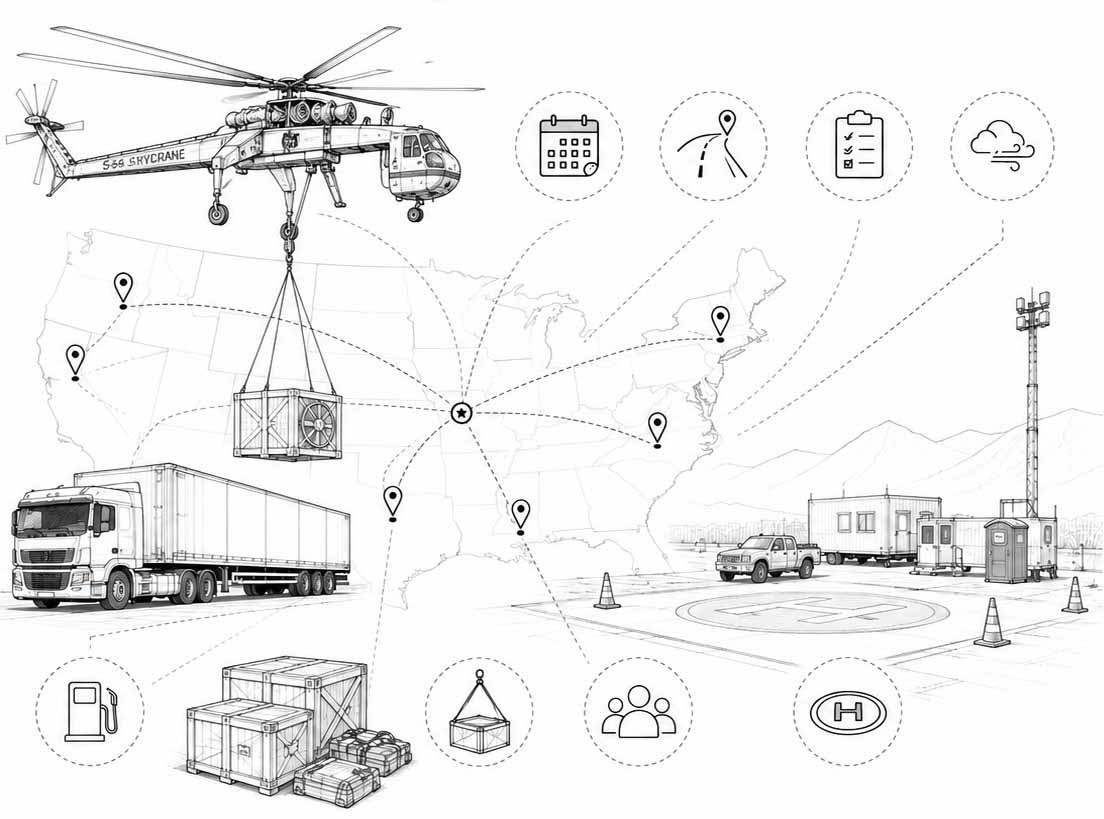
Most contractors think the lift starts when the crane swings or the helicopter picks. It doesn't. The lift starts, and most of the cost is decided, long before anything leaves the ground. Mobilization is the part of the job nobody quotes you on a napkin, and it's the part that separates a sharp lift plan from an expensive one.
Here's the uncomfortable truth: two contractors can run the exact same lift, with the exact same unit, at the exact same address, and pay wildly different prices. The unit didn't change. The site didn't change. What changed was where the right asset was sitting when the phone rang, and whether anyone bothered to plan around it.
This is the section where we show you the moving parts.
Proximity vs. Cost
Myth: The closest asset is always the lowest cost.
This one survives because the logic sounds airtight. Mobilization creates cost. Longer mobilizations create more cost. Therefore the nearest crane or helicopter must be the lowest cost. It feels like arithmetic.
It falls apart the moment you look at what's actually rolling toward your site.
The closest asset is often the wrong asset, and the wrong asset is expensive. The nearest available crane or helicopter may have more capability than your job needs. A 300-ton crane parked across town doesn't just show up; it arrives with a convoy of counterweight trucks, a longer assembly and teardown, and a bigger crew clock running the whole time. A right-sized crane an hour farther out can roll in on fewer trucks, set up faster, and beat the "closer" option outright. The same logic runs on the aircraft side: send a Super Puma or a Kaman K-MAX when a lighter ship would clear the job and you pay for capacity you never use, and because the bigger aircraft are rarer, you often pay for a longer mobilization on top of it. Distance is one line on the invoice. Over-capability touches half a dozen of them.
The single best price you'll ever see comes from an asset already in motion. When an operator is already mobilizing through your area for another project, your job stops being a full mobilization and becomes a marginal one: you're splitting the cost of the deviation with the project that's already moving, not paying full freight from a home base. We won't pretend it's free; it isn't. But it creates a price no other option on the board can touch. It's a genuine win-win: the operator monetizes a trip they're already taking, and you get a lift at a number that looks like a typo. The catch is that no contractor can engineer this from a single phone call to a single operator. You can only catch it if someone is watching where assets are headed across the whole market, which is the entire reason this planning function exists.
And the two asset types don't even measure distance the same way. A helicopter mobilizes as the crow flies: point to point, straight line, terrain mostly irrelevant. A ground crane mobilizes through a series of far less efficient roads: permit corridors, weight-rated bridges, mountain passes, turn radii its trailers can actually make. "Forty miles away" can mean two very different things depending on which one you're booking. The map lies to you, and it lies differently for each asset.
The Bundling Strategy
If mobilization is the biggest hidden cost, bundling is the biggest hidden discount.
The principle is simple: every day a helicopter isn't flying, it's losing money. Idle assets are bleeding assets. That economic reality is your leverage, because operators will price aggressively to keep their machine productive. It cuts the other way too: when work is thin, an operator has to charge more per job to stay whole, which is exactly why stitching several projects, or a few longer ones, into one trip is what unlocks the better number.
Bundling your own projects. If you, your clients, or several clients together control multiple sites (a portfolio of schools, a chain of warehouses, several stores across a mall complex) the savings show up cleanly and directly on your quote. We re-price the program as a unit instead of as a stack of one-offs, and the mobilization that would have been charged seven times gets charged closer to once.
Bundling onto someone else's project. Even if you've only got one site, you can still ride another client's mobilization. When your job sits along the line another operator is already traveling, you're not splitting a fresh mobilization down the middle, you're adding a stop. In practice that tends to land as a 20–40% reduction rather than a full 50/50 split, because the client who booked the original project set the table and deserves to keep a benefit for it. Everyone comes out ahead of where they'd have been alone.
Bundling with a lift specialist. You don't have to own all the sites yourself, either: a specialist can stitch several different clients into one back to back schedule, and back to back is usually the requirement, since the asset won't sit idle waiting days between roofs.
The cost of bundling is flexibility, specifically dates. Here's the constraint people miss: "in the same area" is not the thing that unlocks the savings. Position along the mobilization line is. Two sites can be ten minutes apart and capture none of the benefit if their lift dates are weeks apart, because by then the asset has demobilized and gone home. To bundle, the contractor or end client who needs the lift has to be willing to move dates to meet the asset's schedule. Lead time is the other half of it: a lift you need tomorrow is hard to attach to anything, while one scheduled three months out gives a specialist room to line up other work along the same path. The savings are real, and they're paid for in calendar flexibility, and the contractors who win here build that flexibility in from the start instead of locking a date and hoping the economics work out. The ones who stay rigid pay full price, because they aren't bundling at all.
Case Study: Aircon Energy 7-School RTU Program (Menifee / Murrieta / Sun City, CA)
Upwards of $30,000 was saved by combining all seven schools and using the right aircraft for each, with tens of thousands more saved by flying the units instead of bringing in a ground crane.
Aircon Energy needed rooftop HVAC units (RTUs) replaced across seven schools clustered tightly across Menifee, Murrieta, and Sun City, 358 units in total, ranging from sub-1,000 lb units up to roughly 2,500 lb.
The instinct is to ask "what's the biggest crane or aircraft that can do all of it?" and book that. That instinct is exactly what costs contractors money.
There wasn't one right answer. There were two.
- La Piedra (72 units, up to 2,500 lb): higher unit density and heavier picks pointed to a Sikorsky S-58T, which has the muscle for the 2,500 lb units and the cycle speed to clear 72 picks well inside a single day.
- The remaining six schools (286 units, max ~1,000 lb): an MD-500 is the right tool: lighter, faster on cycle time, less expensive to run, and more than capable of every unit in the group.
Could the S-58T have done all seven schools? Yes. It can lift everything on the list. But putting it on six schools of light units means paying to haul lift capacity you're not using on every single pick, the same over-capability tax that drives the Proximity vs. Cost myth above. The MD-500 cycles the light units faster and at lower cost. Two assets, each matched to its work, beats one asset stretched across all of it. This is one option out of hundreds we narrow down, and in this case the right answer was a split, not a single machine.
The math that matters:
- Helicopter program: averaging ~15 units/hour across up to 8-hour flying days, the six MD-500 schools clear in roughly two to three flying days, with La Piedra's S-58T work well under a day. The tight geographic cluster means the aircraft can do multiple schools per day, so the typical 3-hour helicopter minimum is never wasted: there's always another roof a few minutes' flight away to keep the rotor earning.
- Ground crane alternative: at even an optimistic half-hour per pick, 358 units is over 20 working days of picking alone, before you add seven separate crane mobilizations and seven assemble-and-teardown cycles. Realistically, weeks.
Where the savings come from: crew time (the single biggest driver, days instead of weeks of labor clocks), mobilization collapsed across a bundled cluster instead of repeated seven times, and minimums that actually get used up instead of paid-for-and-wasted.
Helicopter Positioning & Fire Season
You can't bundle around an asset's path if you don't know where the asset is.
Knowing where helicopters are at any given moment isn't luck; it's a mix of tools that track helicopter movement remotely, direct relationships with the pilots and operators flying them, and simple visibility from the projects we set up ourselves (when we schedule a job, we know exactly when and where that aircraft will be). Stack those together and a picture emerges that no single contractor calling a single operator can see: who's where, who's headed which direction, and whose trip your job could ride.
Fire season cuts both ways. Through the season, helicopters get pulled onto firefighting contracts, which tightens availability and pushes up price and lead times for everyone else. That's the part everyone knows. Here's the part most don't: those firefighting deployments create mobilization lines: an aircraft flying from its base of operations out to where it'll be stationed. Any lift that sits along that line can be picked up for the cost of a deviation rather than a full mobilization from base. Most firefighting runs out west, which is also why helicopters are simply more plentiful on the West Coast, with shorter mobilizations to match. East Coast lifts are just as doable; they only lean harder on a specialist to manage schedules and mobilization. And the opportunity isn't limited to the fire zone; it's available to anyone positioned anywhere along the route the aircraft is already flying. Fire season looks like a wall to most contractors. Planned right, it's a discount.
Staging & Access
Where the asset can physically stand, fly, and reach decides as much as what it costs to get there.
Ground cranes reposition; they don't teleport. You don't pick one spot and order the longest-reach crane that can hit everything from it; that's how you end up renting a 300-ton machine to do a 100-ton job. If three of ten units sit 300 feet out from the first staging spot, the right move is usually to move the crane to a position where the reach is shorter and the crane is smaller, not to buy the reach. The staging plan is the cost plan.
The ground itself bites back. Cranes and counterweights are heavy enough to crack landscaping, and they can't stage on a parking structure, above or below grade, that wasn't engineered to carry them. A staging area that looks perfect on a satellite image can, in practice, block the only entrance, choke a fire lane, or sit on a slab that won't hold the load. These are the problems that surface on mobilization morning if nobody scouted them, and they're expensive to discover late.
Closure footprints are bigger than people expect, and a helicopter's is different in shape. As a planning rule of thumb, expect everything within roughly 150 feet of a helicopter carrying a load to require road closures, and typically the top two floors of any building inside that radius. A ground crane's footprint is tighter but its duration is longer: because it physically takes longer to set each unit, the roads and building areas stay shut down for far more total time. Final closure requirements always come from the local authority having jurisdiction and the FAA; we treat these as planning envelopes and confirm the final requirements with the AHJ.
Some sites only work one way:
- Near airports, ground cranes are effectively out; they can't reposition fast enough when ATC needs them to move. Helicopters integrate with airspace control in a way a crane never can.
- Active retail sometimes forbids cranes outright. Simon Malls, for example, will only allow helicopters, precisely because the aircraft can clear rooftop units in the early hours just after sunrise without obstructing the lot during operating hours, where a crane would block parking through the busy day.
- Hospitals can take helicopters, but the rule is to close one floor more than a dropped unit could penetrate (it doesn't actually drop, it's a safety rule), and that floor stays closed for the duration of the lift set, not just while the load is overhead. A ground crane at a hospital usually only has to close the exact interior route the unit travels, often coned off temporarily.
Snatch jobs are the planner's pressure-release valve. A helicopter can run a job without ever landing, attaching the unit to the hook in flight, which is invaluable when there are only a few units or nowhere to set down. The bigger payoff, though, is the closure footprint: flying the job lets you design a path that deliberately minimizes how many roads and how many building floors have to shut down during the lifts.
None of this is in the price you were quoted. Mobilization, bundling windows, asset positioning, staging hazards, closure footprints: these are the variables that decide whether your lift is efficient or expensive, and they're invisible until someone maps them against the whole market instead of a single operator's driveway. That mapping is the job.
Send us your site list (multiple locations, dates, and unit weights) and we'll show you where the bundling, positioning, and right-sized-asset savings actually live. [Request a lift plan →]
None of this is in the price you were quoted. Mobilization, bundling windows, asset positioning, staging hazards, closure footprints: these are the variables that decide whether your lift is efficient or expensive, and they're invisible until someone maps them against the whole market instead of a single operator's driveway. That mapping is the job.
Send us your site list (multiple locations, dates, and unit weights) and we'll show you where the bundling, positioning, and right-sized-asset savings actually live.
Equipment Specs: Weight, Reach & Limitations
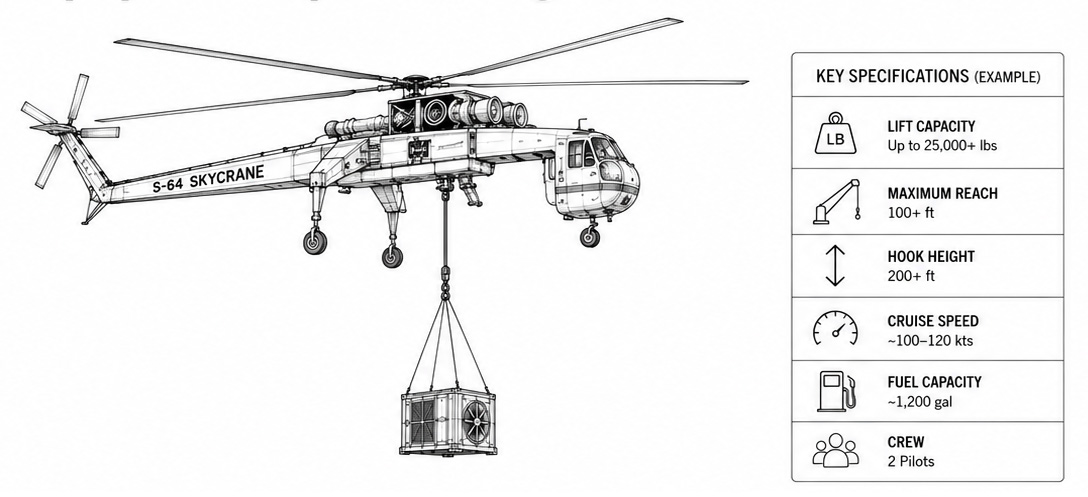
Every lift plan starts with one number: the heaviest single thing you have to pick up.
That number, not the average unit, not the total tonnage, not the count, dictates the class of equipment for the entire job. You can have ninety units at 800 lb and one at 4,200 lb, and that one outlier sets your floor. But an outlier isn't destiny. A surprising amount of the planning in this section is about defanging that one heavy pick: trimming its weight, handing it to a second asset, or otherwise working around it so it doesn't drag the whole job into a bigger, costlier class. Everything else downstream, cost, mobilization, staging, the closure footprint, flows from correctly identifying the limiting lift and then not over-buying past it.
Below that headline rule sits a surprising amount of physics. This section walks you through the variables that decide what an asset can actually lift on the day of your job, the things that never appear on the quote and that no contractor has the time, data, or experience to run themselves. Think of it as the tour, not the recipe. You'll see exactly how complicated it gets. You won't walk away able to do it yourself, and that's rather the point.
Two Ceilings: Helicopters vs. Ground Cranes
The hard outer limit is different for each asset type, and knowing where each ceiling sits tells you which conversation you're even in.
Helicopters top out around 25,000–26,000 lb. Above the light and medium classes, capacity climbs into serious territory, but there's a practical ceiling in the U.S. market: the largest aircraft flying external load (the Chinook C-47D) tops out near 26,000 lb. If your heaviest single pick is heavier than that and can't be broken down, you're in ground-crane territory by default.
Ground cranes effectively don't have a ceiling that matters for this conversation: capacity climbs by tonnage class well past anything a helicopter will touch. The trade-off is everything else on this page, and most of it shows up as cost: capacity that collapses as the crane reaches toward your load, staging that has to bear the weight, road and building closures that last (and bill) longer, and a mobilization that crawls in by road instead of flying straight in.
So the first fork is simple. Heaviest lift under ~26,000 lb, or able to be reduced where it isn't? Both asset types are on the table, and the planning gets interesting. Heaviest lift well past that with no way to reduce it? The crane chose itself.
The Helicopter Lift Cost Ladder
Because we work across the whole market rather than off a single owned fleet, every category of lifting helicopter is available to us. Here is a representative spectrum with approximate external-load capacities and starting hourly rates. The capacity shown is a general figure, not a hard limit: an aircraft's true lifting capacity depends on its upgrades and on the conditions of your project, so the real number can come in higher or lower than what's listed. The rate is a starting point that final cost builds on (more on that below). This list isn't a complete catalog; the Bell 407 HP (~2,400 lb), for example, is a possible option even though it isn't shown here.
| Helicopter | Approx. Capacity | Starting Rate (per hour) | Approx. Cost per Pick |
|---|---|---|---|
| Bell 206 B3 "Jet Ranger" | 800 lb | $1,150 | $46–$1,150 |
| McDonnell Douglas MD-500 | 1,000 lb | $1,600 | $64–$1,600 |
| Robinson R-66 | 1,200 lb | $1,000 | $40–$1,000 |
| Bell 206 L4 "Long Ranger" | 1,400 lb | $1,800 | $72–$1,800 |
| Bell 407 | 1,800 lb | $2,200 | $88–$2,200 |
| Eurocopter AS350 "AStar" | 2,200 lb | $2,000 | $80–$2,000 |
| Sikorsky S-55T | 2,500 lb | $3,500 | $140–$3,500 |
| Bell UH-1H "Huey" | 3,000 lb | $3,000 | $120–$3,000 |
| Bell 205 | 3,500 lb | $4,000 | $160–$4,000 |
| Bell 212 | 3,500 lb | $4,000 | $160–$4,000 |
| Huey Plus "Super Huey" | 4,000 lb | $4,000 | $160–$4,000 |
| Sikorsky S-58T | 4,500 lb | $5,000 | $200–$5,000 |
| Bell 412 | 4,500 lb | $5,500 | $220–$5,500 |
| Bell 214 | 6,000 lb | $7,000 | $280–$7,000 |
| Kaman K-MAX | 6,000 lb | $7,000 | $280–$7,000 |
| Sikorsky UH-60 Blackhawk | 8,000 lb | $8,000 | $320–$8,000 |
| Sikorsky S-61N | 8,000 lb | $8,000 | $320–$8,000 |
| Boeing-Vertol 107 | 9,200 lb | $9,000 | $360–$9,000 |
| Eurocopter AS332 "Super Puma" | 9,700 lb | $10,000 | $400–$10,000 |
| Sikorsky S-64E | 18,000 lb | $23,500 | $2,350–$23,500 |
| Sikorsky S-64B | 23,000 lb | $19,000 | $1,900–$19,000 |
| Boeing CH-234 Chinook | 25,000 lb | $20,000 | $2,000–$20,000 |
| Chinook C-47D | 26,000 lb | $23,000 | $2,300–$23,000 |
Cost per pick is a throughput illustration, not a quote. It assumes as few as one pick an hour when each pick is slow, far, or finicky, and up to about 25 an hour on light, tightly clustered units, with that fast end easing toward 10 an hour once loads pass roughly 10,000 lb. It leaves out mobilization, minimums, and everything else in this guide.
Read this chart wrong and you leave money on the table, which is exactly what most contractors do. The obvious move is to run your finger down the capacity column, find the lowest number that clears your heaviest pick, and book it. That instinct is wrong more often than you might think, and the chart itself shows why it isn't a rule:
- The biggest swing isn't even on this chart. Where the aircraft already is, how far it has to mobilize to reach you, and whether your job can ride another trip move the final number more than any rate gap in the columns below. Read the chart, but never apart from mobilization and asset location, which is where the real money is won or lost.
- More capacity doesn't always cost more. The AS350 "AStar" lifts more than the Bell 407 (2,200 lb vs. 1,800 lb) and starts at a lower rate ($2,000 vs. $2,200/hr). The "smaller" aircraft is the more expensive one.
- The same capacity can carry a different price. The Bell 412 and the Sikorsky S-58T are both rated at 4,500 lb, but the S-58T starts at $5,000/hr against the 412's $5,500, a $500-per-hour gap for the identical rated lift.
- Bigger isn't always pricier by the hour. The Sikorsky S-64B lifts more than the S-64E (23,000 lb vs. 18,000 lb) yet starts lower per hour ($19,000 vs. $23,500). Hourly rate is only half the story, though: the rarer aircraft can still cost more once mobilization is added (see below).
The right answer is the most cost-effective aircraft that safely clears your limiting lift on your site under your conditions, and finding it means reading capacity, rate, availability, and mobilization together, not picking the smallest box that fits.
And the cost between rungs compounds, it doesn't add. Two reasons. First, the hourly rate climbs steeply up the ladder, and that same rate is what you pay during mobilization, so a higher rate multiplies across every travel hour, not just the hours over your site. Second, the big aircraft exist in far smaller numbers. A light Robinson or Jet Ranger is around the corner in almost every region; a Skycrane or Chinook may travel a long way to reach you, stacking even more high-rate mobilization hours onto the bill. You go from ~$1,000/hr at the bottom to $8,000–$10,000 in the heavy-medium range and into $19,000–$23,500 at the top. Which is why dropping a single class is one of the highest-leverage moves in the entire plan (more on how we do that below).
The Crane Ladder
Ground cranes scale by tonnage, and it's cleanest to think of them in classes: boom truck, 100T, 150T, 200T, 300T, 500T and beyond. There's no single "if a helicopter weren't an option" crane worth naming, because the right class is never just about the weight. It's about the weight at your radius, on your ground, reaching your unit's actual position, and that's where the real planning lives.
What Changes a Helicopter's Capacity
Here's where the spec sheet stops being the truth. A helicopter's lifting capacity is not a fixed number, it's a calculation we have to re-run for your site, your day, and your unit. (Altitude, temperature, and fuel requirements are among the factors weighed in selecting the proper aircraft.) The major inputs:
- Temperature, which is really about time of day. Cooler air is denser, and denser air gives the rotor more to bite. That's why prime lifting happens first thing in the morning, before the day heats up and thins the air out from under the aircraft. The same helicopter that comfortably handles your unit at sunrise may not at 2 p.m.
- Elevation and region. Higher elevation means thinner air, same as heat, and the two stack. A job in the mountains on a hot afternoon is a very different lift than the same unit at sea level at dawn. Where in the country you are isn't a footnote; it's a factor in the math.
- Surface area and rotor downwash. This is the one almost nobody anticipates. The rotor doesn't just lift, it pushes air down, and that downwash presses on the top of whatever's hanging below, effectively making the unit heavier than it weighs on a scale. The standard countermeasure is a long line, commonly around 100 feet, which moves the load far enough below the rotor wash to blunt the effect, sometimes erasing it entirely. But a unit with enough surface area can't be fully helped no matter how long the line. That added effective weight has to be calculated in.
The saving grace of all this: when a helicopter is over its limit, it simply doesn't lift. It's an honest, self-enforcing failure mode: the aircraft tells you no on the ground, not in the sky. (Contrast that with the crane, below.)
What Changes a Crane's Capacity
A crane's rated capacity and its capacity at your radius are two completely different numbers. A 300-ton crane lifts 300 tons only at a very short radius, with full counterweight and minimal boom out. Push the load away from the crane and capacity falls off a cliff.
To illustrate (figures are illustrative, not a chart): a crane rated around 90,000 lb at a 20-foot radius might handle only ~12,000 lb at 80 feet, and a fraction of that again at 120 feet. So the impressive crane on paper becomes a modest crane exactly where your rooftop unit actually sits. Contractors who don't read it this way "buy reach" by renting a bigger and bigger crane, when smart positioning, or a different asset entirely, would have done it for less.
A few mechanics behind the number:
- The safety margin (sometimes called the derate). A crane is never worked to the load that would tip it. Industry practice rates it to a percentage of that tipping point, because the cost of being wrong is catastrophic. That cushion is already baked into the load chart, so the chart number is the working number, not a target to push against.
- Counterweights and outriggers. Counterweights balance the load; outriggers create the stable footprint the whole lift stands on. Configuration changes the chart: the same crane rated one way on outriggers reads differently on tracks, with more or less counterweight, and so on.
- Ground bearing and cribbing. A crane funnels its entire weight, machine, counterweights, and load, down through a handful of outrigger pads, each pressing on the ground with enormous concentrated force. Cribbing (heavy timbers or engineered mats under the pads) spreads that force across more area so the surface can carry it. Get the ground-bearing pressure wrong and an outrigger punches through asphalt, cracks a slab, or drops into the void of an underground garage, the staging hazard from the previous section, now with the crane's full rated load behind it.
Capacity at radius is also why a gantry earns its keep. Instead of reaching the crane all the way to a unit's final resting place on the roof, bleeding capacity with every foot of radius, the crane sets the unit at the edge of the building, where the radius is short and capacity is high. From there, a gantry or roof skate walks the unit across to position, but only if the roof structure can bear it. You've decoupled the lift from the move, and kept the crane in its strong range the whole time.
And the failure mode here is the dangerous one. An overloaded crane doesn't gently set a unit down. It tips, it drops, it damages property, and it endangers people. Where a helicopter's limit is self-enforcing, a crane's limit has to be respected in advance, on paper, by someone who read the chart correctly. There's no second chance in the air.
Weight-Reduction Tactics: How We Drop You a Class
Because each step down the ladder saves so disproportionately, getting a unit under the next threshold is often worth real effort.
Old units are gold here. When you're removing aging mechanical equipment headed for scrap, every bit of weight is fair game: it can be stripped, disassembled, and broken down as far as you like, because nobody cares about preserving a unit headed for the scrap yard, and there's no real limit to how much you take off. (Old units also tend to weigh more than their original spec by the time they come off, years of accumulated grime, corrosion, water, and add-ons, so the spec sheet can actually understate them.) Pull the compressors, the fans, and the removable components off an RTU and you may slide from a 5,000 lb class aircraft into a 3,500–4,000 lb one, with the compounding savings that implies.
New units take more care, not none. Warranties limit how far you can disassemble equipment you intend to keep running, but they rarely end the conversation. You can often ship the unit in sections, remove the pieces that don't void coverage, or get the manufacturer to build flexibility in. The same stripping that's automatic on a scrap unit is frequently still possible on a new one; it just has to stay inside the warranty.
Malleable loads divide cleanly. Rip rap rock, concrete, and similar bulk materials aren't single fixed weights, they're piles. We work with the client to portion them into lifts sized to a smaller, more cost-effective aircraft.
One important counterpoint: smaller isn't always more cost-effective. For bulk malleable loads especially, a larger helicopter that clears the job in far fewer lifts can beat a smaller one grinding through many cycles. Most of the time the smaller aircraft wins, but "most of the time" is not "always," and knowing which job is the exception is the whole job.
The non-negotiable input: accurate weights. All of this runs on data the client provides: spec sheets are typically required, and we double- and triple-check what we're given. But we ultimately rely on those numbers being correct. If a helicopter arrives and can't lift a unit on site, it traces back to bad information in, not bad planning. Get the weights right, give us the spec sheets, and the plan holds.
Reach: One Asset Goes Anywhere, the Other Doesn't
This is where the two asset types diverge most starkly.
A helicopter's reach is, for practical purposes, wherever it can fly. It approaches from above, point to point, indifferent to what's between the staging area and the unit: no boom length to run out, no radius penalty to pay (the capacity variables above are about lift, not reach). Hard-to-access rooftops, interior courtyards, units set deep behind other structures: reach is rarely the constraint.
A ground crane's reach is capped, and worse, its capacity collapses as it extends. As we covered above, the farther out the load, the less the crane can hold. "Reach" and "capacity" are intertwined specs, trading against each other.
This is precisely why contractors in the real world routinely rent more crane than they need. They size up to buy reach, when the reach was never planned out, the repositioning options were never mapped, and the alternative assets were never compared. The fix is the same discipline as before: position the crane where the radius is short, reposition it rather than over-reach, and weigh it honestly against an aircraft that has no reach penalty at all. Reach is a planning problem long before it's an equipment problem.
It Plays Out in the Field
Pritchard Signal & Light, 52 high-mast light poles, I-64, West Virginia. Fifty-two poles at 6,000 lb each, lining an interstate. On a ground crane, the job was estimated at 7.5 weeks, not because the lifting was slow, but because the crane's small lift radius meant building, deconstructing, and relocating the crane at each of the fifty-two sites, with every pole trucked to its own lift point in advance. That is capacity at radius and limited reach written across an entire project. Fair Lifts ran it with a Kaman K-MAX, rated at exactly 6,000 lb, matched precisely to the load, and set all fifty-two poles, including refueling, in about four hours, roughly 99% faster. A congested-area flight plan filed with the FAA turned weeks of lane closures into a rolling roadblock that slowed traffic for an afternoon. Right asset, right size, reach that made the crane's biggest limitation irrelevant.
Towson Town Center Mall, HVAC replacement, Maryland. The mall needed 27 old rooftop units removed, 27 new units set, and 25 new curb adapters placed, 79 lifts, units around 6,800 lb each, without disrupting operating hours or imposing extended road closures. A ground crane, under those constraints, was a roughly month long proposition. The right-sized answer was a Sikorsky S-61N (8,000 lb class), enough for the 6,800 lb units with margin, and no reason to reach for a Skycrane. The whole program was flown on a closed Easter Sunday in about five hours (one hour of standby included), even under VFR conditions in less than ideal weather. The numbers: 79 picks, ~19.5 picks per hour, four active lift hours. That real-world rate is faster than the conservative 15-per-hour we plan around, which is exactly why a tight, well-prepped cluster of units beats the schedule every time.
Not one of these variables shows up on the quote you were handed. Density altitude, downwash, capacity-at-radius, ground bearing, the non-linear cost between aircraft classes, the weight a fifteen-year-old unit quietly gained, these are the calculations that decide whether your lift is right-sized or ruinous, and they have to be run before anything leaves the ground. Lifts are a facilitator for your business, not the business itself; you shouldn't have to carry this in your head. That's what the plan is for.
Send us your heaviest single lift, your unit spec sheets, and your site, and we'll tell you the right class, not the biggest one.
Site Restrictions & the Surrounding Environment
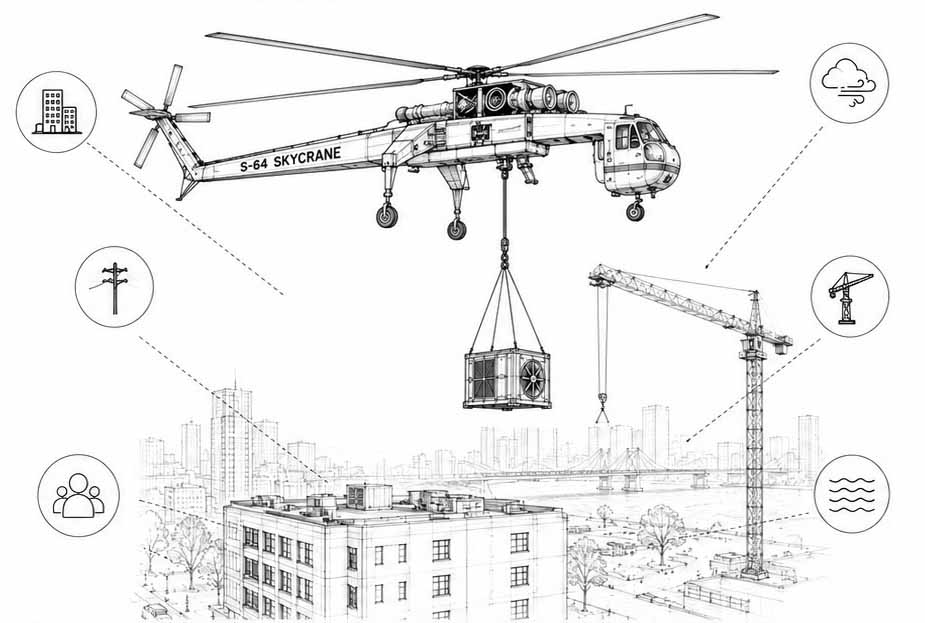
The weight of your unit tells you what class of equipment you need. The site tells you what you can actually do there, and the two questions are completely separate. A 2,000 lb rooftop unit is a simple lift in an empty field and a regulatory project on top of an occupied hospital. Same weight, two different jobs.
This is also where the most stubborn myth on the page lives: that helicopters are a last resort, the thing you call only when a crane physically can't reach. The truth runs the other way. The harder, denser, and more regulated the environment, the more often the helicopter is the better answer, and not just out on a mountainside. Sometimes in the middle of a city, over a working hospital, the aircraft is the right call. The industry's reflex to assume "crane unless impossible" gets the answer backwards more often than it admits.
Ground Hazards: What the Site Can't Bear
A crane doesn't just sit on a site, it presses into it. Machine, counterweights, and load all funnel down through a few outrigger pads, and that concentrated force has to land on something that can take it.
Often it can't. Cranes routinely chew up landscaping, hardscape, and finished grounds simply by setting up. Worse, the spot that looks ideal is frequently a structure that won't bear the weight, commonly an underground parking garage, which is exactly where you'd want to stage in a dense site and exactly where you can't, because the slab was never engineered to carry a loaded crane.
A helicopter sidesteps the question entirely; it never puts that load on the ground in the first place. That's not a "crane can't, so helicopter must" situation. It's one of several places where the helicopter is quietly the cleaner option even when a crane is technically possible.
Remote Locations
Everyone already knows remote sites are hard for ground cranes, so we won't belabor it. The part most people don't price correctly is where the cost actually goes.
It isn't the crane. It's the road. Getting a crane to a remote cell tower, a facility up a mountain, or a site at the end of an inadequate access route often means building or widening a road to carry it, and that can run well into the tens of thousands of dollars, sometimes far more, depending entirely on length and conditions. Is there even space for the road, or does brush have to be cleared? Does the ground need leveling? Does an existing route need widening for the loads to pass? The lift is almost the easy part; the civil work to reach the lift is the line item nobody saw coming.
A helicopter flies over all of it. But, and this matters, that's not the reason to call one. Remote access is just the most obvious case for the aircraft, not the most important one. The helicopter's real advantages show up just as much in a parking lot as on a ridgeline. Don't let "remote" become the headline; it's the easy example, not the thesis.
Traffic, Closures & the Non-Participating Public
This is the part of the job that happens on the ground, around the lift, and it's most of the planning nobody sees.
The FAA's term for everyone not involved in the operation is the non-participating public, and the entire game is keeping them out of harm's way. The standard is a roughly 150-foot radius around a helicopter carrying a load: every road, walking path, and access point inside that circle has to be controlled. The FAA isn't prescriptive about how, because it depends on the scenario, so the plan is built case by case out of the same toolkit:
- Barriers and tape to seal off the perimeter and walking paths.
- Cones and interior controls for crane work, so no one walks beneath the path the load travels, including temporary closures inside a building along the transfer route.
- People, crew, security, and often hired local police, physically holding the line, because a barrier no one is watching is a suggestion.
- Notification of police and fire, a required part of filing the congested-area plan (CAP) in the first place.
Helicopters make this harder in one specific way: they draw a crowd. People stop, stare, and walk toward the aircraft to get a better look, exactly the wrong instinct, which makes active crowd control non-negotiable, not a formality.
On roads, the lift dictates the closure. A rolling roadblock can hold highway traffic back during the actual lifts and release it between them; on surface streets, one or more lanes may be closed outright with physical barriers, which carries its own permitting. The closure footprint, and how long it lasts, is its own planning problem layered on top of the lift itself.
Tricky Locations
Different environments fail in different ways. A few that come up constantly:
Near airports. Ground cranes are largely out; they can't reposition fast enough when air traffic control needs the airspace cleared. A crane that can't move on command doesn't belong under a flight path.
Warehouses, actually less tricky than they look. With either asset, the work is choosing staging areas and lift paths that minimize disruption. The real variable is what else is happening at the site. If the warehouse is under construction, every other trade on site has to stand down for safety during the lifts, and the cost of that pause scales with the size and value of the project. If the building is already operating, its hours and purpose are everything: a 24/7 shipping or manufacturing facility loses an enormous amount for every hour it's shut down, which puts a premium on the speed of the lift, and that speed is where the helicopter pulls away.
High-rises. Height does something sneaky: it artificially inflates the reach a crane needs, often past the point where any mobile crane works at all and into tower crane territory. Tower cranes typically rent by the month, take days to erect and dismantle, and close streets for the duration. Small and midsize cranes are simply off the table. To a helicopter, the height barely registers. Helicopters aren't always the only option on a high-rise, but they're the better option far more often than the industry assumes.
Hospitals, the hardest of all, and worth its own case below. The governing constraint is the rule that you close one floor more than a dropped unit could penetrate, for the full duration of the lift set, which on a working hospital means relocating patients and limiting the building's ability to care for people, even if only for a fraction of the time a crane would take. (The one point in the crane's favor: it generally wouldn't shut down a parking garage, though, as you'll see, it might have to stand on one that can't hold it.)
Case Study: Georgetown University Hospital Lift, Washington, D.C.
This one breaks every assumption about when you reach for a helicopter, which is exactly why it's here.
A national rigging and heavy-hauling company, a firm that owns and operates its own cranes, called Fair Lifts. They'd been handed the project and couldn't see a way through it. The crane plan meant setting a large crane on a hospital parking garage that might not support the machine and its counterweights in the first place. A crane company, looking at a crane job, concluded the crane was the problem.
The answer was a Sikorsky S-64E, lifting a generator (the heaviest piece, approximately 17,900 lb) and a custom lift assembly, with the remaining pieces lighter. A dense urban hospital, the opposite of a remote, crane-impossible site, and the helicopter was both the safer and, in all likelihood, the lower-cost option.
What it took to get there is the real story. This single lift required, among other things:
- The operator's FAA certificate on file.
- A Letter of Authorization (LOA) from the FAA.
- A waiver of authorization from the FAA.
- Operating in Class B airspace over the nation's capital.
- A hazardous-materials permit from the DOT, required even though nothing being lifted was actually hazardous.
- TSA approval.
- An armed officer posted with explicit authority to kill the pilot if the aircraft deviated from the plan (for example, toward the White House).
- Evacuation and formal notice for the top two floors of two separate Georgetown buildings.
- A secured perimeter around the lift site.
- And the kicker: documented proof that a helicopter was the only viable option.
Sit with that last one. To be allowed to do the obviously right thing, Fair Lifts had to formally prove a negative about the crane. That requirement is the entire bias of this industry captured in a single line of paperwork: the helicopter treated as guilty until proven necessary. The job got done, the hospital kept running, and it still likely came in under the crane alternative. The only thing the helicopter couldn't overcome easily was the assumption that it shouldn't be there.
The site picks the asset as much as the weight does, and the reflex to default to a crane until a crane is impossible quietly costs contractors money, time, and sometimes the only safe path to getting the job done at all. Ground bearing, closure footprints, the non-participating public, airspace, operating hours, the cost of a road you didn't know you'd have to build, none of it is on the quote, and all of it decides the job. That's the planning. That's what we do before anyone says yes.
Tell us about the site, not just the unit. Address, surroundings, operating hours, what's overhead and underfoot, and we'll tell you what's actually possible there, and what it really costs.
Safety, Regulations & Rigging
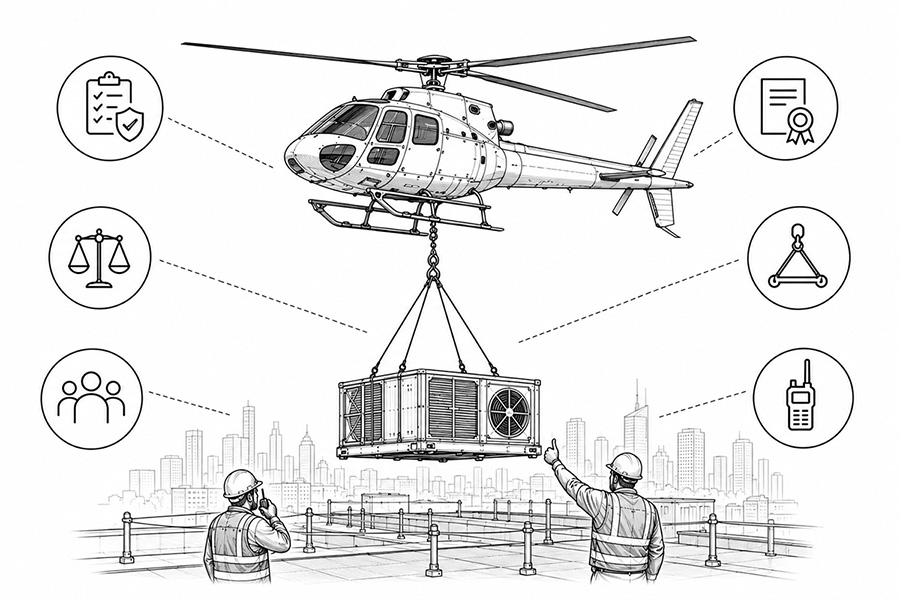
There's a whole half of every lift the customer never sees. It happens before the aircraft starts and after the crane is gone, in the certificates, the plans filed with the FAA, the rigging, the weather calls, and the contingencies that exist precisely so they never have to be used. It's the least glamorous part of the job and where everything quietly goes right or wrong. Get it wrong and you don't get a revision; you get a shutdown, a fine, or a denied operation.
It's also where the conventional wisdom is most often flat wrong. Contractors repeat "rules" about lifting that aren't rules at all, then plan around them and pay for them. So this section does two things: it shows the real weight of compliance (the strongest argument that nobody should carry it part-time), and it corrects a few myths that cost real money. Consider it a tour of what's involved, enough to see the depth of it, not a manual you could run yourself.
The Rulebook: FAA Part 133
Helicopter external-load work in the U.S. runs under FAA Part 133 (Rotorcraft External-Load Operations). The key thing most people miss: it's not enough to have a helicopter and a good pilot. The operator has to hold a Rotorcraft External-Load Operator Certificate, issued for specific aircraft and specific types of load, renewed every two years, and flown according to an approved flight manual for each rotorcraft-and-load combination. A pilot's license doesn't authorize this work; the certificate does.
The FAA also sorts every external load into a class, and the class drives the rules:
- Class A, the load is fixed to the aircraft and can't be jettisoned (think supplies in a bolted-on cargo rack).
- Class B, the load hangs free below the aircraft and can be released in an emergency. The FAA's own textbook example is setting an air-conditioning unit on a rooftop. This is the class nearly all HVAC, curb, and tower work falls under.
- Class C, jettisonable, but stays in contact with the ground or water during the operation (dragging and certain long-line work).
- Class D, the specialized category that covers carrying people on the outside of the aircraft.
That Class B "can be released in an emergency" detail isn't trivia; it's the built-in safety backstop the whole operation is designed around, and it comes back in the weather and contingency planning below.
Three "Rules" Most Contractors Get Wrong
Here's where knowing the actual regulations, versus the folklore, saves you money and bad plans.
Myth 1: "The clearance radius is 150 feet." The radius itself is mandatory, and the area inside it has to be cleared of the non-participating public, with the top two floors of buildings and the roads inside it shut down. What's not fixed is the number. The required radius is calculated for each setup: take the greater of the aircraft's overall length (rotor included) or the length of the line plus the load, and apply a 1.5× factor. On a typical job the line and load hanging below the helicopter are far taller than the aircraft is long, so the line drives the radius. The standard long line is 100 feet, and 100 feet times that 1.5 factor is exactly where the familiar 150-foot radius comes from. It's an output of the rig, not folklore: change the line and the required radius changes with it. And because the line governs the circle, the line length you choose is also a lever on how much has to be shut down.
Myth 2: "You need a twin-engine helicopter to lift." For ordinary cargo, Class A, B, and C, which is virtually all construction lifting, that's simply false. Single-engine aircraft do this work legally and routinely every day. The only time Part 133 mandates a twin is when you're carrying people externally (Class D), which requires a transport-category twin that can hover on one engine. Everywhere else, a twin-engine requirement is a contract or insurance specification, not an FAA one. That matters to your wallet: if a contract specs a twin, it narrows the eligible fleet and raises the price, and knowing whether that spec is a genuine requirement or an inherited assumption can save you a lot.
Myth 3: "The long line has to be a specific length." No FAA rule sets long-line length. The 100-foot line is most common, but lines run anywhere from about 50 to 200 feet, chosen for the job: downwash, obstacle and terrain clearance, the pilot's sightline, the clearance radius it creates on the ground (Myth 1), and sometimes a contract spec. On one Las Vegas job we ran a 200-foot line specifically to keep the rotor wash from breaking windows on a tall hotel.
The thread through all three: contractors quote these as fixed rules and plan, and overspend, accordingly. Knowing what's actually required, what's merely contractual, and what's a choice you can use to your advantage is exactly the expertise a lift facilitator brings, and exactly what a busy contractor can't be expected to track.
Congested-Area Plan vs. Flight Plan
These two get conflated constantly, and they're entirely different instruments.
A flight plan is about the aircraft's trip, its route and altitude through the airspace. A VFR flight plan is essentially a search-and-rescue safety net; an IFR one is for flying in instrument conditions.
A congested-area plan (CAP) is the approval to work over a populated job site. By regulation it's leaner than the internet suggests: a plan coordinated with and approved by the FAA's local Flight Standards office; an agreement with local authorities to keep unauthorized people out of the area; coordination with air traffic control where needed; a chart of the flight routes and altitudes; and routing that always allows a jettisonable load to be dropped and the aircraft landed without endangering anyone below. The longer published checklists, police and fire notifications, obstruction charts, designated jettison zones, are FAA best-practice guidance layered on that legal core. Worth knowing: "congested area" itself isn't defined with exact parameters in the regulations; it's judged case by case, and a city's business districts are generally treated as congested by default. A single CAP can cover a job that runs many flights over several days. (The Georgetown hospital lift was a CAP, and then a great deal more.)
Rigging
The fundamentals are the same whether the lift is by crane or helicopter: properly rated shackles, slings and straps, and spreader bars, each inspected, matched to the load and the lift points, with the rigging's own weight counted against the total being lifted. Good rigging is good rigging.
What's different on a helicopter is the hardware at the top and two hazards a crane never has:
- A belly cargo hook with both an electrical and a mechanical emergency release, function-tested before each day's flying, so the load can always be released.
- A swivel on every load, an industry rule reinforced by FAA safety guidance, because a freely suspended load that starts spinning can destabilize the aircraft. The swivel lets it turn without winding up the line.
- Static electricity: a suspended load builds a charge in flight that has to be dissipated to ground before any crew member touches it.
- Tag lines kept short enough that they can never reach the rotor.
And then there's tempo, the part that decides whether a helicopter job is efficient. The aircraft bills by the hour and mobilizes at that same rate, so every second it hovers waiting to be hooked is money burning in the air. The answer is pre-rigging: every load slung, staged, and ordered on the ground before the aircraft arrives, so it sets one piece, pivots, and immediately picks the next without pausing. That's the mechanic behind Towson's 19.5 picks per hour.
Long Lines: Length Is a Planning Lever
Length is a lever, not just a spec. A longer line drops the load farther below the rotor's downwash (easing the effective-weight problem that downwash creates), clears obstacles and terrain, and improves the pilot's view of the load, at the cost of more pendulum motion to control.
The less obvious trade-off is where this gets useful. Because the line drives the mandatory clearance radius, a longer line means a bigger circle to clear: more public to hold back, more building floors closed, more road shut down. Our standard 100-foot line produces the standard 150-foot radius. When closures are the binding constraint, a road that can't be shut for long or a neighboring building you'd rather not evacuate, we can deliberately run a shorter line, say 50 feet, to shrink the radius to roughly 75 feet and limit those closures. You give up some downwash margin and some clearance to buy it, but that tactic has saved jobs that would otherwise have stalled on a closure no one could permit.
Weather & Risk
Weather is a planning input, not a day-of surprise, and it ties into everything else here. Temperature and elevation set the day's lifting capacity through density altitude. Wind limits depend on the load, the line, and the aircraft. The work is normally flown VFR.
Some conditions are simply hard stops: lightning and icing end the conversation. The line between "marginal but flyable" and "no-go" is real. The Towson job was flown VFR in rain, which can be acceptable, but the deciding factor was that lightning was absent. Rain you can sometimes work; lightning you never do. Reading that line correctly, in advance, is part of the plan, and it's one more reason the early-morning window matters, when the air is cooler, denser, and often calmer.
The contingencies are engineered in before the day, never improvised on it: load jettison into a pre-identified clear zone (the Class B backstop), routing that always allows a safe emergency landing, defined abort procedures, weather holds, conservative weight margins for gusts, and standby aircraft where the schedule is time-critical. And the pilot always has the final say on safety once on site.
Reliability
Reliability comes from depth. Because we work across the whole market rather than a single owned fleet, a weathered-out date, a grounded aircraft, or an operator conflict doesn't sink the job; there are alternatives to reach for. A single-asset supplier can't make that promise: if their one applicable machine is down, so is your project.
And the honest failure-mode contrast is the heart of it: asked to do something unsafe, a helicopter simply won't lift, the limit is built to fail safe. A crane pushed past its limit fails dangerously. Either way, safety isn't summoned in the moment; it's designed into the plan long before anyone leaves the ground.
Beyond U.S. Borders
The rules don't travel with you. We work in Canada, on the island of Dominica, and in other international locations, and each crosses into a different regulatory environment.
Canada runs a different structure: external-load authority lives inside the operator's air operator certificate plus aerial-work standards rather than a standalone external-load certificate, and working over a built-up area means filing an "aerial work zone plan" with Transport Canada, generally about five working days ahead, with the local municipality notified. Same spirit as the U.S. (protect people, plan the emergency), different paperwork and lead time.
International projects have no universal permit. Each country's civil aviation authority has its own approvals, its own lead times, its own rules for bringing an aircraft across the border (customs and temporary import), local insurance, and noise and site rules, and very often the practical need to partner with a locally certified operator. The one constant is that someone has to navigate a fresh rulebook from scratch every time.
State Crane Rules Change: Florida as the Example
Ground cranes are mostly governed federally, by OSHA's cranes-and-derricks standard (certified operators, qualified riggers and signal persons, ground-bearing and power-line rules). But states add their own layers, and those layers move.
Florida is the live example. After two high-profile crane failures, a tower crane that shed a section into an office building during Hurricane Milton and a fatal crawler-crane collapse at a hospital construction site, Florida enacted a statewide law requiring crews to keep a hurricane-preparedness plan on site and to secure all hoisting equipment, per manufacturer specs, no later than 24 hours before a hurricane is expected to hit. The state is due to publish more detailed best practices, so the rule will keep evolving.
The point isn't Florida specifically. It's that the plan that was fully compliant last season may not be this one, by state, by city, by airspace, by aircraft configuration. "The asset and the plan we used last time" is not a plan. Tracking that moving target, so your job doesn't get shut down on a technicality, is part of the service. (Regulatory details current as of 2026; this area changes often.)
None of this is the part you were quoted on, and all of it is the part that keeps the job legal, safe, and finished. Certificates and congested-area plans, the real rules versus the folklore, rigging fast enough to keep an aircraft fed, the weather call, the backup that means a bad forecast doesn't sink your schedule, the cross-border rulebook nobody warned you about: this is the invisible majority of expert lift planning. You shouldn't have to hold a Part 133 rulebook and a shifting state crane code in your head to replace a rooftop unit. That's what we're for.
Send us the job and the site, and we'll handle the compliance, the rigging plan, and the contingencies, and tell you up front what the regulations actually require for your lift and what's just folklore.
The Hybrid Approach: Using Both
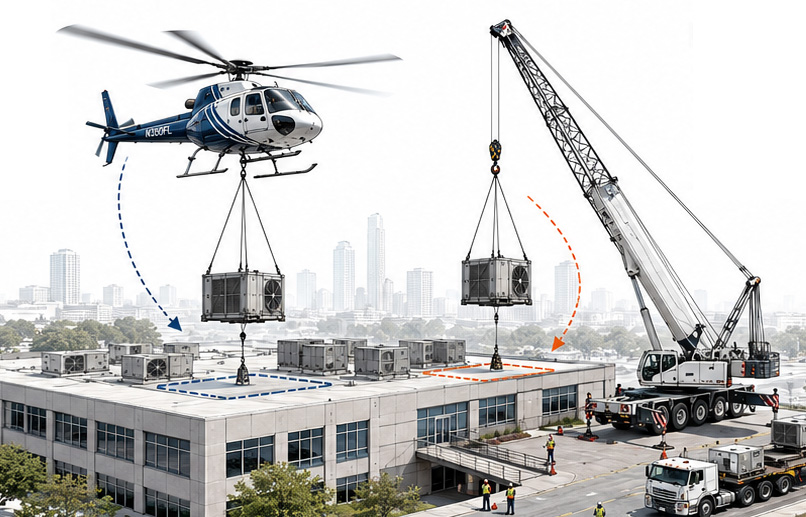
Most of the time, running a crane and a helicopter on the same job isn't a decision anyone made on purpose. It's a patch. A contractor already has a crane lined up, finds out partway through planning that it can't reach a handful of units, and bolts on a helicopter to cover the gap. That's a band-aid on a crane-first plan, not a plan for the whole job, and it's how most hybrid lifts go wrong.
A real hybrid is decided the other way around. You look at the entire job objectively, price out every sensible option, and land on two assets only when splitting genuinely beats either one alone. The gap between the patch and the plan is the whole point of this section.
Two assets mean two mobilizations. For both to make sense, the combined cost of both mobilizations plus both assets' time on site has to come in under what a single, more capable asset would cost to do the entire job alone. The test reduces to one comparison:
Mobilization A + Mobilization B + on-site cost of A + on-site cost of B < cost of one capable asset doing the whole job
If the two-asset total lands under the one-asset total, a split is worth examining. If it doesn't, it isn't. Often it doesn't, and in fact, once a helicopter is already on site, the smarter move is frequently to let it absorb the crane's work entirely rather than keep a crane around for part of it (more on that below). A true hybrid isn't a hedge. It's a deliberate split that pays only in specific situations: when each asset is doing exactly what the other does badly, and you've stripped the expensive extreme off both. Get it right and you buy full capability at a fraction of the cost. Get it wrong and you've paid to mobilize a crane you never needed.
This is the section where the specialty shows most plainly, because you're not choosing between two assets. You're choosing the best combination from a spectrum of assets on each side, and there are hundreds of those combinations before you even factor in where every asset is and where it's headed.
The Textbook Case: Towers
Tower work, construction and deconstruction of cell towers, transmission and lattice towers, and the like, is the cleanest example, and a common one.
It works because the two assets have opposite strengths, and a tower exploits both. A crane lifts the most when it isn't fighting reach, and a tower is tall but narrow, so the heaviest pieces, the base sections, sit at almost no horizontal reach. That means a relatively modest-tonnage crane can hoist the immense weight of the bottom section, because it's lifting straight up its own mast, not out at radius. But ask that same crane to place the top of the tower and you'd need a massive, expensive machine just to buy the reach.
The helicopter is the polar opposite. Height barely matters to it; weight matters enormously. Flying every section, including the heavy base, would force you into an exponentially larger and more expensive aircraft. As with any rule there are exceptions, like an extremely tall tower with consistent section weights throughout, where flying the whole thing can pencil out.
So you combine, and you cut the costly extreme off each one: a small-to-midsize crane takes the heavy base sections at short reach, and a mid-size helicopter flies the lighter upper sections to any height. Together they deliver the full capability of a giant crane or a heavy-lift helicopter at a fraction of either's cost. This is exactly why you evaluate a spectrum of combinations, not single assets: a single-asset owner, looking only at their own equipment, literally cannot see this answer, and the bias against it shows even when it's obviously the efficient call.
Wide Roofs and Warehouses
The same per-unit logic works horizontally instead of vertically. On a large warehouse or an unusually wide building, a smaller crane can handle the units near the edge, or the ones that can be set on the edge and walked across the roof by gantry. The helicopter takes the units the gantry can't move, because the roof or the gantry can't bear their weight, plus the units set so deep into the roof that reaching them would force you into an oversized, expensive crane just for those few. Two right-sized assets beat one over-spec'd one, applied unit by unit across the footprint.
The Access Case: Crane, Then Truck, Then Helicopter
Sometimes the hybrid is a relay. A ground crane loads a piece onto a truck, the truck hauls it most of the way, and a helicopter flies only the final leg into a destination no road or access route could deliver a crane to. Flying the load the entire distance would be wildly expensive and would demand closures all along the flight path. Handing off, crane to truck to helicopter, keeps each asset on the stretch it runs most efficiently.
The Trap the Formula Misses: Minimums
Even when the split math pencils out, splitting can still be the wrong call, because of the helicopter's minimum.
Helicopters carry a minimum charge. Say a job has a three-hour minimum and about an hour goes to mobilizing and demobilizing; that leaves roughly two hours on site already paid for, and at an average of 15 picks per hour, that's about 30 units you can lift without adding a dollar. Now suppose the whole job is 15 units, and the model says splitting them 10 to the crane and 5 to the helicopter beats using one big crane. It might pass the formula and still be wrong, because the helicopter can do all 15 inside its minimum. So you drop the crane entirely and save its whole cost. The minimum quietly erased the case for splitting.
The same thinking runs the other way and can justify multiple helicopters. Picture 150 units where only 5 require a more capable, more expensive aircraft. Doubling up on mobilization, a smaller helicopter for the 145 and a heavy one for the 5, barely matters, because running that expensive aircraft for all 150 units at its high hourly rate would cost more. But shrink that to 6 units, 1 light and 5 heavy, and you wouldn't split at all: you'd fold the single light unit into the heavy aircraft's minimum (or hand it to the larger crane) and be done.
And weight bends the math further, because it changes the rate. Past roughly 10,000 pounds, picks per hour start to fall, a Sikorsky S-64 might manage 8 to 10 an hour where an AStar could potentially clear 25-plus, which feeds straight back into every comparison above. None of these levers move independently. That's the point.
How the Split Actually Gets Decided
Here's the part that doesn't fit on a quote: the formula points you in the right direction, but it never makes the decision for you.
You model it. You compare the crane size, cost, completion time, and safety of doing the whole job with one capable crane against the same factors when a smaller crane handles most of it and a helicopter takes the outliers, the picks that are heavier, farther out, or harder to access. If it's just one or two outliers, the decision is simply Crane 1 versus Crane 2. But the moment the units fall into more natural groupings, it becomes Crane 1 versus 2 versus 3 versus 4, and then you layer in the many helicopter options that would let you drop to the smaller crane.
The same comparison, put another way: splitting starts to pay when the money saved by dropping to the smaller crane is greater than the cost of adding the helicopter. That's directionally true and a dangerous oversimplification at the same time, because every other option and factor has to be reviewed first. The false simplicity of a one-line formula is precisely what gives a contractor the unearned confidence that they're consistently picking the right option. Outliers in weight, reach, or access are the flags a specialist watches for, and spotting them is where the planning intensifies, not where it ends.
Is the answer a 100-ton crane and a K-MAX? A 200-ton crane and a Bell 205? It depends on the units, the site, the locations of the assets, and a dozen other things, and that "it depends" is not a dodge. It's the job.
Who Decides
The contractor, the end client, the pilot or crane operator, and the lift specialist can all offer input on how to split a job. But only an unbiased specialist, after actually reviewing every option, arrives at the best one, because everyone else is reasoning from a partial view or a vested interest. If a client wants the work done a way that doesn't prioritize efficiency, they may have other reasons, and we'll execute it their way, provided it's safe. Whether the two assets work the site sequentially (most common) or simultaneously comes down to the size and demands of the location.
This is the clearest proof on the entire page that lifting is a specialty, not a part-time effort. A quote shows you a number. It doesn't show the hundreds of asset combinations tested to land on it, the outlier picks that flagged a possible split, or the helicopter minimum that quietly made splitting pointless. The contractor who runs lifts a few times a year sees one or two of those moves; the specialist sees all of them, every time, without a thumb on the scale for any one asset. That difference can seem invisible on the invoice, and it's most of the value.
Tell us the whole job, every unit, every weight, every awkward one, and we'll model the combinations you'd never have time to: one asset, two, or more, and which one actually wins.
Types of Lifts & Case Studies
Most contractors can't even count their own job correctly, and that's not an insult, it's the first sign of how much hides beneath a "simple" lift. Tell us you have eight units and that could be 8 picks, or 16, or 24, or 32, depending on whether those units are new installs or replacements, and whether the curbs underneath them are being lifted too. Before anyone talks about aircraft, we're already asking the questions that change the number.
That's the theme of this section. The range of what gets lifted on a line is enormous, and each kind behaves by its own rules. Here's the work, and what actually makes each piece of it hard.
HVAC & Infrastructure
Rooftop units and curbs are the bread and butter, and the most misunderstood. Beyond the picks-vs-units confusion above, HVAC is the textbook bundling opportunity: a contractor almost never has exactly enough units to fill an aircraft's minimum efficiently. Think hot dogs and hot dog buns, the pack sizes don't match. A crane often carries an eight-hour on-site minimum; a helicopter may run a three-hour job minimum that includes mobilization. If your units only fill half the time you're already paying for, you can add units at no added cost, and since every other aging unit on that roof will need replacing eventually, doing them now saves the client money and lets the contractor sell more units in one trip.
It's also the clearest case for getting a lift specialist involved before the units are chosen, not after. Most contractors design the HVAC solution, buy the units, and only then think about getting them up there. Flip the order and the options multiply, because we can ask the manufacturer questions the contractor never thinks to: can this 12,000-pound unit ship in sections, with no single piece over 2,500 pounds? That one question can collapse the entire lift plan into a lower-cost class of aircraft. Custom-fabricated units open the same door, if we're early enough.
Priorities for assessment: spec sheets, dimensions, and exact roof placement. Not every contractor has them, and a specialist can start to walk them through the project regardless, but without weights and a labeled plan of where each unit lands, you can't plan, and worse, the pilot burns expensive flight time hovering while someone figures out where a unit goes. A clear labeling system is what lets us pre-rig four to five units at a time (which takes extra sets of rigging) so the ground crew can keep pace with the aircraft. Depending on a unit's dimensions, that rigging might mean a specific spreader bar plus matched shackles and straps. And every unit, old or new, comes off drained of liquids and refrigerant before it flies; older units, having sat for years, weigh more than their spec sheet ever said.
Chillers and cooling towers flip the logic. They come in small numbers, one to three lifts often, so it's harder to spread an aircraft's hourly efficiency across a minimum, which makes a ground crane the better tool more often. They're heavier than RTUs, and their dimensions can force a different rigging setup. That said, helicopters routinely do this work too.
Smokestacks are sometimes demolition, and sometimes the opposite, flying steel or antennas up onto them.
This breadth is exactly why a lift specialist's experience differs from a pilot's. A great pilot specializes in flying; we specialize in having seen all of it, a different kind of expertise, for good reason.
Case study: Generator removal, Adirondacks, NY (ProComm Systems). We pulled a generator off a decommissioned wind turbine on a mountaintop, blades already removed, and set it in a field roughly five miles away, on a route that required a road closure along the way. We flew it with an AStar brought in from out of state, and aligned the job with a nearby tower lift so the client split the mobilization rather than paying it twice.
Case study: Oil-pipeline corridor (multiple projects). Along a pipeline running toward the Canadian border, across land with strict use restrictions and demanding permitting, we ran weeks of work. One project was continuous rip rap placement with a UH-60, every load deliberately bundled to stay at or under 6,800 pounds so that the rock, the bucket, and the rigging together never exceeded the helicopter's 8,000-pound capacity, the capacity math applied load after load. On other pipeline work, landing simply wasn't an option, so we used human external cargo to sling pipeline technicians out to a bridge each morning and retrieve them each evening, so they could reach the stretch of line they needed.
Towers & Antennas
Contractors routinely underestimate how much each tower section weighs, so a real part of the job, especially in deconstruction, is sitting down with them to calculate section weights from the materials and specs and decide where to break the tower into liftable pieces. The crane-and-helicopter combination lives here, and for antenna and equipment swaps, the helicopter is usually the answer outright. It all depends on whether it's a monopole, a guyed tower, or something else. (An antenna, after all, is just a piece of equipment bolted to a tower.)
Deconstruction is the easier direction; there's more freedom, because no one needs the structure to stay sound for the long term, so we pick exactly where to cut, breaking through whichever beams create the cleanest liftable sections. Construction is constrained by whatever sections the tower manufacturer can or will design.
Antenna work demands a specific kind of pilot. When crew members are climbing the tower to bolt on or detach equipment, the pilot has to hold a hover in exactly one spot, precisely, for as long as the crew needs to work safely. That's a different skill than setting an RTU, which the roof crew can simply guide into place, or even a precision set like an elevator, which doesn't require holding position that long. Wind is a bigger factor on towers too; taller and more remote means more exposure.
Case study: Tubac, AZ (100-foot tower decommission). A three-legged, 100-foot tower in four sections. Here we used a 120-ton crane with a luffing jib, no helicopter. A big parking lot, easy access, and a tower that wasn't especially tall made the ground crane the right, lower-cost call. (We recommend the asset that wins, and sometimes that's a crane.)
Construction Materials
Speed here is all about pick-to-drop distance; some runs are a half-mile or more, some are as short as the parking-lot-to-roof hop of an RTU job. As with RTUs, multiple sets of rigging and pre-staged bundles get the cycle down to minutes between picks. The upside is that material often doesn't need pinpoint placement (with exceptions). Concrete pouring is done with a bucket the aircraft pours from, vastly more efficient than a crane, though the bucket itself is heavy enough that this is midsize-and-up helicopter work. Construction material projects range from roofing materials (we helped lift them for NRG Stadium in Houston) to the full range of materials and equipment we lift out to islands with no other way in.
Specialty Lifts
Pools, jacuzzis, and saunas. Pools usually arrive in one piece, which makes weight the whole game, and they're generally better suited to a crane, since the reach isn't far. But some go where no crane can get behind the house, and then it's a helicopter, provided the pool is light enough, because with a single lift there's no hourly efficiency to spread across a minimum. Access and weight are everything for pools. Jacuzzis and saunas, by contrast, can go onto the top floor of a high-rise, where a helicopter doesn't care about the building's height (nobody is renting a tower crane to install a jacuzzi in a penthouse) and where HOA and noise concerns barely register.
Signage comes either all at once or in pieces, letter by letter. Art and statues aren't hard to handle carefully; with fewer picks we simply slow down, taking an extra minute over the four-minute-average turns we run on RTUs to place them right. The rigging matters more here, even if the lift isn't harder. A statue or sign going to the top of a building runs into the same crane-reach wall that favors a helicopter; a piece set at ground level is more about access and not tearing up the landscaping.
Shipping containers are bulky, big surface area for the rotor to fight, and surprisingly heavy even empty, which usually means loading by crane onto a flatbed truck instead. Disassembling and rebuilding them on site can make a helicopter viable, but that rather defeats the purpose of a container, so a lighter container type is often the better helicopter load. (It's the same reason helicopters lean on straps, shackles, and netting: every pound of rigging is a pound of capacity spent on something other than the load.)
Prefab homes come down to which sections can move; more often they're built too heavy to fly cost-effectively, leaving flatbed and crane the answer, unless the volume of homes justifies the largest aircraft in the country. Mining frequently means moving personnel and equipment into genuinely remote sites, which is exactly where a helicopter earns its keep.
Unique & Extreme Recoveries
Case study: Submerged-vessel fuel retrieval (Global Diving). We've done this with them repeatedly: lifting totes of fuel off recently downed boats before that fuel becomes an ecological disaster. Divers, from the U.S. Coast Guard or from our client, fill each tote underwater, then inflate a lift device to float it to the surface, where they hook it to the helicopter's line and we fly it to a landing zone onshore. One such job was near Hacken Island, NC. The Coast Guard is involved because of the emergency nature and location of the work.
Case study: Recovery of a downed K-MAX helicopter. A genuinely hard one. A K-MAX lay on its side at 9,000 feet of elevation, submerged in five to six feet of water with only part of the tail and rear gear above the surface, mostly intact, blades off. Empty it ran around 5,100 pounds, closer to 5,500 with fuel, and then there was trapped water no one could measure. So step one was simply finding out what it weighed: a small crane on site let us weigh the aircraft so we weren't guessing. We weighed two options, a Bell 214B at 6,000 pounds capacity and a UH-60 at 8,000. The 214 would have needed a fuel truck on site to run on light fuel and gain capacity, but that required road access the site didn't have (they'd already tried a forklift that couldn't reach it). With the weight uncertain and no way to lighten the 214, we couldn't get comfortable with the margins, so we flew it out with the Black Hawk. Note how many threads converged: the altitude robbing capacity, an unknown weight, and access dictating the asset.
Drop Testing
Drop testing inverts everything else on this page. Altitude doesn't just affect the aircraft, it's the point, because the test is about dropping from height, so density altitude bears on capability far more than in a normal lift. And we're not placing anything precisely; we're simply releasing. The test articles are often oddly shaped and won't even stand on their own, so a telehandler stands the load upright, the helicopter attaches and lifts slightly while the telehandler backs clear, and then the aircraft carries it to altitude on a long line. There the pilot waits for the load to settle, watching for the visual cues and the stability lights that tell him it's balanced, and only then releases it. After the drop, the test team watches how the parachute deploys and flies. Each drop test studies what happens to some object, system, or sensor after release. It's all flown in protected airspace, with a NOTAM filed to keep other traffic out, and a program usually means multiple drops, with more to follow depending on the results.
Here's the tell that runs through all of it: contractors reach for a crane whenever there's physical access to the site, and reach for a helicopter only when there isn't. Access is their entire barometer. And while that's not wrong, no access does mean a helicopter, it misses how often a helicopter is the better, more cost-effective, safer answer on sites a crane could reach perfectly well. A rooftop swap, a penthouse jacuzzi, a tower antenna, a fuel tote off a sunken hull, a spacecraft on a drop test: knowing how each one flies, and which asset truly wins, is the difference between a specialty and a side project.
Whatever needs to move, however ordinary or strange, tell us what it is and where it's going. We've likely planned something like it, and we'll tell you the asset that actually wins.
The Steps of Planning a Lift
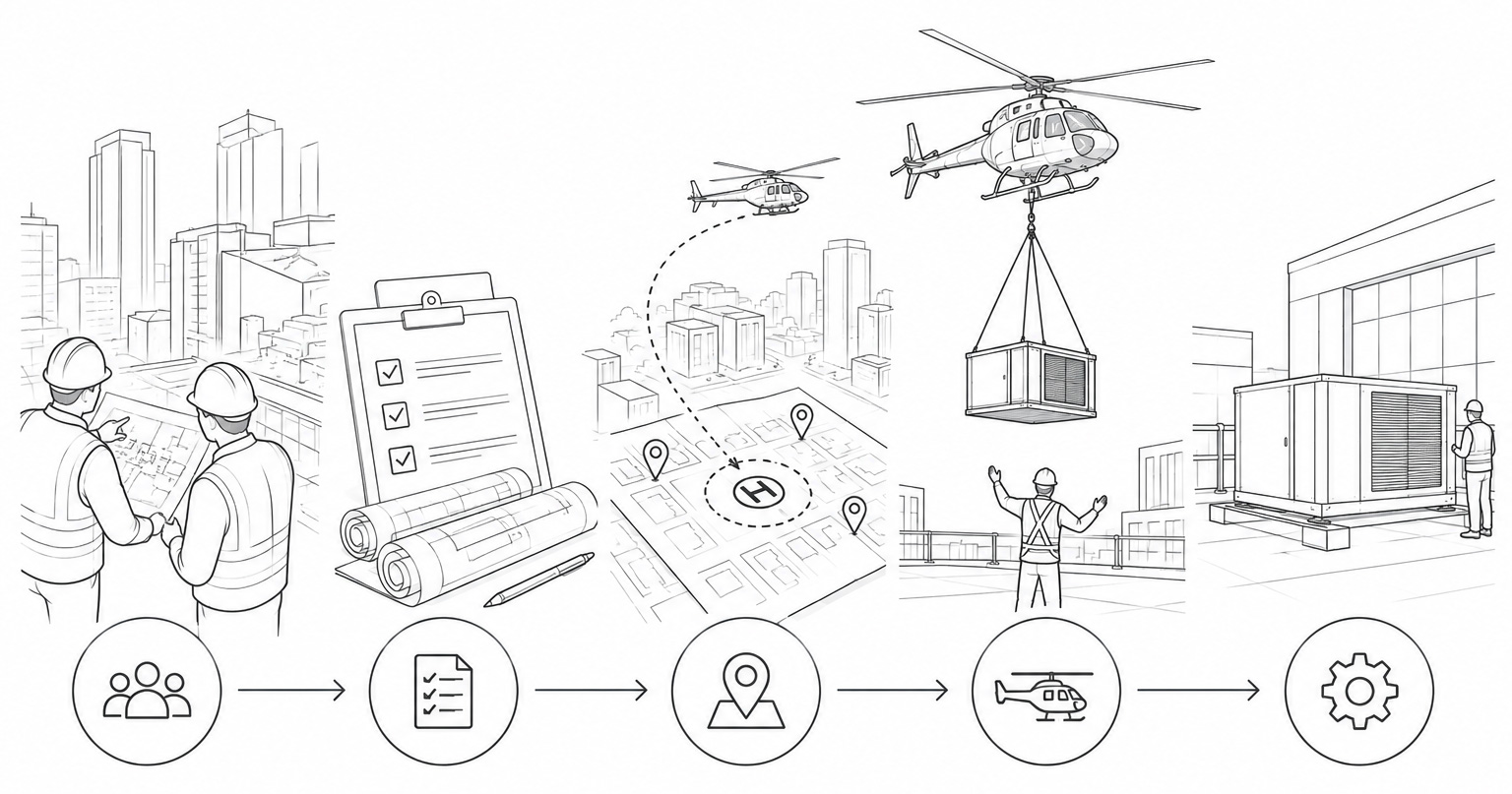
You do not need to have any of this worked out before you call. The earlier you reach out, the more we can do for you, and the more of this we carry on your behalf. What follows is the planning that happens between your first call and a unit setting cleanly onto a roof. Almost none of it shows up on the quote, and none of it is work you have to do alone.
- Define the real scope. It starts with the questions that change the number. How many picks, not units, since a swap doubles the count and curbs add to it. What each piece weighs, its dimensions, and exactly where on the roof it lands. We help you gather the spec sheets, weights, and placement, so a thin or uncertain scope does not quietly steer you toward the wrong asset.
- Treat the units themselves as a variable. If you have not bought the equipment yet, the lift can shape what you buy. A unit that ships in sections, or a lighter configuration, can move the whole job into a more cost-effective class of aircraft. We will bounce options off you, and off the manufacturer where it helps. This is exactly why the most valuable call comes before the units are spec'd.
- Map the whole field of options. This is the part no single operator can do, and it is worth being blunt about why. A limited-asset vendor can only sell you what sits in their yard, so the truly helpful ones reach out to other operators when they do not have the right tool for your job. Some do that. Some quietly sell you what they happen to own. Getting the right solution takes a planner with no stake in any one machine, and we will tell you the right answer even when it does not carry our best margin, because we are in this for the long relationship, not the single invoice. There are hundreds of crane, helicopter, and combination options to weigh before you even account for where each asset is sitting today and where it is headed.
- The site visit, in person or remote. We look at the things that decide the plan and rarely show up in a description: site access, staging, what the ground can bear, the building's operating hours, the airspace overhead, and whatever is unique to your location. Whether on the ground or through the imagery and detail we can gather remotely, a visit is where a problem gets found now, on paper, instead of on lift day.
- Work the regulatory, airspace, and closure path. The operator's Part 133 certification, the flight plan or congested-area plan for work over a populated site, the permits, the road closures, the clearance radius the rig will require, and any airspace restrictions in play. None of it is optional, all of it has lead time, and we manage it for you.
- Re-evaluate the options on the merits. Here is the step most people skip. The best choice is rarely obvious at the start, because it depends on what the earlier steps turn up. A site constraint, a required closure, or an asset that just came free nearby can each change the answer. We weigh the real pros and cons of every option, and the winner is not always the lowest number on a quote. It is the safest, fastest, most cost-effective way to do your specific job.
- Lock the plan and execute. Out of all of that comes one recommendation, chosen without a thumb on the scale. Then the coordination begins: the operator or operators, the rigging, the crew, the closures, the weather window, a backup asset where the schedule cannot slip, and the choreography of the day itself.
A contractor sees the last line of a quote. Everything above is the work underneath it, and you do not have to do that work yourself. The single best move you can make is to reach out early, while the options are still open. We take it from there.
Myths, Busted
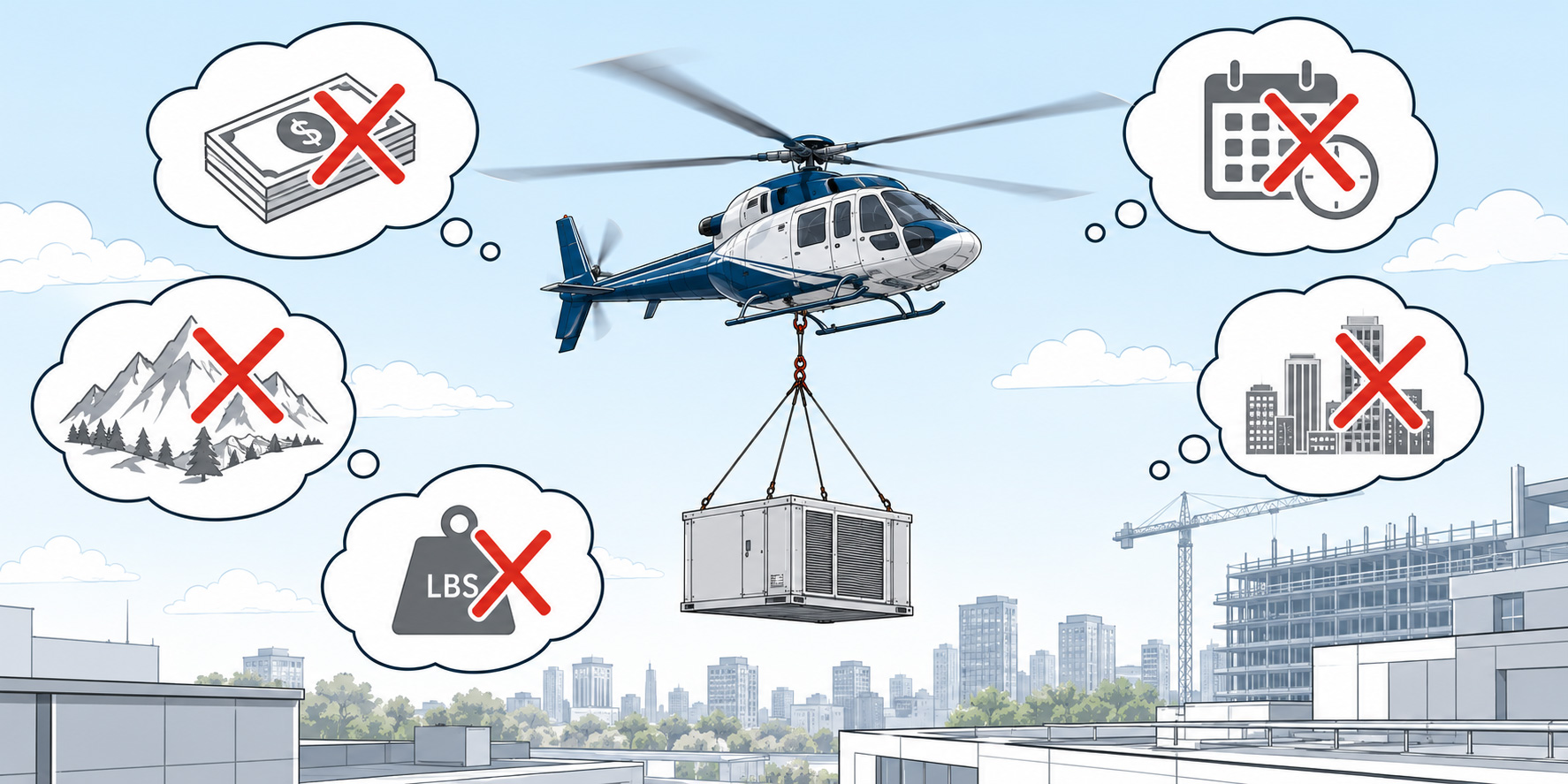
You have seen these taken apart through the guide. Here they are in one place: the beliefs that quietly cost contractors money, and what is actually true.
- Myth: A ground crane is the default for every lift. Reality: once a job calls for a crane over 100 tons, a helicopter has to be evaluated. And once you pass roughly 10 units, the helicopter becomes far more likely to win, as long as the crane alternative is still in that 100-ton-plus range. Defaulting to a crane without that check is where money leaks.
- Myth: Helicopters are only for sites a crane cannot reach. Reality: a helicopter is often the better, more cost-effective, and safer answer even with full ground access, including, sometimes, in the middle of a city over a working hospital.
- Myth: The closest asset is the most cost-effective. Reality: the closest asset is frequently oversized and overpriced. The right-sized machine an hour farther out, or one already passing through your area, often wins.
- Myth: A bigger crane is the safer bet. Reality: a crane's rated tonnage is its capacity at minimal reach. The farther it has to reach toward your load, the less it can actually lift, so buying tonnage just to buy reach is the most expensive habit in ground lifting.
- Myth: You can compare two quotes by the number at the bottom. Reality: crane and helicopter quotes are built differently. What matters is the total delivered cost, the quote plus your crew days plus the disruption to your project.
- Myth: Ground cranes always cost less than helicopters. Reality: it is intensely job-specific. Plenty of construction projects run on more expensive ground cranes for no better reason than that no one thought to consult a lift specialist.
- Myth: There is a fixed 150-foot safety radius for helicopter lifts. Reality: a clearance radius is required, but the number is calculated from the aircraft and the length of the line. A shorter line can deliberately shrink it to limit road and building closures.
- Myth: Always use a ground crane or a helicopter, never both. Reality: on the right job, combining the two beats either one alone, with a crane taking the heavy, short-reach work and a helicopter taking the rest.
- Myth: Heavier units mean a more profitable job. Reality: heavier units raise your bid and lower your odds of winning it. Spreading the weight across more, lighter picks usually wins the work and improves the economics.
- Myth: Reducing a unit's weight always voids the warranty. Reality: not necessarily. Removing a compressor, shipping a unit in sections, and other options exist, and each depends on the unit and the project. Bounce the idea off a lift specialist or the manufacturer before assuming it is off the table.
- Myth: The spec sheet always has the exact weight. Reality: a sheet that reads 7,384 pounds often carries a "plus or minus 10 percent," section weights buried inside the total, or other terms that make the real number more flexible than it looks.
- Myth: Once you have used a helicopter, you know what helicopter versus crane costs. Reality: every project is different. Taking the number from one job and using it to judge the next, instead of consulting a specialist, is how good contractors talk themselves into the wrong asset.
- Myth: The pilot or crane operator always plans the best lift. Reality: the person at the controls should understand the lift, fly it, and call the safe conditions to operate. Planning it is a different job. It takes the unbiased, broad experience of a lift specialist, because no pilot has flown every aircraft or every type of lift.
The common thread is simple. Lifting rewards expertise that only looks like common sense after someone has explained it. Before that, the obvious answer is usually the expensive one.
- Define the real scope. It starts with the questions that change the number. How many picks, not units, since a swap doubles the count and curbs add to it. What each piece weighs, its dimensions, and exactly where on the roof it lands. We help you gather the spec sheets, weights, and placement, so a thin or uncertain scope does not quietly steer you toward the wrong asset.
- Treat the units themselves as a variable. If you have not bought the equipment yet, the lift can shape what you buy. A unit that ships in sections, or a lighter configuration, can move the whole job into a more cost-effective class of aircraft. We will bounce options off you, and off the manufacturer where it helps. This is exactly why the most valuable call comes before the units are spec'd.
- Map the whole field of options. This is the part no single operator can do, and it is worth being blunt about why. A limited-asset vendor can only sell you what sits in their yard, so the truly helpful ones reach out to other operators when they do not have the right tool for your job. Some do that. Some quietly sell you what they happen to own. Getting the right solution takes a planner with no stake in any one machine, and we will tell you the right answer even when it does not carry our best margin, because we are in this for the long relationship, not the single invoice. There are hundreds of crane, helicopter, and combination options to weigh before you even account for where each asset is sitting today and where it is headed.
- The site visit, in person or remote. We look at the things that decide the plan and rarely show up in a description: site access, staging, what the ground can bear, the building's operating hours, the airspace overhead, and whatever is unique to your location. Whether on the ground or through the imagery and detail we can gather remotely, a visit is where a problem gets found now, on paper, instead of on lift day.
- Work the regulatory, airspace, and closure path. The operator's Part 133 certification, the flight plan or congested-area plan for work over a populated site, the permits, the road closures, the clearance radius the rig will require, and any airspace restrictions in play. None of it is optional, all of it has lead time, and we manage it for you.
- Re-evaluate the options on the merits. Here is the step most people skip. The best choice is rarely obvious at the start, because it depends on what the earlier steps turn up. A site constraint, a required closure, or an asset that just came free nearby can each change the answer. We weigh the real pros and cons of every option, and the winner is not always the lowest number on a quote. It is the safest, fastest, most cost-effective way to do your specific job.
- Lock the plan and execute. Out of all of that comes one recommendation, chosen without a thumb on the scale. Then the coordination begins: the operator or operators, the rigging, the crew, the closures, the weather window, a backup asset where the schedule cannot slip, and the choreography of the day itself.
A contractor sees the last line of a quote. Everything above is the work underneath it, and you do not have to do that work yourself. The single best move you can make is to reach out early, while the options are still open. We take it from there.
Frequently Asked Questions
Is a helicopter more expensive than a ground crane?
Not necessarily, and even when the two quotes come out close, the helicopter is frequently far more cost-effective once you count your own costs. On a recent Cincinnati estimate, the crane and helicopter prices came out identical, but the crane would have needed five days on site while the helicopter would finish in under twenty minutes of flight time. Five days of your crew standing by, against twenty minutes, is the real comparison. Judge it by total delivered cost, not by the quote alone.
How much does it cost to lift an HVAC unit onto a roof?
The most useful thing to understand is that the cost per unit drops sharply the more units you do. A lone rooftop unit carries the full mobilization and minimum all by itself, so it is expensive per unit. A roof full of them spreads that same mobilization across every pick, so each one gets far more cost-effective. Most rooftop units fall between 2,000 and 8,000 pounds, which keeps them well within the range of common, affordable aircraft. Our HVAC lift services page covers this work specifically, and the fastest way to a real figure is to tell us the unit count, the weights, and the address.
How many lifts per hour can a helicopter do compared to a ground crane?
A ground crane averages about 2 picks per hour while it is set up and actively picking. A helicopter averages about 15, and can reach 25 or more on light, tightly clustered units. Heavier loads slow that down, and past roughly 10,000 pounds the rate falls. The crane's 2 per hour does not even count the days it spends assembling and tearing down, so the real-world gap is wider than the numbers suggest.
How long does a lift take?
A helicopter lift is often a matter of hours, sometimes only minutes of actual flight time. The same work by ground crane can take days, and sometimes weeks once you add setup, repositioning, and teardown. The reaction we hear most after a helicopter lift is how smooth and fast it was. That is the point: nearly all of the work lives in the preparation, the part a lift specialist handles is planned long before the aircraft arrives, so the lift itself looks effortless.
What is the heaviest load a helicopter can lift?
Among the non-military aircraft available for commercial work, the largest top out around 25,000 to 26,000 pounds. That is the ceiling, not the norm. Most loads we lift fall between 2,000 and 8,000 pounds, which is why matching the aircraft to the actual weight matters far more than reaching for the biggest machine.
What kind of permitting do I need for a lift?
More than most people expect. A helicopter lift requires, at a minimum, an FAA flight plan, and often a congested-area plan for work over a populated site. The operator has to hold a Part 133 certificate, which not every helicopter or operator does, and the pilot needs licensed experience specific to Part 133 work and to the aircraft being flown. On top of that come road closures and any airspace restrictions in play, from flight-restricted zones and temporary flight restrictions to the notices to airmen that keep other traffic clear. We handle all of it, so you are not the one chasing approvals.
When to use a helicopter instead of a crane?
Common cases include a high unit count, a tall building or a long reach, a tight or congested site, a job where speed matters because the site cannot stay shut down, or a location a crane cannot reach without building a road to it. But it is worth evaluating far more often than most contractors do, because the right answer surprises people.
How far in advance should I plan and schedule a lift?
As early as possible. Same-day work has been done for simple, non-congested lifts with either a crane or a helicopter. But the average congested-area plan takes roughly two weeks for FAA approval, and even that timeline depends on the FAA. More complex projects, the ones involving TSA or DOT approvals, road closures, and other considerations, need more lead time. Planning early also opens up the savings, like catching an asset already moving through your area, that last-minute scheduling closes off.
Can you lift unusual or oversized loads?
Almost certainly. Beyond HVAC and towers, we have handled everything from pools and statues to submerged-boat fuel recovery, downed aircraft, aerospace drop testing, and, on a particularly memorable job, the airlift of a manta ray in the Bahamas. For the heaviest and most complex work, see our heavy lift page, or simply tell us what needs to move.
Do you work outside the United States?
Yes. While most of our work is in the United States and across North America, we have planned and coordinated a range of international projects as well. Tell us where the job is, and we will sort out what it takes to do it there.
How do I get a quote?
Just call. You do not need every detail lined up first. Tell us what you are lifting, roughly how much it weighs, how many, and where it is going, and we will walk you through the rest. The more we can talk it through, the sharper the plan, and we are glad to help you get there. We can often provide a same-day quote.
The Bottom Line
The number at the bottom of a lift quote is the smallest part of the story. Everything that actually decides your cost lives above that line: the right asset out of hundreds, where that asset is sitting this week, the reach and the radius, the closures, the crew days, and the unit choices you make before you ever call. A quote will never show you any of it.
That is the whole reason this kind of planning is a specialty and not a side project. You do not have to become an expert in any of it, and you do not have to do the legwork before you reach out. You just have to bring the lift to someone who already knows it cold, early enough that the options are still open, and objective enough to put every asset on the table and recommend the one that genuinely wins.
Whether you are bidding a job or planning one you have already won, the best move is the same. Call before the units are set, and let us shape the lift, and the bid, around the cost that actually matters.
Call Fair Lifts at 1-800-318-8940 for a same-day quote from a dedicated lift specialist, or tell us about your lift and we will map the options you would never have time to.