

The Bell 505 Jet Ranger X is a five-seat, single-engine light helicopter built to be simple to fly, maintain, and own. It carries the Jet Ranger name forward while adding modern avionics and a flexible cabin. Operators use it for flight training, private transport, aerial observation, and light utility work. In these roles, visibility, predictable handling, and lower pilot workload matter just as much as speed and range.
Below is a breakdown of the Bell 505’s key specifications and what they mean in real-world use. All figures come from Bell’s published manufacturer data and Safran’s official engine specifications.
Table of Contents
- Aircraft Design
- Power and Rotor Design
- Cockpit and Avionics
- Real-World Performance
- Weight, Payload, and Useful Load
- Cabin and Dimensions
- Bell 505 Jet Ranger X Helicopter Specifications
Aircraft Design

The Bell 505 Jet Ranger X | Photo: bellflight.com
Bell designed the 505 as a light helicopter for short to medium range missions. It seats one pilot and up to four passengers. Its compact footprint makes it a practical fit for training ramps, small heliports, and private landing areas.
The aircraft uses a single Safran Arrius-family turbine engine with dual-channel full authority digital engine control, or FADEC. This system automatically manages fuel flow and engine limits, which helps reduce pilot workload during startup and power changes.
Bell certified the 505 to current TCCA, FAA, and EASA Part 27 standards. Transport Canada certified the model on December 21, 2016, and FAA certification followed in June 2017.
By November 2023, Bell had delivered the 505th aircraft, with the fleet operating in more than 55 countries.
Power and Rotor Design

Arrius 2R Engine | Photo: safran-group.com
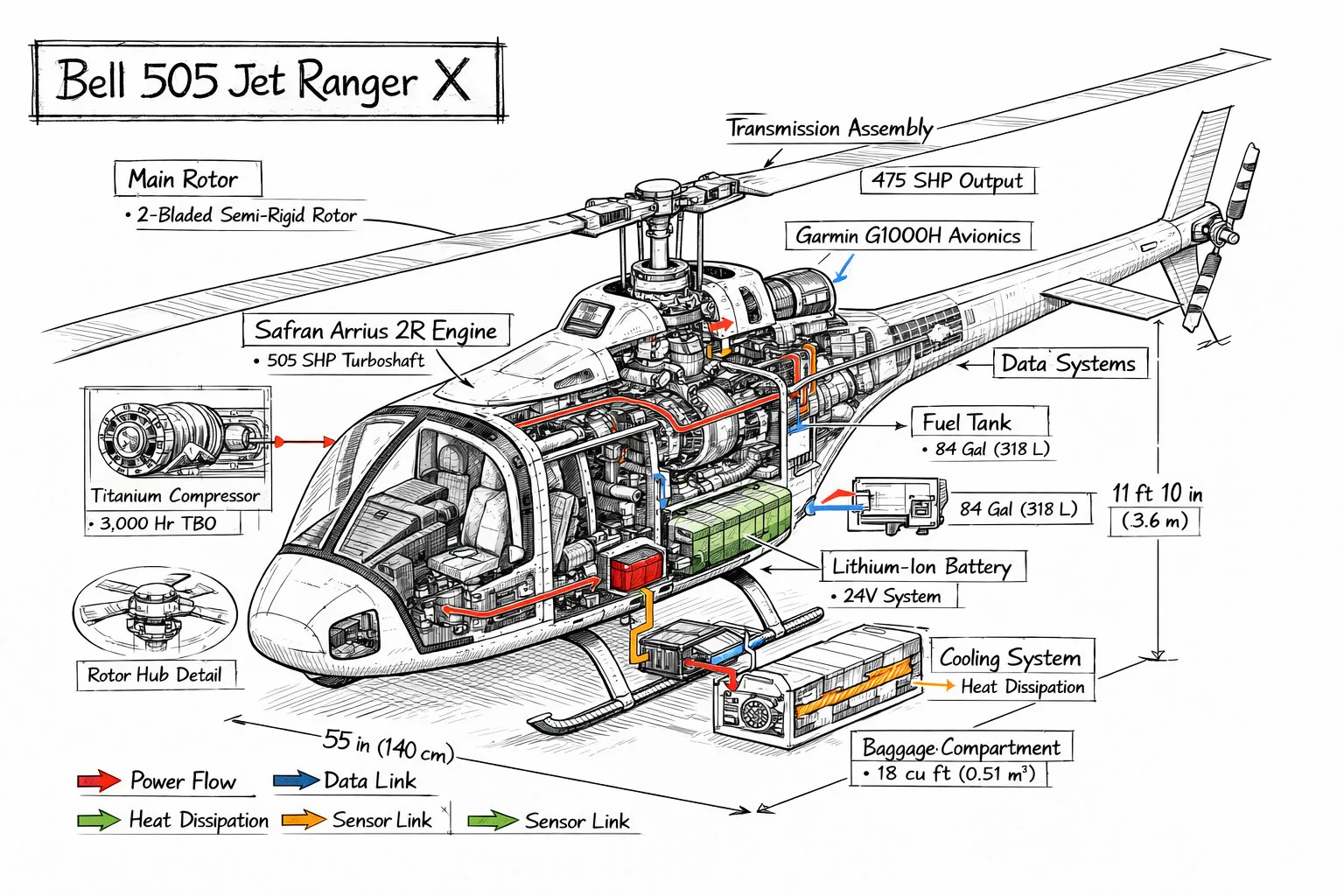
The Bell 505 is powered by the Safran Arrius 2R turboshaft engine. It produces 505 shaft horsepower at takeoff in its uninstalled thermodynamic rating, with a transmission takeoff rating of 475 SHP for five minutes. The engine also uses a titanium centrifugal compressor, a reverse-flow combustion chamber, and overspeed protection. Time between overhaul is 3,000 hours.
Engine management is handled by a dual-channel FADEC system. That matters because if one channel fails, the second takes over automatically. An Auxiliary Control Unit adds another backup layer if both main channels are lost. The system also manages automatic starts, surge and flameout protection, and engine data recording for maintenance tracking.
The main rotor uses a two-bladed semi-rigid teetering design that stays true to the Jet Ranger family. Its high-inertia blades help improve autorotation performance by giving the aircraft more stored rotor energy during a power-off descent. The design also keeps the helicopter compact on the ground, since the skids are the widest point of the airframe.
Cockpit and Avionics

Garmin G1000H integrated flight deck | Photo: bellflight.com
The Bell 505 uses the Garmin G1000H integrated flight deck. It was the first helicopter in this class to offer a fully integrated glass cockpit as standard equipment. The system uses dual 10.4-inch displays to show flight instruments, moving map navigation, engine data, and aircraft alerts in one organized layout.
The primary flight display includes a Power Situation Indicator, or PSI, which groups key engine and flight data in one place. The system also handles communication and navigation tuning, along with flight plan management, through the displays. Two SD card slots support database updates, flight plan uploads, and data downloads.
Real-World Performance

A Jet Ranger X sits atop a mountain. | Photo: bellflight.com
At its maximum internal gross weight of 3,680 lb under ISA conditions at sea level, the Bell 505 reaches a maximum cruise speed of 125 KTAS (232 km/h). At a lighter 3,000 lb gross weight, cruise speed increases to 128 KTAS. Long range cruise averages 112 KTAS across the weight range.
At long range cruise and sea level ISA, the Bell 505 has a published no-reserve range of 306 nautical miles (566 km) at maximum internal gross weight. At 4,000 feet under ISA conditions, range increases to 333 nautical miles (617 km). Endurance at loiter speed of 60 KIAS is 3.9 hours at sea level and 4.2 hours at 4,000 feet.
Hover performance is one of the most useful measures for a light helicopter because it shows how well the aircraft can maneuver with a given load at a given elevation.
- IGE hover ceiling at 3,680 lb, ISA: 14,450 ft (4,404 m)
- OGE hover ceiling at 3,680 lb, ISA: 10,460 ft (3,188 m)
- Service ceiling at maximum continuous power, ISA: 18,610 ft (5,673 m)
- Maximum altitude: 20,000 ft (6,096 m)
At lighter weights, these ceilings improve significantly. At 3,000 lb gross weight under ISA conditions, the IGE hover ceiling reaches 20,000 ft and the OGE hover ceiling reaches 17,400 ft. That extra margin can be important for mountain work and high-elevation landing zones.
Weight, Payload, and Useful Load

A Bell 505 maneuvers a skyscraper landscape. | Photo: bellflight.com
The Bell 505 has a base empty weight of 2,180 lb (989 kg) and a useful load of 1,500 lb (680 kg) in base configuration. Maximum internal gross weight is 3,680 lb (1,669 kg). With a cargo hook installed, maximum external load gross weight rises to 4,475 lb (2,030 kg), and the hook itself is rated for 2,000 lb (907 kg).
Useful load is the amount available for fuel, passengers, and baggage before the aircraft reaches its gross weight limit. That makes it one of the most important numbers in real-world mission planning. Even with a strong useful load for its class, the Bell 505 still requires careful balancing of fuel, payload, and baggage to stay within approved limits.
Cabin and Dimensions

Interior cabin of the Bell 505 | Photo: bellflight.com
The Bell 505 cabin uses a 22 square foot flat floor and an open layout that feels spacious for a light single-engine helicopter. The rear cabin offers generous headroom and legroom for the class, and the seats can be removed for internal cargo use. Integrated tie-downs are standard.
The clamshell doors on the copilot side open to 55 inches (140 cm), which helps with passenger entry, cargo loading, and medical access. Large rear windows and wrap-around cockpit windscreens also improve outside visibility.
The aft baggage compartment provides 18 cubic feet (0.51 m³) of storage.
Bell also offers the 505 in several mission-ready layouts. Options include a standard five-seat configuration, a VIP interior by Mecaer Aviation Group, a law enforcement setup with provisions for sensors and external equipment, and an EMS layout that can carry one stretcher along with the pilot and one medical attendant.
For storage planning, the widest point on the Bell 505 is the skid gear rather than the rotor head. That can make hangar placement easier than on aircraft with wider fuselages.
Bell 505 Jet Ranger X Helicopter Specifications
| Category | Specification |
|---|---|
| Engine | Safran Arrius 2R turboshaft, dual-channel FADEC |
| Takeoff Power | 505 SHP engine rating • 475 SHP transmission limit for 5 minutes |
| Engine TBO | 3,000 hours |
| Seating | 1 pilot + 4 passengers |
| Avionics | Garmin G1000H flight deck with dual 10.4-inch displays |
| Main Rotor | Two-bladed semi-rigid teetering rotor system |
| Empty Weight | 2,180 lb (989 kg) |
| Maximum Internal Gross Weight | 3,680 lb (1,669 kg) |
| Maximum External Load Weight | 4,475 lb (2,030 kg) |
| Useful Load | 1,500 lb (680 kg) |
| Cruise Speed | 125 KTAS (232 km/h) |
| Range | 306 nm at sea level ISA • 333 nm at 4,000 ft ISA with no reserve |
| Hover Ceiling | IGE: 14,450 ft • OGE: 10,460 ft at ISA and 3,680 lb |
| Service Ceiling | 18,610 ft |
| Baggage Capacity | 18 cu ft (0.51 m³) |
| Cabin Floor Area | 22 sq ft (2.04 m²) |
| Clamshell Door Width | 55 in (140 cm) |
Performance figures are based on International Standard Atmosphere (ISA) conditions. Actual performance varies with temperature, altitude, payload, and installed equipment.