

When people imagine helicopters, the spinning main rotor usually stands out first. Yet the helicopter tail rotor plays a crucial role in enabling controlled flight. Understanding the helicopter tail rotor purpose explains why it is vital on most rotorcraft, and why some advanced helicopters operate without one.
What Is the Helicopter Tail Rotor Purpose?

Tail rotor of a helicopter
The tail rotor’s primary function is to counteract the torque produced by the main rotor. As the main rotor spins, it creates a rotational force on the fuselage in the opposite direction. Without a tail rotor, the helicopter’s body would spin uncontrollably. The tail rotor generates thrust opposing this torque, stabilizing the helicopter and allowing the pilot to control yaw.
It also enables turns by adjusting tail rotor blade pitch via anti-torque pedals in the cockpit.
How Tail Rotors Work
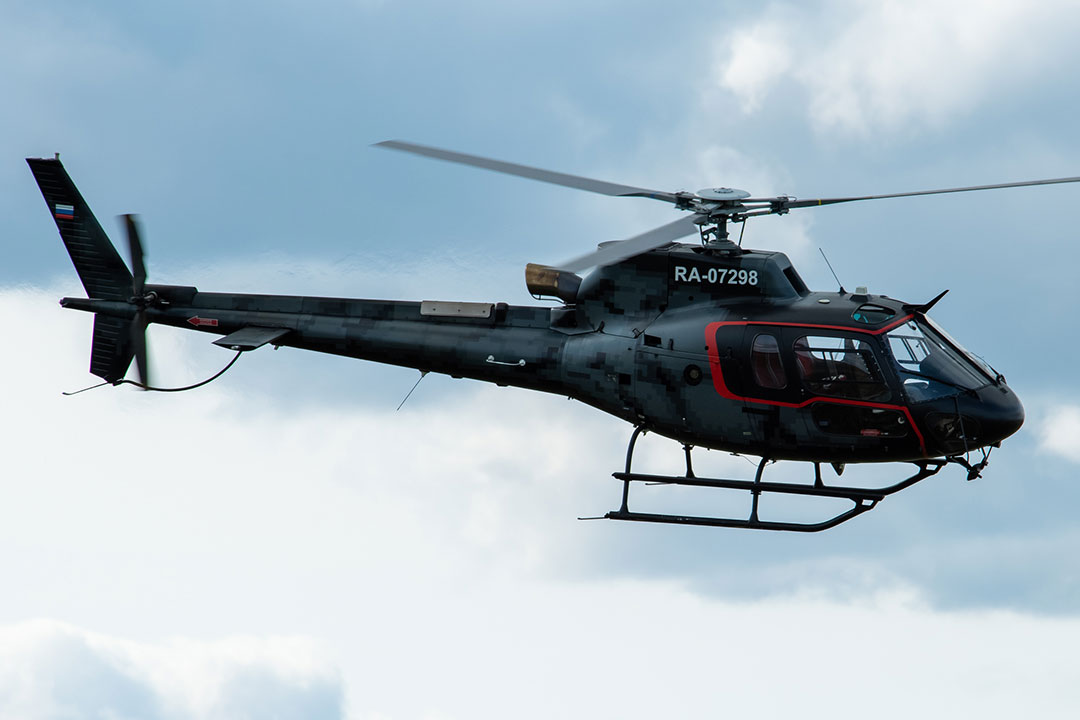
Aerospatiale AS.350 | Photo: Pavel Byrkin
Tail rotors are usually mounted at the tail boom’s end, positioned perpendicular to the main rotor. Powered by the same engine, they spin rapidly to produce lateral thrust. By altering blade pitch, pilots adjust thrust to steer or maintain hover stability.
Types of Tail Rotor Systems
While exposed tail rotors are standard, some designs improve safety, efficiency, or stealth:
- Conventional Tail Rotor: The most common type, found on helicopters like the Bell 206 and Robinson R44.
- Fenestron: An enclosed tail rotor within a ducted fan, used on Airbus H130 and H135 models. It reduces noise and enhances safety near people.
- NOTAR (No Tail Rotor): A system replacing the tail rotor with an air jet expelled from the tail boom. More details follow below.
Why Some Helicopters Don’t Need a Tail Rotor
While most helicopters rely on tail rotors, some designs eliminate them while still managing torque and control.
1. Tandem Rotor Helicopters

Boeing CH-47 Chinook | Photo: VanderWolf-Images
Tandem rotor helicopters, like the Boeing CH-47 Chinook, use two large rotors, one at the front and one at the rear, spinning in opposite directions. This cancels out torque, removing the need for a tail rotor. These systems excel in heavy-lift missions with added stability.
2. Coaxial Rotor Helicopters

Sikorsky X2 | Photo: lockheedmartian.com
Coaxial designs, such as the Kamov Ka-52 and Sikorsky’s X2, stack two rotors vertically on the same axis, spinning oppositely. This balances torque internally, improving maneuverability and lift.
3. NOTAR System (No Tail Rotor)

MD 520N | Photo: mdhelicopters.com
Developed by McDonnell Douglas, NOTAR uses an air jet from the tail boom for anti-torque thrust. Helicopters like the MD 520N and MD 902 Explorer achieve stability without a spinning rotor, enhancing safety in tight spaces.
Benefits and Trade-Offs of Non-Tail Rotor Designs
Helicopters without tail rotors offer key advantages:
- Greater safety with no exposed rotor
- Reduced noise, especially in Fenestron and NOTAR systems
- Better agility, particularly in coaxial designs
Trade-offs include added mechanical complexity, weight, and sometimes lower efficiency at high speeds or altitudes. Design choices depend on mission needs and operating conditions.
Fair Lifts Expertise with All Rotorcraft Designs

Bell 206B2 JetRanger, two-bladed, single- and twin-engined helicopter | Photo: M.J.J. de Vaan / Shutterstock.com
From conventional tail rotor helicopters like the Bell 206 to NOTAR aircraft like the MD 902 Explorer, Fair Lifts partners with operators specializing in every configuration. Whether heavy-lift CH-47 missions or precision Airbus transports, we match the right aircraft to your needs.
Balancing Stability and Innovation in Helicopter Design
The helicopter tail rotor purpose is essential for yaw control and stable flight. While most helicopters rely on tail rotors, tandem, coaxial, and NOTAR systems provide alternatives. Each design has unique benefits based on mission requirements, safety, and performance. Understanding these differences is key for pilots, engineers, and those seeking specialized services like Fair Lifts.
For expert helicopter solutions, contact us today or call 1-800-318-8940 to speak with a lift specialist.