
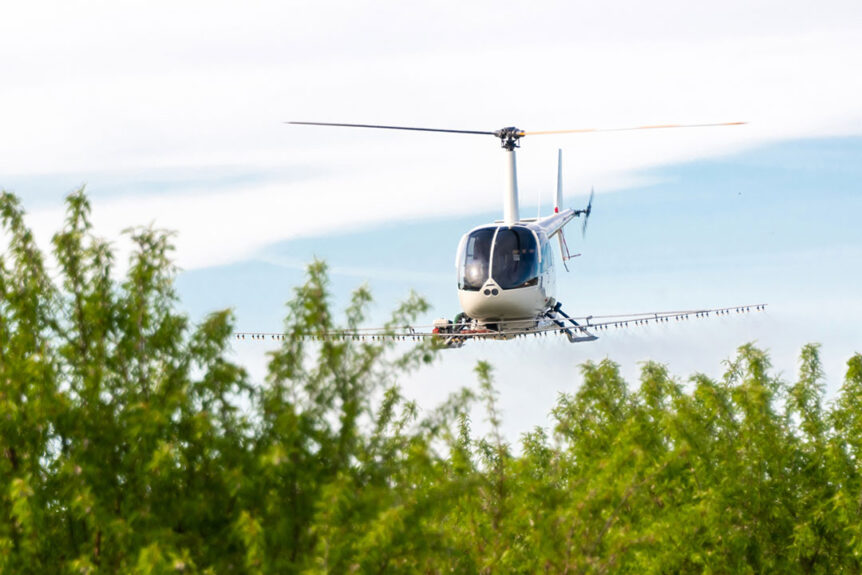
When forests or crops are besieged by pests, time is of the essence. Agricultural helicopter pest control gives land managers and growers a rapid, scalable means to deploy treatment over large areas, reach remote terrain, and respond swiftly before damage becomes irreversible.
The Challenge of Large Scale Infestations
Pest outbreaks such as spruce budworm or the spongy moth cause massive defoliation in forests. Insect populations can grow exponentially, crossing thresholds beyond which natural control is insufficient. Delay in response leads to tree mortality, habitat loss, economic damage to timber industries, reduced ecosystem services, and increased risk of wildfires.
Traditional ground based treatments are often too slow or inaccessible in mountainous or heavily wooded terrain.
Why Helicopters Are Game Changers
Substantial acreage can be addressed in brief periods of suitable weather, pest life phase, and host plant timing.
- Speed and reach: Helicopters can fly directly to rugged or remote zones where road access is limited, covering steep slopes and remote forests without the need for established infrastructure.
- Precision application: Modern aerial spraying systems, combined with GPS, can apply insecticides or biological agents accurately, minimizing drift and reducing environmental impact.
- Scalable operations: Large acreage can be treated in short windows of favorable weather, insect life stage, and host plant phenology.
- Flexibility: Helicopters can use a variety of treatment agents including bio insecticides, insect growth regulators, or reduced toxicity chemicals, allowing for integrated pest management strategies.
Operational Successes in 2025
Maine: Spruce Budworm Early Intervention

spruce budworm | Photo: Jerald E. Dewey, USDA Forest Service, United States
Northern Maine saw rising spruce budworm populations in early 2025, with larval counts crossing outbreak thresholds on thousands of acres. Aerial survey revealed approximately 3,400 acres of defoliation in 2024, and larval densities reached or exceeded seven larvae per branch on targeted spruce fir forests.
The Maine Budworm Response Coalition (MBRC), working with the Maine Forest Service and other partners, executed an aerial spray program treating roughly 240,000 acres using low toxicity insecticides. Helicopters and fixed wing aircraft were used to apply treatments during early larval stages and optimal bud development windows. The program prevented extensive damage near the Quebec border and in locations along Cross Lake and the Fish River Chain.
Pennsylvania: Spongy Moth Suppression

Lymantria dispar dispar (Spongy Moth) | Photo: pa.gov
In Pennsylvania, the spongy moth (Lymantria dispar dispar) threatens forest biodiversity and hardwood stands including oak, apple, birch, and aspen. In 2025, state officials initiated an aerial treatment program over state forests and parks totaling nearly 75,000 acres, plus an additional 38,000 acres of State Game Lands.
Helicopters and fixed wing aircraft applied Bacillus thuringiensis kurstaki (Btk), a biological insecticide, and tebufenozide, an insect growth regulator. Treatments were scheduled to match larval feeding activity to maximize impact while limiting non target effects.
Midland County, Michigan: Local Spongy Moth Suppression by Helicopter
Midland County launched its annual spongy moth suppression over about 4,200 acres using helicopters to apply treatments. The program is largely residential and focused where defoliation risk is high. This smaller scale effort still demonstrates how helicopters enable speed and flexibility in response even where terrain and budget constrain ground access.
Technical and Operational Considerations

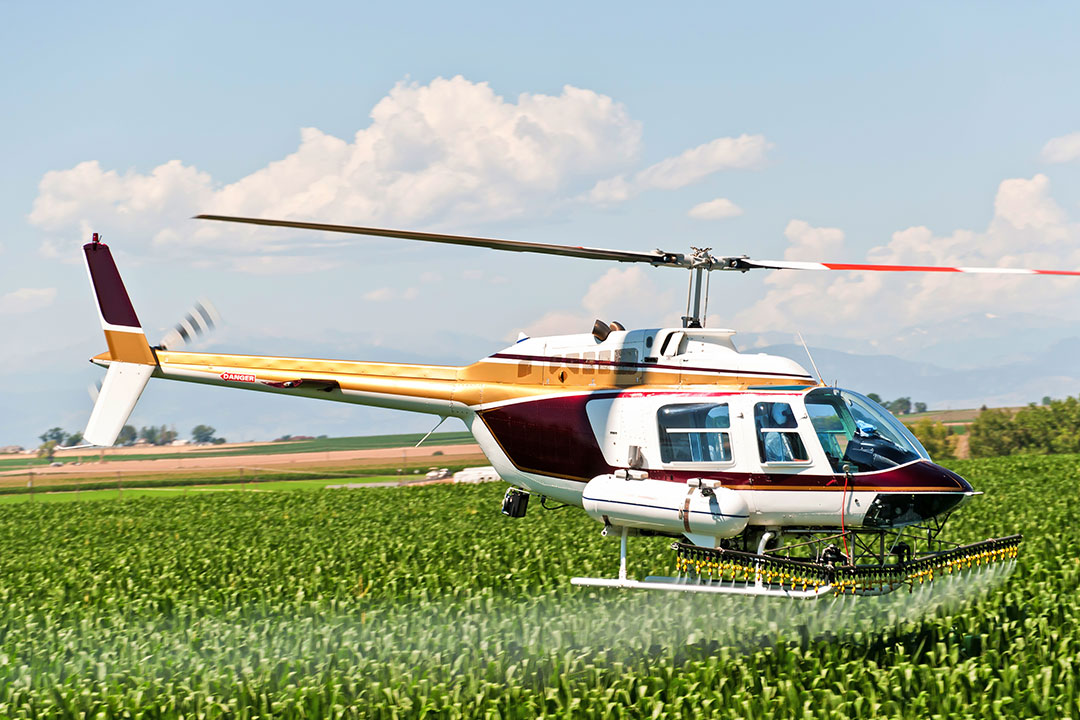
Low flying ag helicopter spraying row crops.
Effective helicopter pest control deployment relies on key factors:
- Monitoring and thresholds: Regular surveys (egg mass counts, larval sampling, defoliation mapping) detect approaching outbreaks. Early intervention reduces treatment scale and cost.
- Treatment agent selection: Bio insecticides, insect growth regulators, or reduced toxicity chemicals minimize collateral damage to non target species and the environment.
- Weather windows: Applications require suitable conditions to minimize drift, prevent evaporation, and ensure foliage adhesion. Wind, precipitation, and temperature are critical.
- Piloting and equipment: Helicopters need proper spray systems, GPS navigation, altitudinal control, and trained operators for precise, safe application.
- Regulatory compliance: Permits, chemical registrations, buffer zones, community notifications, and agency oversight must all be secured.
- Cost and funding: Large scale treatments are costly. Public private partnerships, cost share programs, and government funds help distribute financial burden.
Best Practices & Future Trends
Some best practices include integrating aerial treatments into integrated pest management plans, using early intervention rather than waiting for full outbreaks, employing biological or environmentally sensitive compounds, and ensuring operational excellence in helicopter technology and pilot training.
Emerging trends feature unmanned or semi autonomous helicopters or UAVs (drones) that can carry lighter payloads or navigate remotely, remote sensing to pinpoint infestation hotspots, and improved meteorological and flight path planning to increase precision and reduce chemical usage.
A Proven Strategy for Protecting Resources

An agricultural helicopter sprays crops
Infestations in forests and agricultural lands can escalate rapidly and lead to severe damage if not addressed early. Agricultural helicopter pest control has proven capable of turning the tide covering vast acreages, reaching difficult terrain, and delivering treatment when it matters most.
With proper planning, environmental safeguards, and investment, helicopters offer a powerful tool in the quest for healthy forests, resilient farms, and sustainable landscapes.
Contact Fair Lifts for Agricultural Helicopter Services
To learn more about how Fair Lifts can support your upcoming agricultural helicopter pest control spraying or infestation control project, call 1-800-318-8940 or contact us to request a quote.
From early planning through safe and effective aerial application, Fair Lifts delivers agricultural helicopter services designed to protect your land and crops.