
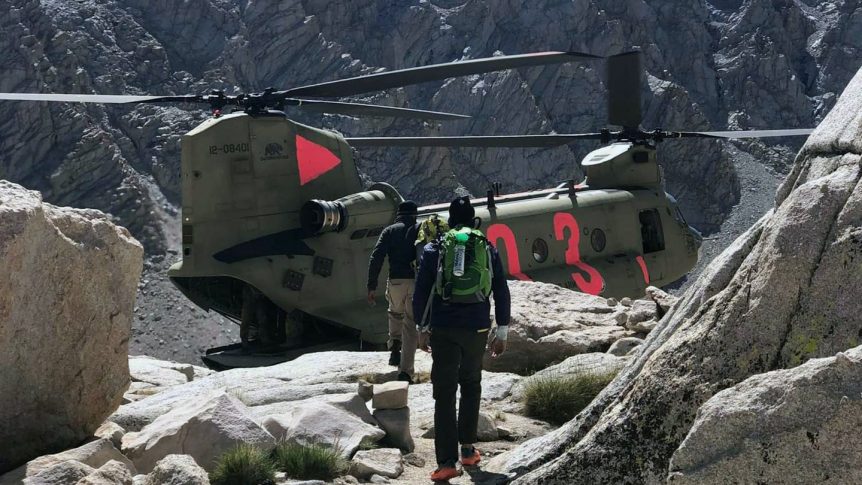
A daring high altitude helicopter rescue took place on July 29th when a U.S. Army CH-47 Chinook airlifted three stranded hikers from the slopes of Mt. Whitney in Inyo County, California. Facing challenging weather and extreme elevations, the California Army National Guard crew executed a precision rescue in coordination with the Inyo County Sheriff’s Office and the Governor’s Office of Emergency Services.
Challenging Conditions for a High Altitude Helicopter Rescue
The CH-47 Chinook, a heavy-lift military helicopter, was piloted by U.S. Army Chief Warrant Officer 3 Aaron Mello and his four crewmembers. As the helicopter ascended to 13,500 feet, it encountered a thick cloud bank clinging to the mountain’s slopes. To continue their high altitude helicopter rescue, the crew pushed through the dense cloud cover while relying on supplemental oxygen due to the thin air.
The stranded hikers were still higher up, forcing the helicopter to climb another 1,000 feet to reach their emergency camp near Mt. Whitney’s 14,505-foot summit. The hikers were found in poor condition, relying on assistance from other climbers after enduring the night without proper shelter or supplies.
Pinnacle Landing: A Precision Rescue Technique
With clear weather at the summit but no safe landing zone, the crew had two options: deploy a ground rescue team or perform a challenging pinnacle landing. Opting for the latter, the crew carefully positioned the massive Chinook to land with only its rear wheels touching the rocky terrain, allowing rescuers to guide the hikers onto the aircraft.
Pinnacle landings require exceptional skill, as the pilot cannot see where the rear wheels will make contact. Instead, Mello relied entirely on visual cues from the flight engineer, two crew chiefs, and co-pilot Chief Warrant Officer 3 Craig Hannon. A misstep on jagged rocks could have punctured the helicopter’s hull or damaged critical landing gear.
Successful Evacuation and Medical Assistance
Despite the treacherous conditions, the crew stabilized the helicopter while the hikers were swiftly brought onboard. The Chinook then descended safely to Bishop Airport in Owens Valley, where medical personnel assessed the hikers. Fortunately, they suffered no major injuries but were exhausted from their ordeal.
The Importance of High Altitude Helicopter Rescue Missions
High altitude helicopter rescues are essential for reaching stranded hikers and accident victims in extreme terrain where traditional ground rescues are impossible. While military helicopters like the Chinook are occasionally deployed for these operations, private emergency helicopter services frequently perform similar missions with remarkable precision and expertise.
- Military and private high altitude helicopter rescue teams operate in remote and dangerous conditions to save lives.
- Helicopters designed for high-altitude rescues require specialized piloting skills and rigorous training.
- These missions are crucial for hikers, climbers, and outdoor adventurers who find themselves stranded in extreme environments.
When accidents occur in the world’s most challenging landscapes, high altitude helicopter rescue teams remain the most reliable solution for swift, life-saving evacuations.
Photo Credit: Jaime Peske