
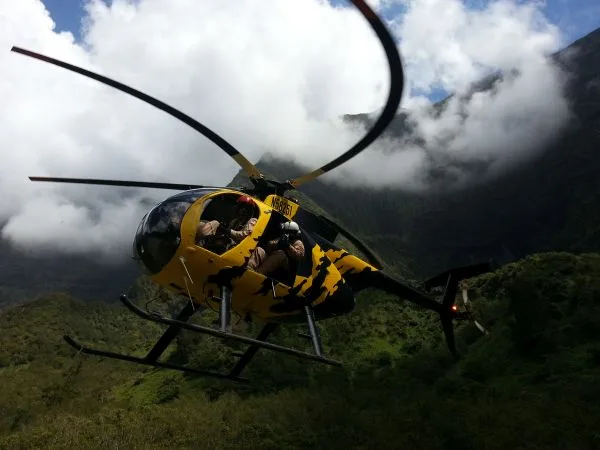
Controlling invasive species is a significant challenge in environmental management. Traditional methods often involve manual labor or ground-based equipment, which can be time-consuming, labor-intensive, and ineffective in hard-to-reach areas. Enter Herbicide Ballistic Technology (HBT), a revolutionary approach that combines the precision and reach of agricultural helicopters with the power of herbicides, encapsulated in small projectiles.
Understanding Herbicide Ballistic Technology (HBT)
Developed by James Leary, an associate professor in the College of Tropical Agriculture and Human Resources (CTAHR), HBT involves the use of pneumatic paintball guns adapted to shoot small gelatin capsules filled with herbicide. These capsules can be accurately targeted at invasive plants and trees, even in difficult-to-reach areas such as cliffs and ravines.
The capsules, custom-made by Nelson Paint Company, safely contain the herbicide, reducing the risk of exposure for the applicator. This technology also minimizes disturbance to remote areas, making it an environmentally friendly approach to invasive species control.
Helicopters: Enhancing the Reach and Efficiency of HBT
When used in conjunction with helicopters, HBT becomes even more powerful. From a helicopter, an operator can treat individual invasive plants from a range of up to 100 feet, covering large areas quickly and efficiently. This is particularly beneficial for controlling invasive species in remote or inaccessible areas.
In Maui, for example, HBT has been used to control miconia, an invasive weed that shades out native plants and damages the ecosystem. More than 4,000 invasive weed trees were targeted and eliminated in remote areas of Maui watershed in just over a year using this innovative technology.
Cost-Effective and Targeted Treatment
One of the key advantages of HBT is its cost-effectiveness. According to Leary, it’s possible to protect an acre of forested watershed for a surprisingly low price, thanks to the efficiency provided by the helicopter. This makes HBT a viable option even for large-scale invasive species control projects.
Moreover, HBT allows for targeted treatment of invasive species. Each herbicide capsule can be precisely aimed at a specific plant, minimizing impact on non-target species and the surrounding environment. This level of precision is difficult to achieve with traditional ground-based methods.
A New Weapon for Invasive Species Control
Herbicide Ballistic Technology (HBT) represents a significant advancement in the field of invasive species control. By combining the precision and reach of agricultural helicopters with the power of herbicides, HBT offers a cost-effective, efficient, and environmentally friendly solution to this pressing environmental challenge.
At Fair Lifts, we’re committed to providing innovative solutions for environmental management. Contact us today to learn more about our services and how we can assist with your invasive species control project.