
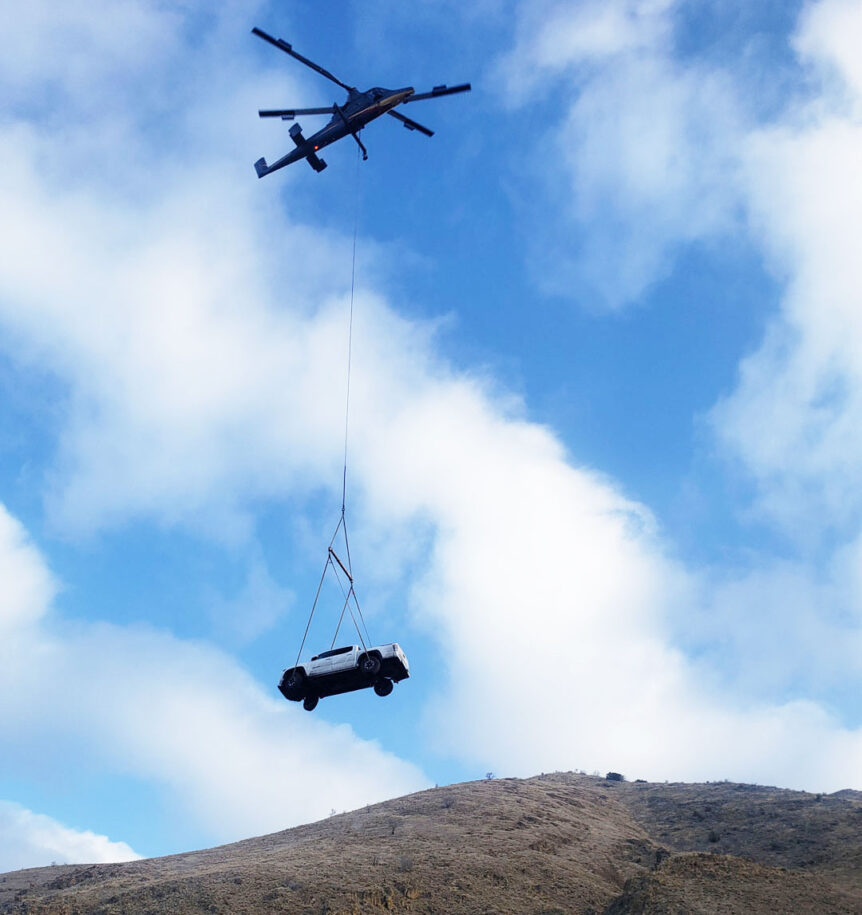
Can a helicopter lift a car?
Quick Answer: Yes. Under the right conditions, helicopters routinely lift cars, trucks, and heavier vehicles. It requires specialized “external load” operations, certified rigging, and a helicopter matched to the vehicle’s weight. Utility helicopters (like the Bell 205A) handle smaller cars, while heavy-lifters (like the Boeing CH-47 Chinook) can lift large trucks.
While it may sound like an action movie stunt, vehicle lifting is a real, highly regulated part of aviation. The success of a lift depends on the vehicle’s weight, the helicopter model, rigging methods, and environmental factors.
This guide explains how vehicle lifts work, the real-world limits, which helicopters are used, and when aerial lifting is the smartest option.
Table of Contents
How Helicopters Lift Vehicles
Helicopters lift vehicles using external load operations, commonly called sling or longline work. Instead of putting the cargo inside the cabin, the vehicle hangs beneath the aircraft. Crews use certified rigging and a cargo hook to secure the load.
This is not a “hook it and hope” scenario. External loads require meticulous planning, trained crews, and inspected equipment. A proper lift plan must account for weight, center of gravity, wind speeds, safe clearances, and communication protocols.
Average Vehicle Weights for Helicopter Lifts
Most passenger vehicles fall within the lifting limits of utility and heavy-lift helicopters. However, curb weight is only a baseline.
- Compact and midsize cars: 2,800 to 3,500 lb
- Electric vehicles (EVs) and SUVs: 4,000 to 6,000 lb
- Pickup trucks: 5,000 to 7,500 lb
Pro Tip: Two vehicles with the same curb weight can behave very differently. A car that is crushed, filled with mud, or stuck in a ditch acts like a much heavier object. A safe lift plan anticipates these extra forces.
What Actually Limits a Helicopter Vehicle Lift?
Real-world go/no-go decisions rely on several practical limits:
- Power Margins: Lift capacity drops as altitude, temperature, and fuel weight increase.
- Rigging Geometry: The vehicle must be lifted in a stable position using proper attachment points and a balanced bridle.
- Clearance and Routing: The flight path must stay clear of obstructions, powerlines, traffic, and bystanders.
- Load Stability: Wind and awkward shapes increase the risk of swinging and spinning. Some loads require stabilizing parachutes or taglines.
- Placement Precision: Dropping a vehicle into an open field is much easier than setting it perfectly onto a narrow flatbed.
The Rules Behind Vehicle Lifts
In the United States, external-load work falls under strict FAA Part 133 regulations. Jobsite practices must also meet construction safety requirements regarding load attachment and static electricity grounding.
The short version? The load must remain within the manufacturer’s limits, all rigging must be inspected, and the pilot holds the final authority to refuse any unsafe lift.
Helicopters That Can Lift a Car (By Capacity)
A surprising number of aircraft can lift passenger cars. Here is an overview of the most common models used in real-world operations.
Bell 205A (3,000 – 4,000 lb)
A proven utility platform for light loads. Under controlled conditions, it easily lifts smaller vehicles. It is ideal for short distances where conditions allow for simple pickup and set-down.
Bell 212HP (4,000 – 5,000 lb)
Thanks to twin-engine reliability, the 212HP offers better operational margins than single-engine models. It is frequently used for infrastructure work and remote recoveries.
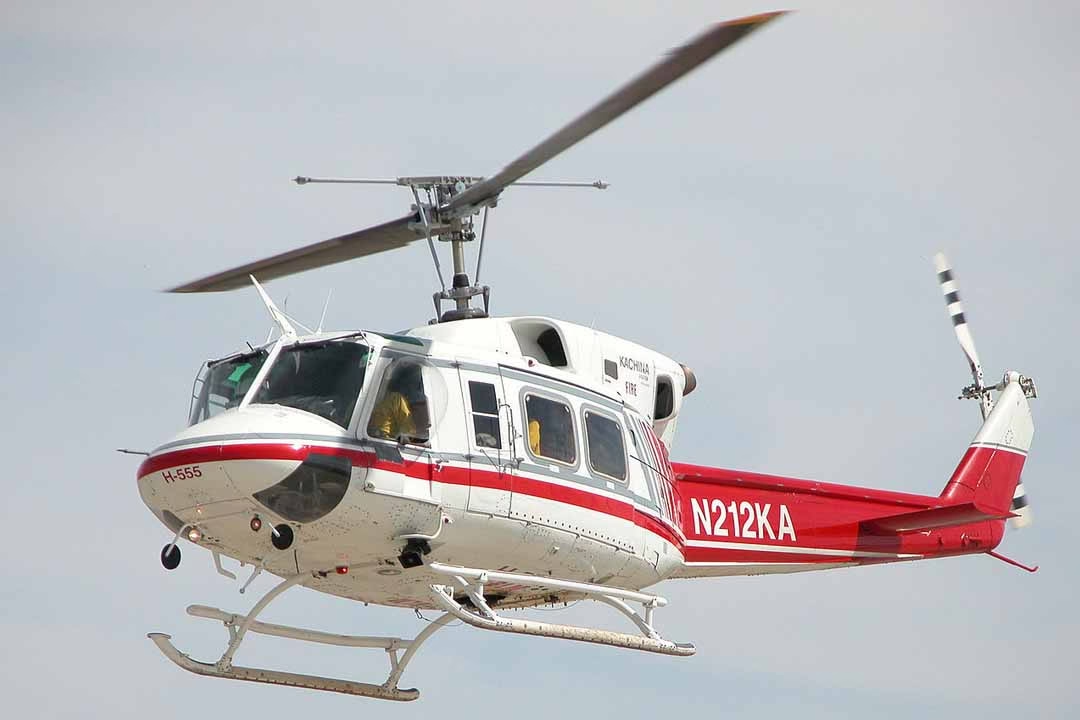
Bell 212HP configured for utility external load operations, commonly used for lifts where access and schedule matter.
Kaman K-Max (5,000 – 6,000 lb)
Purpose-built for external lifting, the K-Max offers incredible precision and pilot visibility. It excels in tasks requiring accurate, repeatable set-downs.
Bell 214 (7,000 – 8,000 lb)
This higher-lift utility helicopter provides the extra power needed for heavier SUVs and equipment trailers. It handles high temperatures and high elevations beautifully.
Sikorsky UH-60 Black Hawk (8,000 – 9,000 lb)
Famous for military use, the Black Hawk boasts massive external lift capabilities. It is the go-to choice for demanding environments, rescue operations, and specialized logistics.
Airbus H225 Super Puma (9,000 – 10,000+ lb)
A heavy twin-engine helicopter popular in offshore operations. Its strong cruise performance makes it perfect for moving vehicles over long distances or through unpredictable weather.
Erickson S-64F Air-Crane (20,000 – 25,000 lb)
The Erickson S-64F Air-Crane is a purpose-built flying crane. Capable of lifting loads far heavier than standard vehicles, it is used when ground solutions are impossible or too expensive.
Boeing CH-47 Chinook (20,000+ lb)
A tandem-rotor heavy lifter capable of moving massive trucks and outsized loads. If you are asking, “Can a helicopter lift a large truck?” the Chinook is usually the answer.
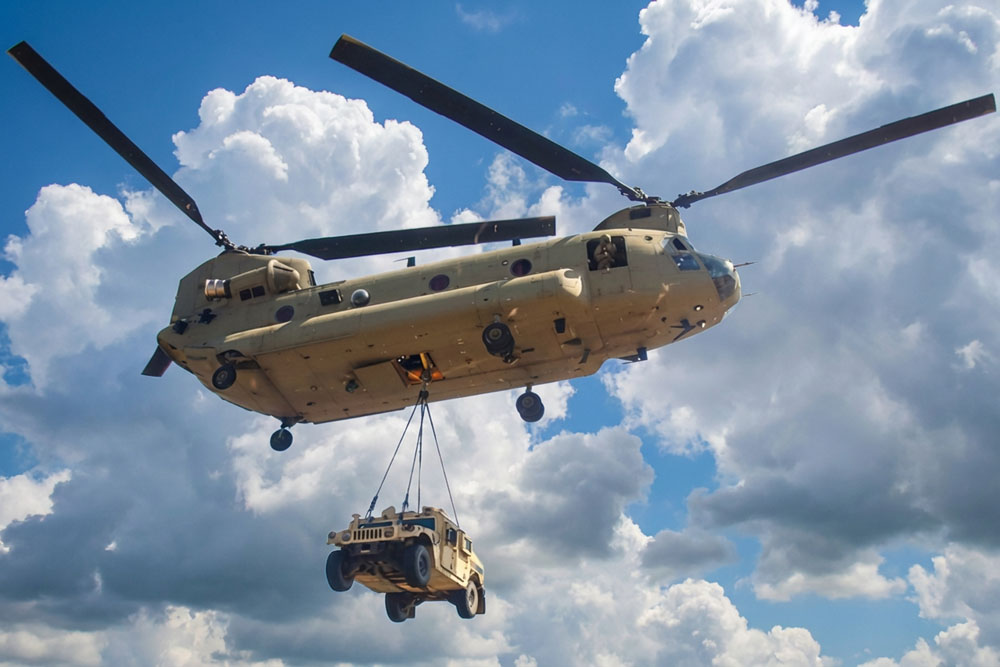
Boeing CH-47 Chinook lifting a military Humvee as an external sling load, a real-world example of heavy helicopter vehicle transport.
Sikorsky CH-53 King Stallion (30,000+ lb)
Designed for extreme heavy lift missions, this is one of the most powerful helicopters in existence. It handles large equipment in austere environments where error margins are zero.
Fast Feasibility Checklist
Want to know if a helicopter vehicle lift is realistic? Answer these questions:
- What is the *real* weight today? Mud, water, and damage can add thousands of pounds to the curb weight.
- Where can the rigging attach safely? You need solid structural points that won’t tear under pressure.
- Is the pickup zone safe? The aircraft needs clearance from trees and wires, plus a secure perimeter.
- Is the flight path clear? The route must avoid populated areas and sensitive infrastructure.
- What is the weather doing? High winds and gusts can make the vehicle spin dangerously.
Real-World Scenarios: When Does a Helicopter Make Sense?
If a car is sitting in a paved parking lot, call a tow truck. Helicopters become the best option when they reduce safety risks, save critical time, or bypass environmental hurdles.
- Remote Recovery: Pulling a vehicle off a steep mountainside or out of a wetland where tow trucks cannot reach.
- Time-Critical Clearances: Removing accidents that are blocking major transit corridors, saving thousands of dollars in closure delays.
- Site Constraints: Working in dense industrial sites where setting up a massive ground crane is impossible.
- Film and Marketing: Lifting vehicles for high-budget movie shoots or commercial stunts under tightly controlled conditions.
Frequently Asked Questions
Can a helicopter lift a car safely?
Yes, when executed by qualified crews using certified rigging. Poor planning or unstable loads are the primary risks.
Can a helicopter lift a truck?
Absolutely. Utility helicopters can handle light trucks, while heavy-lifters (like the Chinook) handle massive commercial trucks.
Can a helicopter lift an electric vehicle (EV)?
Yes. While EVs have heavy battery packs and weigh more than gas equivalents, they still fall well within utility helicopter lift capacities.
Can a helicopter lift a wrecked car?
Yes, but it requires specialized rigging. Broken axles, missing wheels, or compromised frames make the load unstable, so crews must adjust their attachment points.
Why not always use a helicopter?
Helicopters are premium, strategic tools. If a standard tow truck can do the job safely, it will be faster and cheaper. Helicopters are reserved for situations where ground transport is impossible, highly risky, or environmentally damaging.
Talk With a Heavy Lift Project Manager
Are you considering a helicopter lift for a vehicle, heavy equipment, or an oversized load? Get a fast feasibility check from the experts who plan complex lifts every day.
Call 1-800-318-8940 to speak with a Fair Lifts Project Manager to find out if aerial lifting is the right solution for your project.