
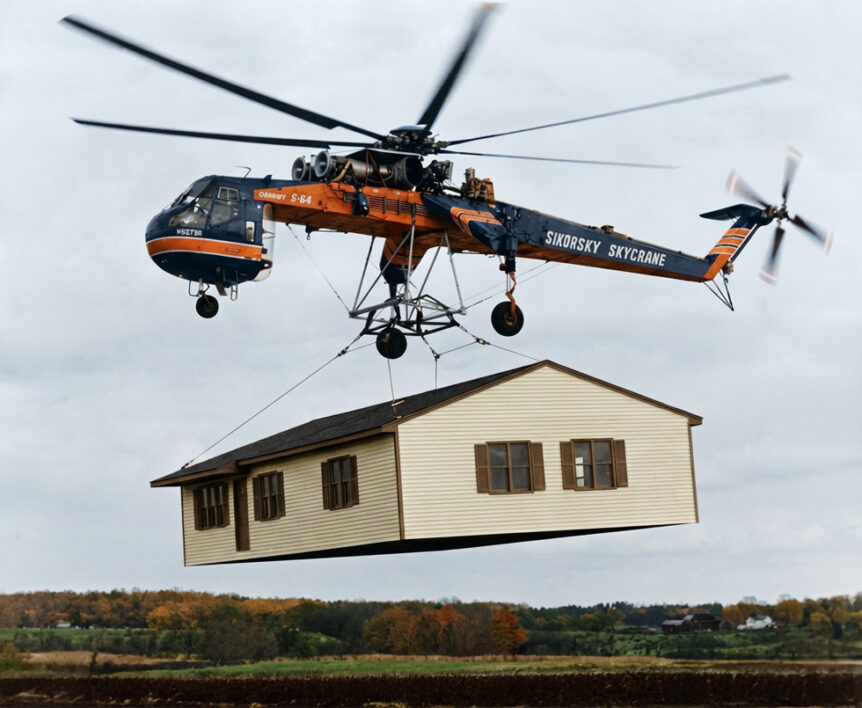
The Sikorsky CH-54 Skycrane occupies a unique place in helicopter history. Unlike transport helicopters adapted for sling work, the CH-54 was designed from the outset as a dedicated flying crane, purpose-built to lift, move, and precisely place extremely heavy external loads. Its evolution from military service into the Erickson S-64F Air-Crane represents one of the most successful transitions of a military rotorcraft into long-term civilian heavy lift operations.
This article traces the Skycrane’s evolution along a specific and important path, from the early CH-54A, through the improved CH-54B, and ultimately into the S-64F Air-Crane. Understanding this progression explains why the Skycrane remains one of the most capable heavy lift helicopters ever built.
Table of Contents
- Origins of the Flying Crane Concept
- CH-54A: Establishing the Baseline
- CH-54B: Increased Capability and Structural Refinement
- From CH-54B to Civilian Conversion
- The Erickson S-64F Air-Crane
- Specifications: Erickson S-64F Air-Crane
- Mission Equipment That Changes What the Aircraft Can Do
- Frequently Asked Questions About the CH-54 and S-64 Evolution
- Talk With a Heavy Lift Project Manager
Origins of the Flying Crane Concept
Sikorsky Aircraft developed the Skycrane during the late 1950s and early 1960s to meet U.S. Army requirements for a helicopter capable of lifting loads far beyond what conventional utility helicopters could handle. Rather than adapting an existing airframe, Sikorsky engineers designed a helicopter around the load itself.
The resulting open-frame, center-spine configuration eliminated a traditional fuselage and kept the underside of the aircraft unobstructed. This architecture improved load stability, gave crews exceptional visibility to the cargo, and enabled precise placement in confined or undeveloped areas.
CH-54A: Establishing the Baseline
The CH-54A was the first operational Skycrane variant delivered to the U.S. Army. Powered by twin turbine engines and optimized for external lift, it demonstrated capabilities that fundamentally changed military logistics planning.
The CH-54A proved capable of transporting artillery, vehicles, prefabricated structures, and even other helicopters as external loads. These early operations validated the flying crane concept and highlighted how heavy lift helicopters could bypass roads, terrain constraints, and infrastructure limitations.

U.S. Army Sikorsky CH-54A Skycrane demonstrating heavy lift capability by transporting two UH-1 Huey helicopters externally.
CH-54B: Increased Capability and Structural Refinement
Sikorsky developed the CH-54B after gaining real-world experience with the CH-54A. Engineers strengthened the airframe, improved the automatic flight control system, and increased the allowable gross weight. These upgrades allowed the Skycrane to lift heavier loads with better control, especially during precision external operations.
The CH-54B also proved its versatility in specialized testing. In 1971, crews equipped three aircraft with skis and auxiliary fuel tanks for cold-weather trials in Alaska. These modifications showed how well the platform could adapt to harsh and demanding environments.
The CH-54B soon became the standard military Skycrane. Crews used it in heavy lift testing and active service, where it transported armored vehicles and other oversized loads with consistency and precision.

U.S. Army Sikorsky CH-54B Skycrane transporting an M551 Sheridan tank during heavy lift testing at Redstone Arsenal, Alabama.
From CH-54B to Civilian Conversion
After completing military service, many CH-54 airframes moved into civilian use. As a result, these aircraft became the foundation of the commercial Skycrane fleet. Their unmatched external lift capability made them especially valuable for construction, infrastructure, and industrial projects.
In civilian service, operators often referred to these converted aircraft as S-64B. While they retained the core Skycrane design, teams adapted them for non-military missions. For example, operators updated systems and configurations to meet commercial requirements.
This transition marked an important step in the Skycrane’s evolution. It carried the flying crane concept into the commercial world, where reliability, maintainability, and mission-specific equipment became the primary focus.

Front view of a Sikorsky S-64B Skycrane converted from U.S. Army CH-54 military service for civilian heavy lift operations.
The Erickson S-64F Air-Crane
The Erickson S-64F Air-Crane represents one of the most important commercial evolutions of the Skycrane lineage. Building on the CH-54B foundation, Erickson developed a fleet-standard configuration optimized for commercial performance, repeatability, and mission tools.
In addition to structural and systems modernization, the Air-Crane became especially well known for aerial firefighting, where an integrated tank and snorkel system allow rapid refilling from natural water sources. For operators, that means more turns per hour and more water delivered where it matters, with fewer logistics constraints.
Specifications: Erickson S-64F Air-Crane
The table below uses published Erickson S-64F fleet specifications. Some performance figures are published in nautical units, conversions to miles and miles per hour are included for easier planning and comparison.
| Specification | S-64F Air-Crane |
|---|---|
| Maximum gross weight | 47,000 lb (21,320 kg) |
| Maximum hook weight | 25,000 lb (11,340 kg) |
| Powerplant | 2 × Erickson JFTD12A-5A |
| Maximum power available | 9,600 SHP (total) |
| Single-engine limit | 4,800 SHP for 30 minutes |
| Cruising speed | ~120 mph (104 knots, published max cruise) |
| Maximum range | ~260 miles (226 nm, 20-minute reserve) to ~283 miles (246 nm, no reserve) |
| Fuselage length | 69 ft 8 in (21.20 m) |
| Fuselage width | 7 ft 1 in (2.13 m) |
| Landing gear width | 21 ft 10.70 in (6.67 m) |
| Main rotor diameter | 72 ft 2.85 in (22.7 m) |
| Tail rotor diameter | 16 ft (4.90 m) |
| Landing gear | Main: wheeled, Nose: wheeled |
| Crew | 2 to 3 (mission dependent) |
Mission Equipment That Expands Capability
The S-64F Air-Crane remains relevant because of its wide range of mission equipment. These tools allow the aircraft to do much more than basic longline lifting.
Depending on the job, operators can add firefighting tanks, snorkels, hoists, anti-rotation devices, shock and pendant systems, and grapples. Each tool is designed for a specific task and operating environment.
This equipment directly affects how the helicopter performs. It can improve cycle times, increase load stability, and enhance safety margins. It also expands the types of projects the aircraft can handle with precision and reliability.
Frequently Asked Questions About the CH-54 and S-64 Evolution
What is the difference between the CH-54 and the S-64?
The CH-54 is the U.S. Army military designation for the original Skycrane helicopters built by Sikorsky. The S-64 is the civilian designation used for commercial versions derived from those military aircraft. While they share the same flying-crane architecture, civilian S-64 variants incorporate different systems, certifications, and mission equipment.
How did the CH-54B lead to the S-64F Air-Crane?
The CH-54B introduced structural strengthening, higher allowable gross weight, and improved control systems. These improvements made it the ideal foundation for civilian conversion. Erickson Aircraft further modernized the platform, standardizing systems and adding mission-specific equipment, resulting in the S-64F Air-Crane.
Is the S-64F still based on military airframes?
Many S-64F Air-Cranes trace their lineage back to military CH-54 airframes, but the aircraft have undergone extensive modification, refurbishment, and re-certification. In operational terms, the S-64F functions as a modern commercial heavy lift helicopter rather than a legacy military aircraft.
Why is the Skycrane design still used today?
The Skycrane was designed around external lift from the beginning. Its open-frame configuration, exceptional visibility, and stable load handling remain unmatched for certain heavy lift missions. That purpose-built design is why the platform has remained relevant for decades.
When is a Skycrane-class helicopter the right choice for a project?
Skycrane-class helicopters are best suited for projects involving very heavy components, limited ground access, or precise placement requirements. They are often used when conventional cranes, roads, or staging areas would add significant cost, risk, or schedule delays.
Talk With a Heavy Lift Project Manager
If your project involves heavy components, limited access, or complex placement requirements, the Skycrane family offers capabilities few aircraft can match. Talk with a Fair Lifts Project Manager to discuss your lift requirements, site conditions, and schedule constraints. We will evaluate whether a heavy lift helicopter can reduce ground complexity, accelerate installation, and lower overall project risk.
Contact Fair Lifts or call one of our expert Project Managers at 1-800-318-8940 to begin planning your heavy lift operation.