
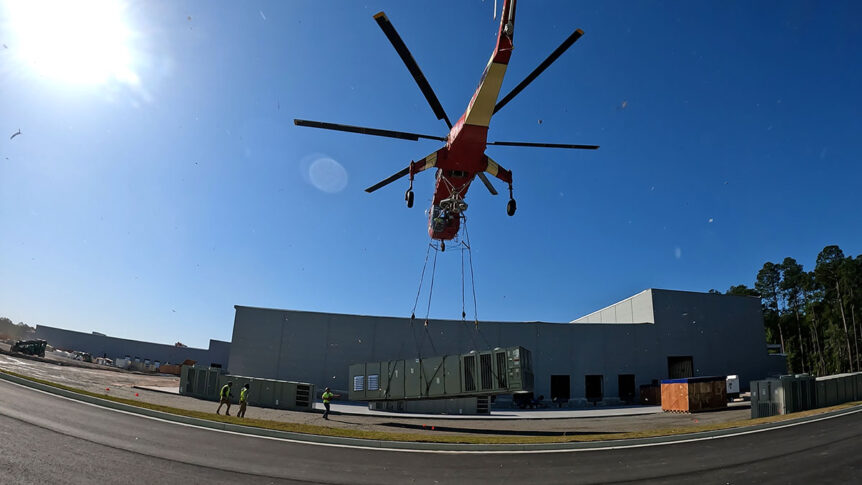
The Sikorsky S-64 Skycrane is a purpose-built heavy lift helicopter engineered for external load work. Its open-frame, center-spine layout is designed around the load, improving visibility and supporting repeatable precision placement on complex job sites.
Table of Contents
- S-64 Skycrane at a Glance
- History and Design Overview
- Key Features That Define the Skycrane
- Specifications
- Understanding Performance Variance
- Operational Capabilities
- Applications
- FAQ: Sikorsky S-64 Skycrane
- When the Skycrane Makes Economic Sense
- S-64 Skycrane Projects Executed by Fair Lifts
- Talk With a Heavy Lift Project Manager
S-64 Skycrane at a Glance
- Role: Dedicated flying crane for external lifts
- First flight: May 9, 1962
- Lift class: Commonly cited around 20,000 lb external, with allowable hook load dependent on conditions
- Power: Twin-engine platform using the Pratt & Whitney JFTD-12 family across major commercial variants
- Best fit: Heavy components, constrained access, tight schedules, and remote or sensitive terrain
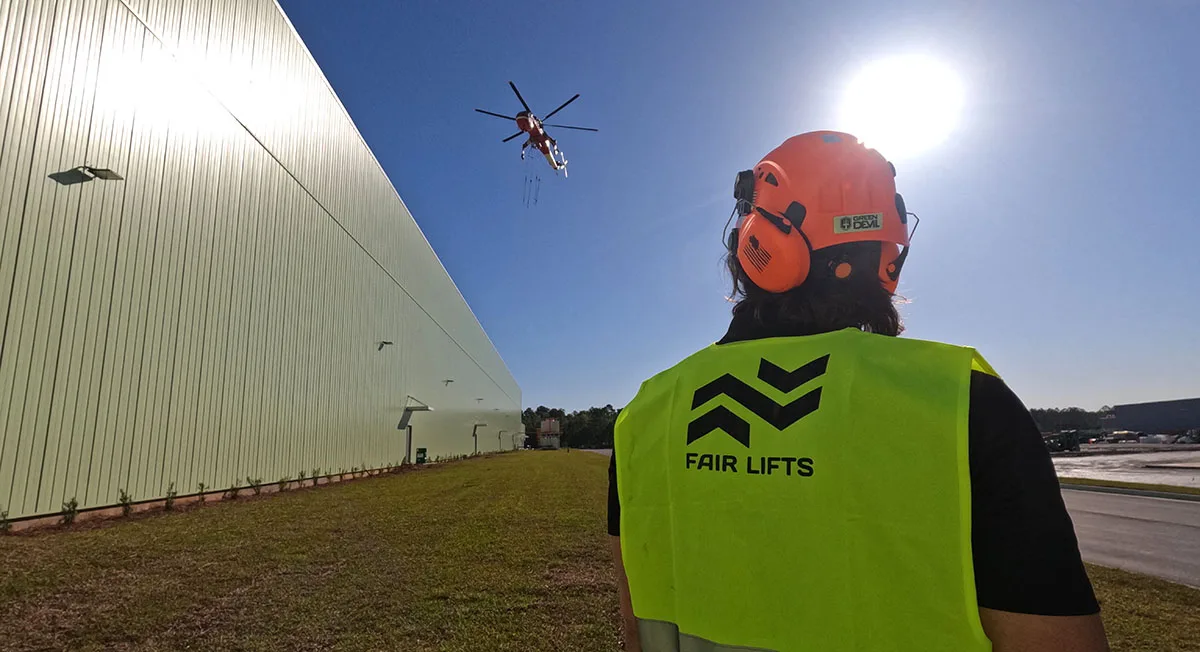
A Fair Lifts project manager monitors a Sikorsky S-64 Skycrane heavy lift operation on an active job site.
History and Design Overview
The Sikorsky S-64 Skycrane, developed by Sikorsky Aircraft, is a purpose-built flying crane designed to move large external loads with precision. Unlike traditional helicopters, it does not carry passengers or internal cargo. Instead, Sikorsky developed the concept in the late 1950s and early 1960s to meet lift demands that conventional utility helicopters could not handle due to limited visibility, cabin constraints, and rigging challenges.
The S-64 completed its first flight on May 9, 1962. Early variants proved that a helicopter designed around the load could significantly improve lifting capability and placement control. This approach helped define the modern heavy lift helicopter category and set a new standard for what a true flying crane can achieve on industrial and infrastructure projects.
The Skycrane’s distinctive appearance is directly tied to its performance. Sikorsky engineers built the airframe around the lift mission, using an open-frame, center-spine design that keeps the load area clear. The landing gear layout and unobstructed underside improve both rigging access and visibility to the load. In real-world operations, this leads to more precise placements, faster lift cycles, and fewer corrections on complex picks.
Over time, the Skycrane became closely associated with heavy lift industrial operations and aerial firefighting. Commercial operators continue to keep these aircraft in service through strict maintenance programs and mission-specific configurations. In active fleets, equipment, allowable loads, and published performance figures can vary by variant and installed systems, including specialized lift hardware and firefighting tank kits.
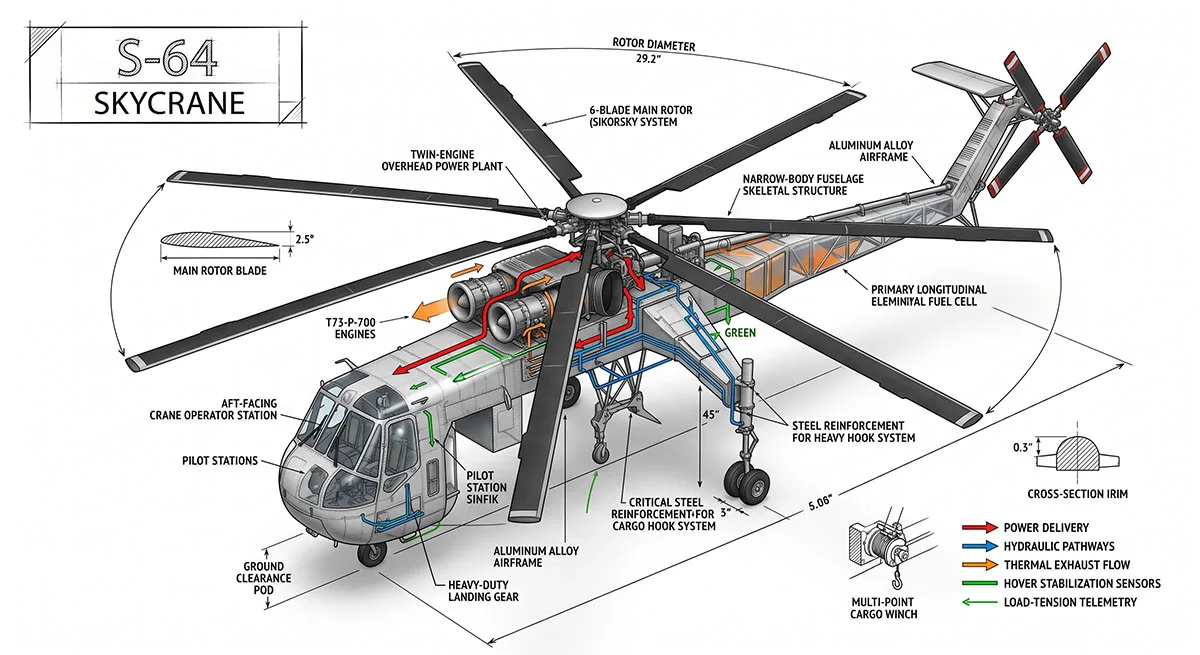
A technical view of the S-64 Skycrane.
Key Features That Define the Skycrane
- External lift-first airframe: Built around load visibility and precise placement, allowing crews to position heavy components with accuracy and consistency.
- High lift capacity: Commonly cited around 20,000 lb, with allowable hook loads varying based on density altitude, temperature, fuel load, and mission conditions.
- Twin-engine power: Powered by the Pratt & Whitney JFTD-12 engine family across major commercial variants, supporting reliable heavy lift operations.
- Flexible configurations: Offered in multiple commercial variants with differences in max gross weight, external cargo ratings, speed, and range.
- Mission-focused design: Well suited for heavy construction, industrial lifting, utility work, and time-sensitive logistics where precision and efficiency are critical.
Specifications
The Skycrane family includes multiple variants. The table below summarizes commonly referenced configurations that are most relevant to Fair Lifts operations. Values can vary by aircraft build standard, installed equipment, mission configuration, and how each source defines reserves, payload, and operating assumptions. Where there is known variance, it is called out directly.
| Specification | S-64E (Commercial) | S-64B (Commonly referenced) |
|---|---|---|
| Max gross weight | 42,000 lb | 42,000 lb (some sources for related B-variant data cite higher, configuration dependent) |
| Empty weight | 19,500 lb (varies by configuration) | 19,800 lb (typical), varies by configuration |
| Max external cargo | 20,000 lb | 20,000 lb (commonly cited) |
| Powerplant | 2× Pratt & Whitney JFTD12A-4A class engines (T73 family) | 2× Pratt & Whitney JFTD12A-4A or -5A class engines (variant dependent) |
| Cruising speed | ~105 mph (published cruise, typical project cruise varies with load and conditions) | ~105 mph (some sources cite ~120 mph for related B-variant data, configuration dependent) |
| Range | ~265 to 274 miles with reserves (converted from 230 to 238 nm, source variance) | ~190 to 230 miles (source variance, reserve assumptions vary) |
| Fuselage length | 70 ft | 70 ft |
| Overall length | 88 ft 6 in | 88 ft 6 in |
| Overall height | 25 ft 5 in | 25 ft 5 in |
| Main rotor diameter | 72 ft (commonly published figure, can vary slightly by documentation and configuration) | |
| Crew | 2 to 3 (varies by mission, procedures, and configuration) | |
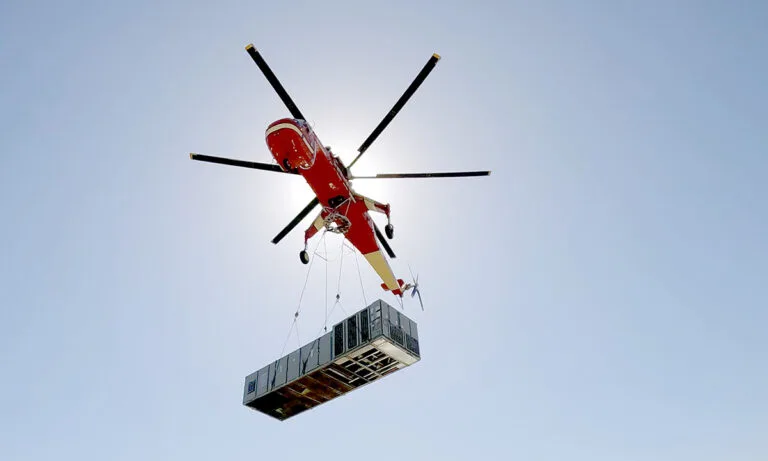
Sikorsky S-64E helicopter in flight, transporting a large RTU to its placement via longline.
Understanding Performance Variance
Skycrane performance is not a fixed number. Allowable hook loads, lift radius, and cycle times all change based on real-world conditions. These include density altitude, temperature, fuel load, wind, terrain, and how conservative the operating margins are for the mission.
Range figures can also vary. Published numbers often assume different fuel reserves and cruise profiles, which can lead to differences between sources.
The most accurate way to evaluate the S-64 is to match the aircraft to your specific site conditions and lift plan, rather than relying on a single published figure.
Operational Capabilities
External lift performance that changes the project plan
The Skycrane is built to move external loads efficiently. This matters because many project delays come from ground logistics. Common issues include staging constraints, right-of-way access, road construction, crane setup and teardown, and limits on when and where heavy components can be moved.
When an S-64 is the right fit, it can:
- Reduce handling steps: Lift materials directly to the work area instead of relying on multiple transfers.
- Limit site impact: Avoid temporary roads, crane pads, and repeated hauling where practical.
- Improve placement accuracy: Set heavy components precisely, increasing installation efficiency and reducing rework.
How Skycrane lifts are planned
Successful heavy lift operations depend on planning. The aircraft is only one part of the system. The full operation also includes rigging, ground crew coordination, clear communication, and defined go or no-go criteria.
For consistent results, lift planning typically includes:
- Load definition: Verified weight, connection points, and total rigging hardware included.
- Pick and set geometry: Required hover height, obstructions, and swing clearance along the full flight path.
- Rigging approach: Sling lengths, attachment methods, taglines, and placement strategy selected for stability and control.
- Environmental margins: Wind limits, density altitude, visibility, and site-specific turbulence or rotor wash considerations.
- Ground safety controls: Exclusion zones, spotter roles, radio communication, and contingency procedures.
Because allowable hook loads change with conditions, lift plans should always be based on site-specific assumptions. What works at sea level on a cool day may not be possible at higher elevations or in hotter conditions.
Applications
The S-64 Skycrane heavy lift helicopter is most valuable when loads are heavy, access is limited, and timing is critical. In these situations, traditional ground methods often add complexity, delay, or cost.
As a result, the Skycrane is commonly used across several demanding applications:
- Utility and transmission work: For example, placing towers, structures, and major components in areas where staging space is limited.
- Construction and industrial lifts: In addition, installing HVAC systems, modular components, and heavy mechanical units with precision.
- Energy and infrastructure projects: Similarly, supporting work where right-of-way constraints or terrain make ground logistics slow or impractical.
- Emergency logistics and response: Finally, moving critical equipment quickly into hard-to-reach or time-sensitive locations.
FAQ: Sikorsky S-64 Skycrane
How much can an S-64 Skycrane lift?
The Skycrane is commonly published in the 20,000 lb external load class, and some configurations list higher ratings. Actual allowable hook load depends on density altitude, temperature, fuel load, distance, wind, and the safety margins built into the lift plan.
Why does the Skycrane have an open-frame fuselage?
The open-frame design is intentional. It keeps the load area clear, improves rigging access, and increases visibility to the load. This added visibility allows for more precise placement and is a key reason the Skycrane is used as a true flying crane rather than a general utility helicopter.
What makes Skycrane performance numbers vary?
Performance figures can vary because different sources use different assumptions. These may include fuel load, reserve requirements, cruise profiles, and installed equipment. Even reliable sources may be referencing different configurations or operating conditions.
When does it make sense to use a heavy lift helicopter instead of a ground crane?
A heavy-lift helicopter is often the best choice when ground-based constraints increase cost, time, or risk. This includes remote or hard-to-access sites, congested urban areas, environmentally sensitive locations, or projects with tight schedules. The key advantage is direct-to-point placement, which removes the need for access roads, large crane mobilizations, and multi-stage material handling.
At Fair Lifts, we use a simple rule of thumb. If your project requires a crane larger than 100 tons, it is worth evaluating a helicopter solution.
What information is needed to plan an S-64 lift?
Accurate lift planning starts with verified load weight, including rigging. It also requires pick and set geometry, lift radius, route constraints, site elevation, and expected temperatures. A complete plan should include ground safety measures such as exclusion zones, communication protocols, and contingency procedures.
When the Skycrane Makes Economic Sense
A heavy lift helicopter is not selected on aircraft hourly cost alone. The Skycrane becomes the best-value option when it replaces weeks of road building, crane mobilization, staging delays, or complex multi-step handling that introduces safety risk and schedule exposure.
It is often the right fit when you need one or more of the following:
- Direct-to-point placement that avoids intermediate staging and double-handling.
- Short schedule windows where mobilizing ground cranes or building access would be slower than flying the lifts.
- Remote or sensitive terrain where minimizing disturbance, traffic, or heavy equipment movement matters.
- Complex picks where precision placement reduces installation time and rework.
S-64 Skycrane Projects Executed by Fair Lifts
Fair Lifts has deployed the Sikorsky S-64 Skycrane on complex projects where heavy components, limited access, and tight schedules demanded precision aerial lift solutions. Explore a few real-world S-64 jobs below.
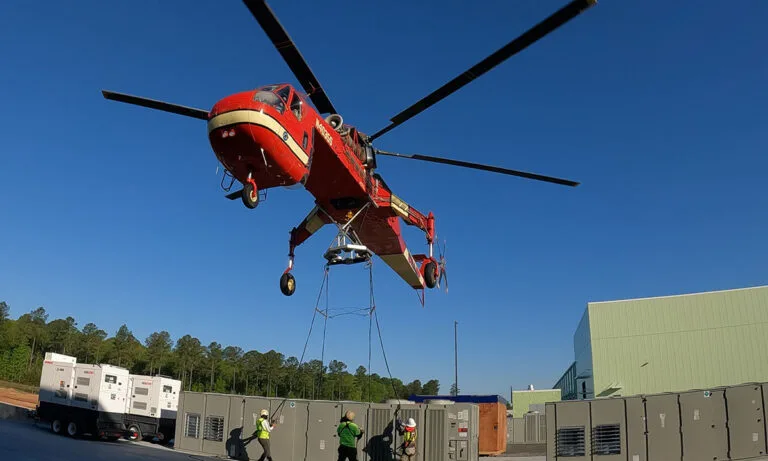
Featured S-64 lift: Rooftop HVAC placement on an active job site. Click to view an S-64 project case study.
- Skycrane vs. Rocky Island, Drill Rig Heavy Lift & Crew Transport
- HVAC Helicopter Lift Project for Four Winds Casino
- Precision Airlift Solutions at the Archlines Seoyon E-Hwa Plant
Talk With a Heavy Lift Project Manager
If your project involves heavy components, difficult terrain, limited access, or a schedule that cannot slip, the Sikorsky S-64 Skycrane solves these challenges directly.
Talk with a Fair Lifts Project Manager to review your lift requirements, site constraints, and timeline. Our team will develop a flight and rigging plan that moves faster, reduces ground complexity, and lowers overall project cost. Call 1-800-318-8940 or contact our team to start planning your Skycrane heavy lift operation.