

The Kamov Ka-60, also known as the Kasatka or “Killer Whale,” was developed as a Russian medium transport helicopter for military and utility missions. However, unlike many earlier Kamov helicopters that rely on coaxial rotor systems, the Ka-60 uses a conventional single main rotor with a shrouded tail rotor, marking a clear shift in the company’s design direction.
Historical Background
Development of the Ka-60 began in the 1980s as Kamov worked to modernize its utility helicopter lineup. The goal was to create a faster, more efficient aircraft capable of supporting a wide range of missions, from troop transport to logistics and medical evacuation.
The helicopter was publicly unveiled in 1997 and shortly after, completed its first flight in 1998. Early development targets included a maximum takeoff weight of about 6,500 kg and a projected range near 700 km, positioning it as a capable medium transport platform.
Design and Mission Role
The Ka-60 was designed as a flexible, multirole helicopter. Its cabin can be configured for troop transport, casualty evacuation, cargo delivery, or mission-specific equipment. It also supports external sling load operations, allowing it to move underslung cargo in challenging environments.
In addition, from a design standpoint, the aircraft incorporates composite materials, redundant onboard systems, and infrared signature reduction features to improve survivability. Its side-by-side cockpit layout supports both pilot workload management and mission coordination, particularly in reconnaissance or support roles.
Kamov Ka-60 Performance
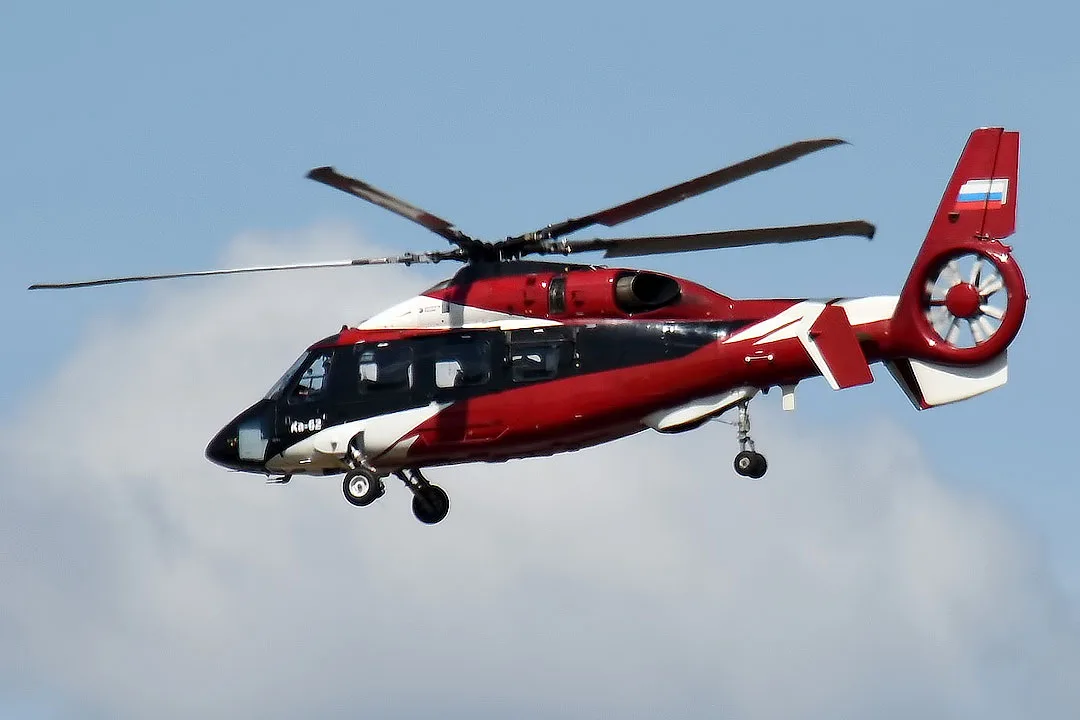
Ka-62 serial configuration prototype | Photo: Anna Zvereva
Performance figures vary slightly depending on the source, but they consistently place the Ka-60 within the medium utility class. Reported maximum speeds reach approximately 186 to 191 mph, with operational ranges between 388 and 652 miles depending on configuration and fuel capacity.
In addition to speed and range, additional data points include a cruise speed of about 148 knots and a service ceiling approaching 16,900 to 18,700 feet, reinforcing its role as a capable and versatile transport platform.
Lifting Capacity and Payload
The Ka-60 does not serve as a heavy lift helicopter, but it still delivers strong payload performance for its class. It carries about 4,409 pounds internally and lifts up to roughly 6,062 pounds on an external sling.
This capability lets crews transport troops, palletized cargo, medical equipment, and underslung loads in active field conditions. Consistent payload figures across technical sources confirm its role as a practical utility platform rather than a dedicated heavy lift solution.
Key Specifications
| Specification | Kamov Ka-60 |
|---|---|
| Type | Medium transport and utility helicopter |
| Crew | 2 |
| Engines | 2 x RD-600V turboshaft engines |
| Maximum Speed | About 186 to 191 mph |
| Range | About 388 to 652 miles |
| Service Ceiling | Up to about 18,700 feet |
| Maximum Takeoff Weight | About 14,330 pounds |
| Maximum Internal Payload | About 4,409 pounds |
| Maximum External Payload | Up to about 6,062 pounds |
Ka-60 vs Ka-62
The Ka-62 represents the civilian evolution of the Ka-60 platform. While the Ka-60 focused on military applications, the Ka-62 was redesigned for commercial transport, offshore operations, and passenger use. Updates include revised avionics, increased use of composite materials, and a more modern cabin layout.
Why the Ka-60 Still Matters
The Kamov Ka-60 stands out because it reflects a departure from the company’s traditional coaxial rotor designs. It shows how Kamov adapted to broader operational requirements by developing a more conventional helicopter platform with wider mission compatibility.
Although it did not see large-scale production, the Ka-60 remains relevant as a case study in medium helicopter design. Its balance of payload, speed, and flexibility influenced later aircraft such as the Ka-62 and continues to provide insight into modern utility helicopter development.