
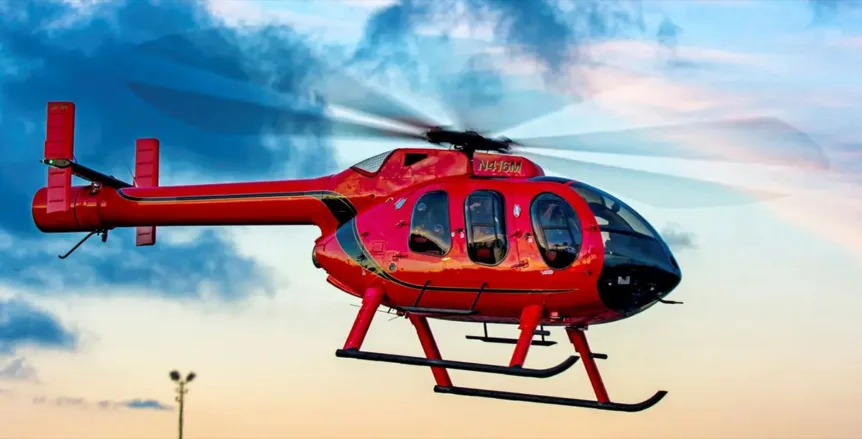
NOTAR technology, standing for “No Tail Rotor”, represents one of the most distinctive innovations in helicopter aviation. This system departs fundamentally from the conventional tail rotor design, offering meaningful improvements in safety, noise reduction, and operational flexibility. Below, we examine how NOTAR works, the advantages it delivers, the challenges it faces, and the helicopters that have used it.
Understanding the Mechanics of NOTAR Technology
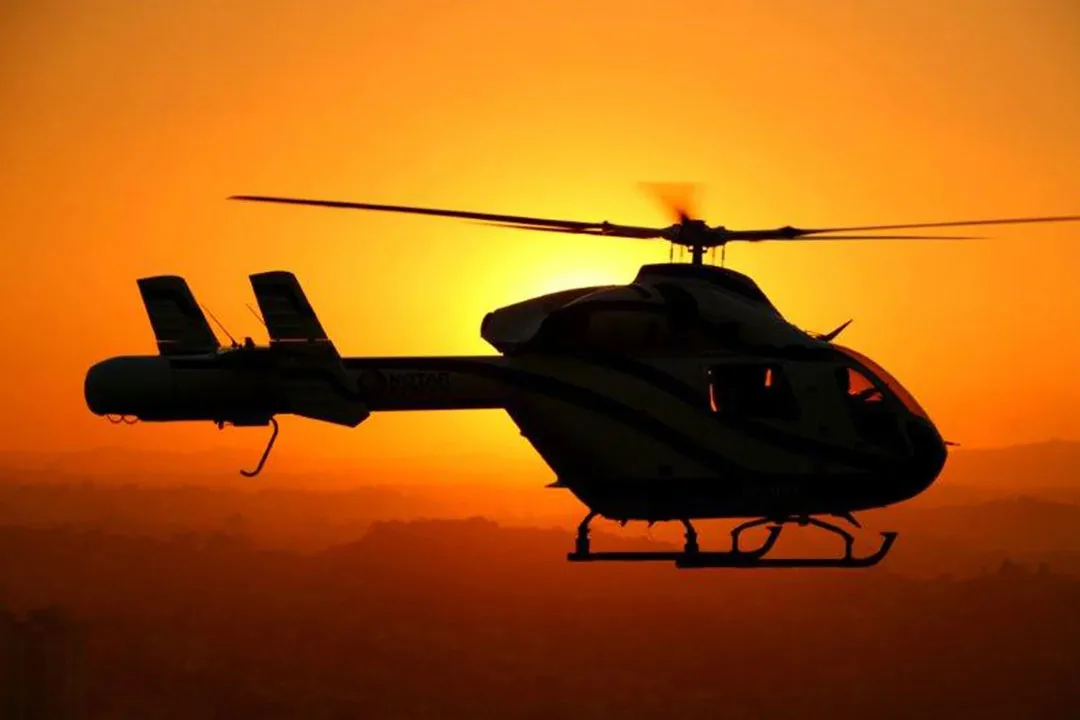
MD 902 NOTAR Helicopter | Photo: mdhelicopters.com
At the heart of NOTAR technology lies the principle of differential pressure. The system employs a variable pitch fan within the tail boom to draw air in and expel it through two primary outlets: the direct jet thruster and the Coandă slots. The direct jet thruster provides immediate yaw control, similar to the tail rotor’s function, while the Coandă slots along the tail boom’s right side create a sheet of air that adheres to the boom’s contour. This airflow, following the Coandă effect, generates a differential pressure that produces a counter-torque, negating the main rotor’s torque effect.
Components of the NOTAR System
The NOTAR system comprises several key components that work in unison to provide stable and efficient anti-torque control:
- Variable Pitch Fan: Located inside the tail boom, it generates the airflow required for the NOTAR system.
- Coandă Slots: These slots release air along the tail boom’s surface, utilizing the Coandă effect for anti-torque control.
- Direct Jet Thruster: Provides directional control and supplements the anti-torque effect.
- Vertical Stabilizers: These surfaces contribute to directional stability and augment the NOTAR system’s effectiveness.
Advantages of NOTAR Technology
NOTAR technology offers several meaningful advantages for helicopter operations:
- Enhanced Safety: By eliminating the tail rotor, NOTAR reduces the risk of accidents involving ground personnel and improves safety in confined spaces and on offshore platforms.
- Reduced Noise Levels: NOTAR helicopters can achieve up to a 50% reduction in external noise levels compared to conventional counterparts, making them well suited for urban and noise-sensitive operations.
- Improved Control: The aerodynamic design of NOTAR provides superior handling and stability, particularly in crosswind conditions and low-speed maneuvering.
- Maintenance Considerations: With fewer exposed moving parts than a traditional tail rotor assembly, NOTAR systems can offer reduced maintenance demands, though the internal fan and associated components still require regular attention.
Challenges and Limitations
Despite its advantages, NOTAR technology is not without challenges. The complexity of the system leads to higher initial costs and requires specialized training for both pilots and maintenance crews. The performance benefits can also vary based on aircraft design and operating conditions. Critically, NOTAR technology has seen limited adoption across the broader industry, with only a handful of production models ever built around it.
Examples of NOTAR-Equipped Helicopters
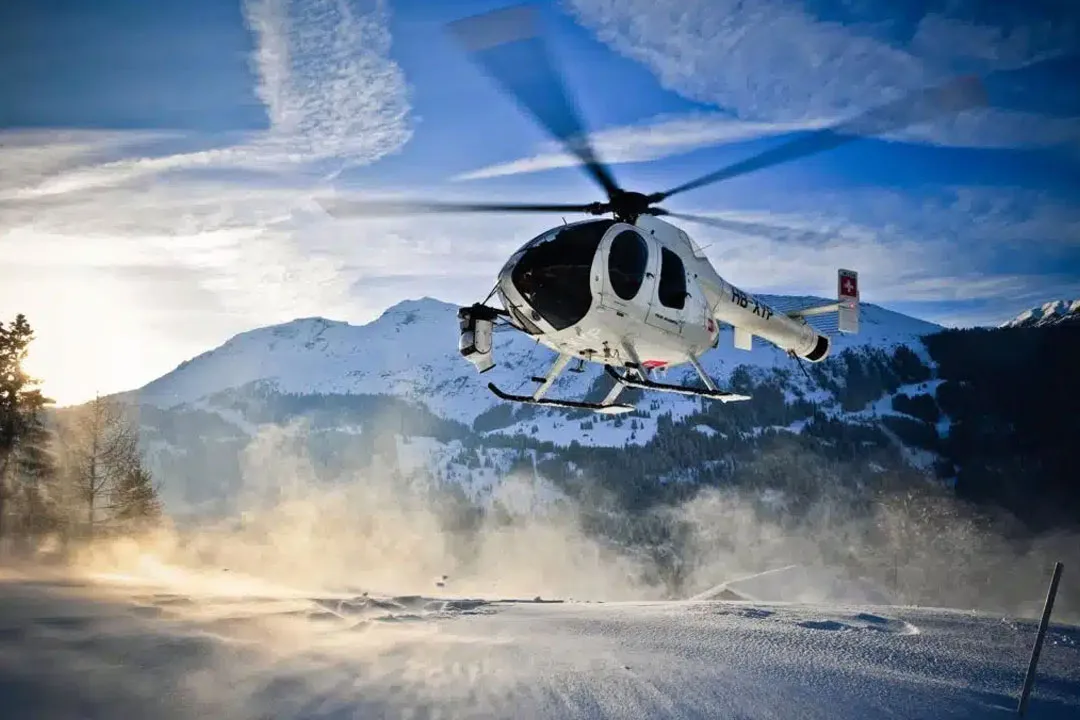
MD 520N Helicopter | Photo: mdhelicopters.com
Three helicopter models from MD Helicopters have incorporated NOTAR technology. It is worth noting that Boeing acquired the former McDonnell Douglas civil helicopter lines following their 1997 merger, retaining the design rights to the NOTAR system before MD Helicopters acquired those lines in 1999.
- MD 520N: A light single-engine utility helicopter known for its agility and low noise footprint, the MD 520N was the first production helicopter to use the NOTAR system, receiving certification in September 1991. It remains in service with a range of operators worldwide in law enforcement, utility, and observation roles. While MD Helicopters continues to support the in-service fleet, new production of the type is not currently planned.
- MD 600N: Building on the MD 500 series with a stretched fuselage and greater capacity, the MD 600N is an eight-seat development of the MD 520N, certified in May 1997. It shares the same NOTAR anti-torque system in a larger airframe and has been used for executive transport, law enforcement, and utility operations. Like the 520N, it is not currently in production.
- MD 902 Explorer: This twin-engine helicopter was designed from the outset to incorporate NOTAR technology, making it the first MD model where NOTAR was part of the original design rather than a retrofit. It has been widely used in law enforcement, medical evacuation, and offshore operations. However, according to MD Helicopters CEO Brad Pedersen, the MD 902 production line has been dormant for eight to ten years, and restarting it would require substantial investment, with no firm plan currently in place.
The Current State and Future of NOTAR
The outlook for NOTAR technology is more uncertain today than it appeared a decade ago. MD Helicopters, the only manufacturer to have produced NOTAR-equipped aircraft commercially, is focused on rebuilding its production capacity around the MD 530F and related conventional single-engine models after emerging from bankruptcy in 2022. MD Helicopters has qualified new composite suppliers to manufacture tail booms and empennages for the MD 520N, MD 600N, and MD 902 in order to support the existing in-service fleet, but new production aircraft are not currently planned.
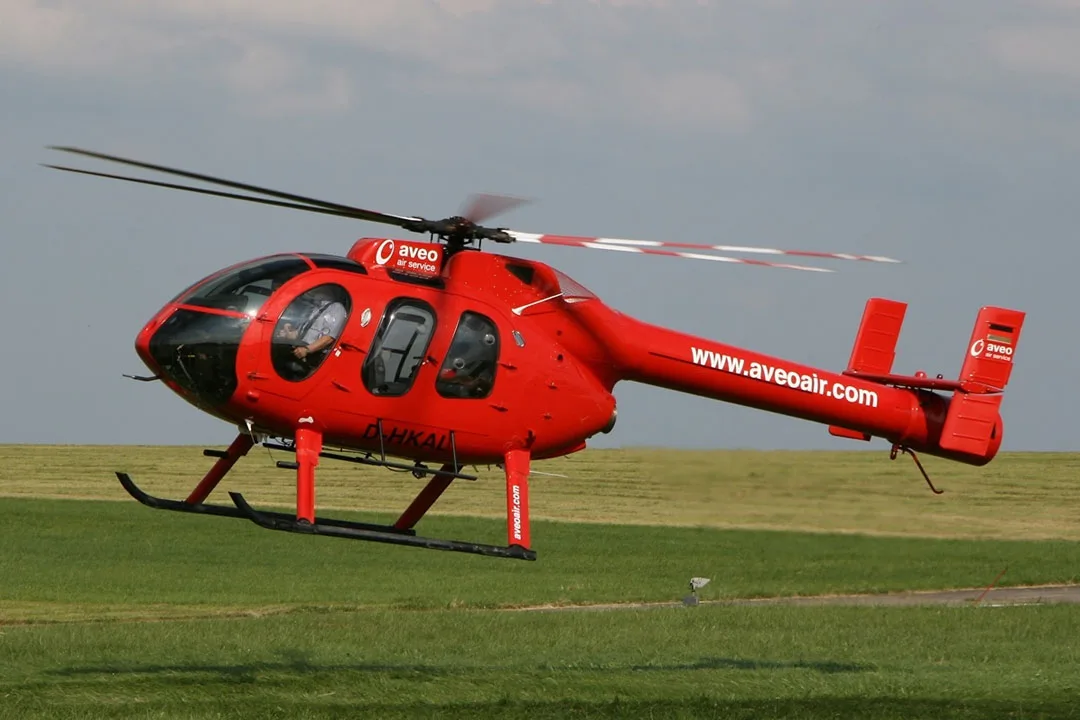
MD 600N Helicopter | Photo: Peter Bakema
That said, demand for the technology has not disappeared. MD Helicopters has acknowledged significant customer interest in new-build NOTAR aircraft, particularly the 902 Explorer, with operators citing the type’s low-noise signature and ground safety advantages. Whether a path exists to renewed production remains an open question. For now, the focus is on supporting the hundreds of NOTAR-equipped aircraft already flying around the world.
A Lasting Contribution to Rotary-Wing Design
NOTAR technology represents a genuine achievement in helicopter engineering, demonstrating that effective anti-torque control is possible without a conventional tail rotor. Its adoption across multiple MD Helicopters models proved the concept in real-world operations spanning law enforcement, medical evacuation, and utility work. While the technology’s commercial future remains uncertain, the safety and noise-reduction principles behind NOTAR continue to influence how engineers and operators think about helicopter design.