
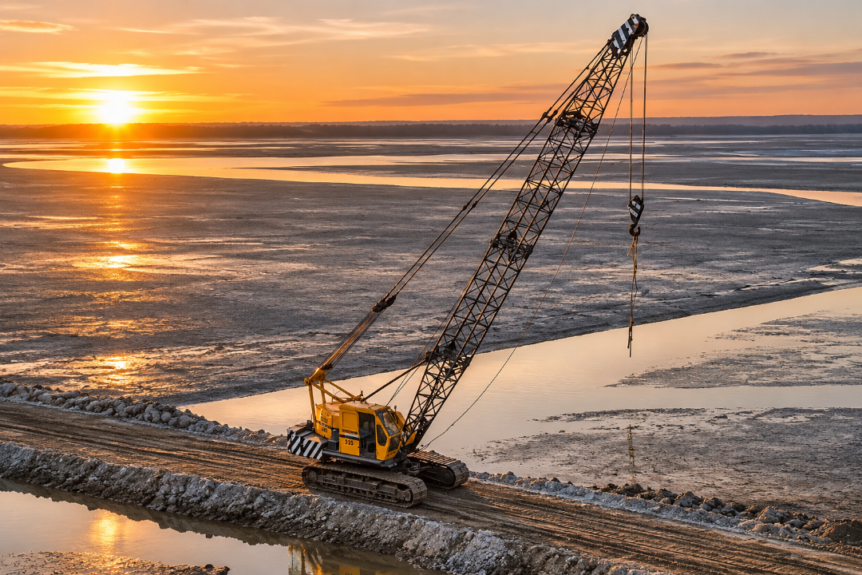
A crawler crane may be the right choice when a construction project requires substantial lifting capacity, repeated picks or equipment that can move around a suitable jobsite on tracks. It can also be a practical option for projects where a crane will remain in operation for an extended period.
But a crawler crane is not the answer to every difficult lift. Delivery, assembly, ground preparation, working radius and site access can add significant cost and time.
The decision should start with the work the crane needs to perform and the conditions under which it must operate. A sound ground crane strategy accounts for lifting requirements, site access, equipment capabilities and the overall demands of the project.
When Is a Crawler Crane the Right Choice?
Crawler cranes are commonly considered for heavy construction, industrial work, infrastructure projects and other applications requiring substantial lifting capacity. Their tracked undercarriage can help distribute machine weight over a larger contact area than many wheeled configurations.
A crawler crane may be worth evaluating when:
- The project requires repeated heavy lifts in a defined work area.
- The crane must move around the site on tracks within its permitted operating configuration.
- The lifting plan calls for a machine with the necessary capacity and working radius.
- The crane will remain on site long enough to justify delivery and assembly costs.
- The site can accommodate the machine, its assembly area and the required support conditions.
5 Factors to Consider When Choosing a Crawler Crane
These factors help narrow the options, but they do not replace a review of the specific crane’s operating requirements and load charts.
1. The Project Involves Heavy or Large Loads
Large structural components, industrial equipment and other substantial loads may require a crawler crane with the appropriate capacity and configuration.
The important question is whether the crane can handle the load at the required working radius and height. A machine’s maximum rated capacity does not establish its capacity at every boom length or lifting position.
Before selecting a crane, document the load weights and dimensions, lifting points, rigging requirements, pick locations and set-down locations. Determine how far the load must travel and whether the crane needs to reposition between picks.
For projects involving multiple lifts, evaluate the entire sequence rather than selecting equipment for the heaviest pick alone.
A crane that can handle the largest load may not be the most efficient choice for every other lift on the schedule.
2. Ground Conditions Favor Tracked Equipment
Crawler cranes can be useful on suitable construction surfaces where tracked mobility supports the work. However, their tracks do not make them suitable for every soft, uneven or unstable site.
Ground conditions must be evaluated for the crane’s actual loads and configuration. Soil strength, slopes, drainage, underground utilities, excavations and recently disturbed ground can affect stability and support requirements.
Depending on the project, preparation may include engineered mats, ground improvements, access-road construction or designated travel paths.
Mobile cranes have their own ground-support requirements, particularly around outriggers. Compare the support demands of the specific machines rather than assuming that tracks automatically make a crawler crane the safer or less expensive option.
The same principle applies when comparing other crane types. For example, projects where a tower crane may also be an option, additional project requirements may influence that decision.
3. The Crane Will Be Needed for an Extended Period
Crawler cranes can make sense when a project requires repeated lifting over days or weeks, depending on the equipment and job requirements.
Keeping a crane in one work area may reduce the need to repeatedly mobilize different machines. Track mobility may also help the crane reach multiple working positions when the site layout permits it.
However, the economics depend on the full duration and scope of work. Delivery, specialized transport, assembly, disassembly and staging can add substantial upfront costs. A crawler crane may be difficult to justify for a short lifting window or a small number of picks.
Estimate the total cost over the planned work period, including setup, standby time, operating requirements and any changes to the construction schedule.
4. Site Logistics Allow for Delivery and Assembly
A crawler crane needs more than a suitable lifting position. Larger machines may require multiple transport loads, counterweights, an assembly area and a clear route into the work zone.
Check the following before committing to the equipment:
- Access: Can transport vehicles reach the site and maneuver safely?
- Staging: Is there room for assembly, counterweights and supporting equipment?
- Ground support: Can the assembly area and operating surface meet the required conditions?
- Schedule: Can assembly and disassembly fit the project timeline?
- Surroundings: Are nearby structures, utilities, traffic routes or active operations affected?
These details can change the economics of the lift. If getting the crane into position requires extensive roadwork, dismantling or site modifications, another lifting method may be worth evaluating.
5. A Helicopter May Be More Practical for Inaccessible Lifts
A crawler crane is not always the best answer when a load must reach a remote or obstructed location. In some cases, the challenge is moving the equipment into position rather than lifting the load itself.
A helicopter lift may be worth considering for rooftop equipment installations, remote infrastructure, restricted industrial facilities or projects where ground-based access would require substantial preparation.
For example, the Mount Morris Dam project illustrates how aerial lifting can address access challenges that affect conventional equipment.
A helicopter is not automatically the less expensive choice. The comparison must account for payload, the number of picks, flight access, weather, ground support, mobilization and the time needed to prepare the site.
For a broader comparison, see Aerial Cranes vs. Traditional Cranes: A Simplified Overview.
Choose Equipment Based on the Entire Project
The decision to use a crawler crane should reflect the loads, ground conditions, project duration and logistics. When those factors favor tracked equipment, a crawler crane can be a practical solution. When access and setup dominate the cost, another crane type or an aerial lift may deserve consideration.
Fair Lifts provides ground crane services for construction and industrial lifting requirements. Evaluating access, equipment needs and the full work sequence before committing can help identify practical options and avoid unnecessary site preparation.
Discuss your project: Contact Fair Lifts to review the load requirements, site constraints and lifting approach.
Crawler Crane FAQs
What types of construction projects use crawler cranes?
Crawler cranes are used on projects that require suitable tracked equipment for heavy or repeated lifting, including some industrial, infrastructure and large-scale construction applications. The specific crane must match the load, radius and site conditions.
Are crawler cranes suitable for soft ground?
Not necessarily. Tracks distribute the machine’s weight across a contact area, but ground bearing capacity, slope and stability still need to be assessed. Ground preparation may be required.
Is a crawler crane better than a mobile crane for long projects?
It can be, particularly when repeated lifts and on-site mobility justify the delivery and assembly costs. A comparison should include the full project duration, mobilization, setup, operating requirements and equipment utilization.
When should I consider a helicopter instead of a crawler crane?
Consider a helicopter when ground access, crane assembly or site preparation creates significant constraints. The decision depends on payload, lift count, flight access, weather and total project cost.