
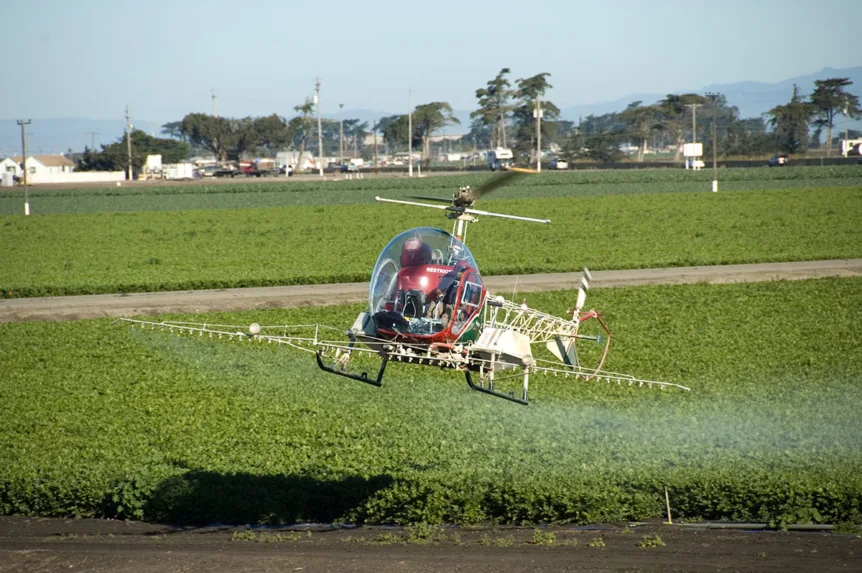
When it comes to Helicopter Aerial Agricultural Services, the choice between dry spreading vs wet spreading plays a crucial role. Both methods have their unique advantages and are suited to different types of crop treatments and farming conditions. This article delves into the specifics of each method, helping you make an informed decision for your agricultural needs.
Understanding Dry Spreading in Aerial Application
Dry spreading, also known as broadcast spreading, involves the distribution of solid granular materials, such as fertilizers and pesticides, over a large area. This method is commonly used for soil amendment products and granular pesticides that need to be distributed evenly across the field.
One of the main advantages of dry spreading is its simplicity and cost-effectiveness. The equipment required for dry spreading is typically less complex and less expensive than that used for wet spreading. Moreover, dry spreaders can cover large areas quickly, making them ideal for large-scale farming operations.
However, dry spreading also has its limitations. The distribution of materials can be affected by wind, potentially leading to uneven application. Additionally, some granular products may not be suitable for dry spreading due to their size or density.
Exploring Wet Spreading in Aerial Application
Wet spreading, on the other hand, involves the application of liquid products, such as liquid fertilizers, herbicides, and pesticides. In this method, the product is mixed with water and sprayed over the crops using a sprayer system.
Wet spreading offers a high level of precision, allowing for targeted application of treatments. This can be particularly beneficial for the application of herbicides and pesticides, where precision is key to avoiding damage to crops and non-target species. Furthermore, wet spreading allows for the application of treatments to the foliage of crops, which can enhance the effectiveness of certain products.
However, wet spreading typically requires more complex and expensive equipment compared to dry spreading. It also requires a reliable source of water, which can be a challenge in some farming conditions.
Dry Spreading vs Wet Spreading: Which is Right for You?
The choice between dry spreading and wet spreading in Helicopter Aerial Application depends on a variety of factors, including the type of crop treatment, the size and layout of your farm, and your budget.
If you’re looking for a simple and cost-effective method for distributing granular products, dry spreading may be the right choice for you. However, if precision and targeted application are your top priorities, you might want to consider wet spreading.
At Fair Lifts, we offer both dry spreading and wet spreading services as part of our Helicopter Aerial Agricultural Services. Our team of experienced pilots and agricultural specialists can help you determine the best method for your specific needs.
Enhance Your Agricultural Productivity
Whether you choose dry spreading or wet spreading, the use of helicopters for aerial application offers a host of advantages over traditional ground-based methods. From superior crop coverage to reduced soil compaction, Helicopter Aerial Agricultural Services can significantly enhance your agricultural productivity.
Contact Fair Lifts today for a free quote on your aerial application project. Let’s take your farming operations to new heights.