
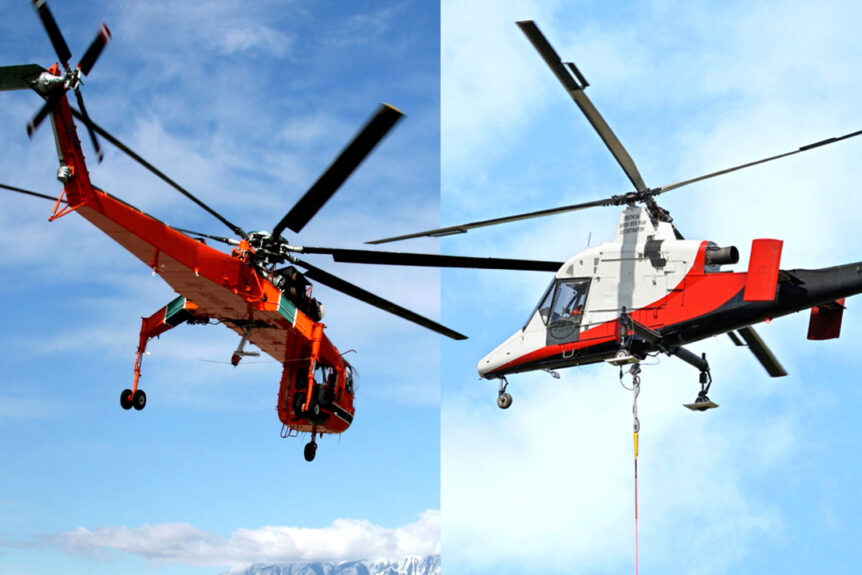
The Sikorsky S-64 Skycrane vs K-MAX comparison highlights two of the most specialized aerial work helicopters in the world, each designed for a very different mission profile. While both aircraft dominate the external load sector, their engineering philosophies, lift capacities, and operational efficiencies make them suited for entirely different types of work. Understanding these differences is critical when planning aerial construction, firefighting, or infrastructure projects.
The Sikorsky S-64 Skycrane is built for extreme heavy lift operations, capable of moving massive loads in a single flight. In contrast, the Kaman K-MAX is optimized for repetitive, high precision long-line missions where efficiency and cycle time matter more than raw lifting power. Together, they represent two ends of the aerial lifting spectrum, though each also serves distinct markets the other cannot.
Breaking Down Skycrane vs K-MAX Capabilities
Sikorsky S-64 Skycrane
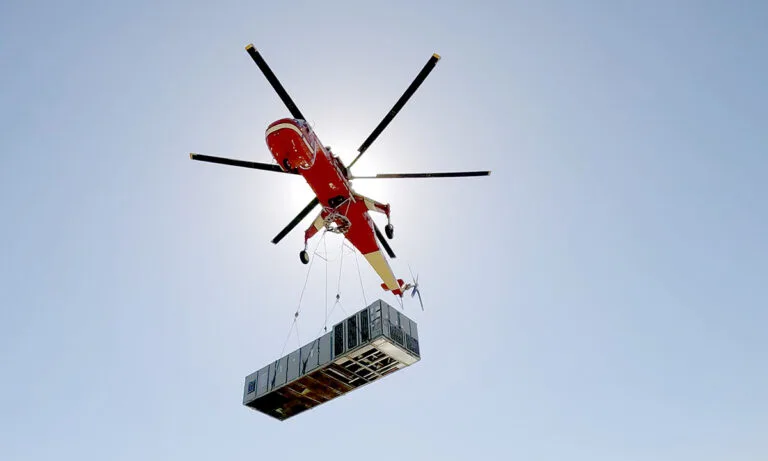
Sikorsky S-64E helicopter in flight, transporting a large RTU to its placement on the Seoyon E-Hwa plant roof via longline.
The Sikorsky S-64 Skycrane is one of the most powerful civilian heavy lift helicopters ever produced. Originally developed by Sikorsky and now supported by Erickson, the aircraft is purpose built for external load operations.
- Maximum lift capacity: Up to 25,000 lbs depending on conditions
- Engines: Twin turbine engines for redundancy and power
- Primary use: Heavy infrastructure, construction, and firefighting
- Special feature: Open skeletal frame fuselage designed to straddle and carry loads underneath
The aircraft’s skeletal design allows it to carry oversized cargo such as HVAC units, bridge sections, and utility structures. Unlike a conventional fuselage, the open frame lets the aircraft position directly over a load for pickup and placement, which is critical for precision work on rooftops and job sites. The S-64 is widely used in infrastructure projects and wildfire suppression due to its unmatched lifting strength and onboard water tank systems.
Kaman K-MAX
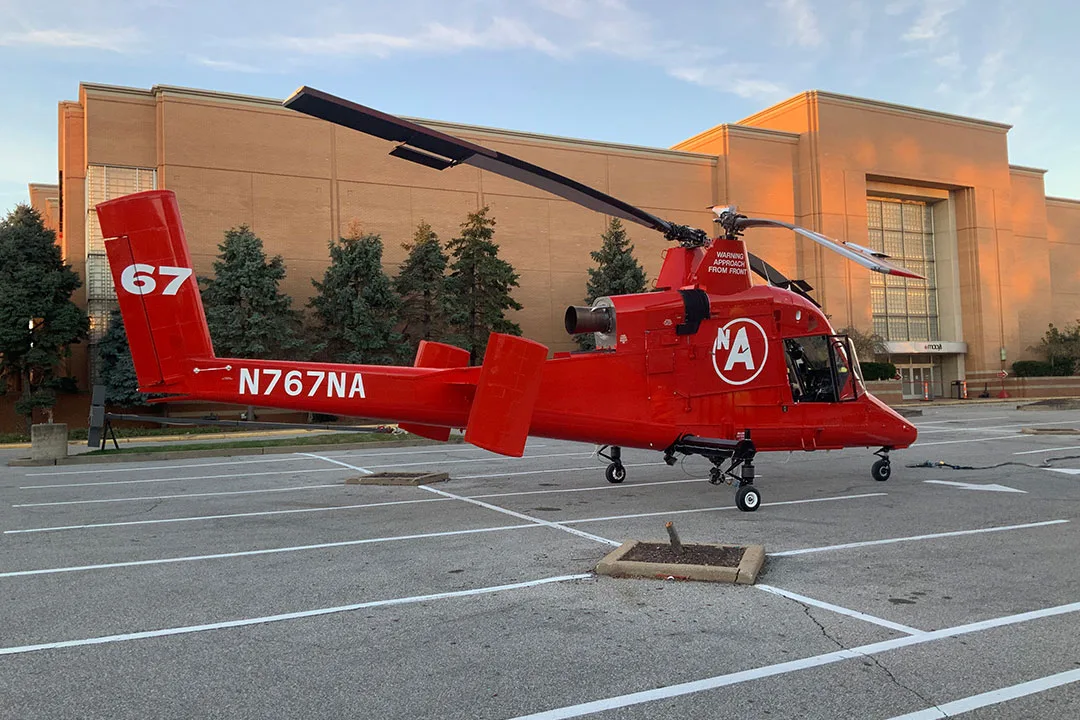
A Kaman K-MAX sits in a staging area for an HVAC lift for Macy’s.
The Kaman K-MAX takes a completely different approach. Designed specifically for external load work, it prioritizes efficiency, simplicity, and precision.
- Maximum lift capacity: 6,000 lbs
- Engines: Single turbine engine
- Primary use: Repetitive long-line missions
- Special feature: Intermeshing rotor system for stability and efficiency
The K-MAX uses a unique intermeshing rotor system, also known as a synchropter, that eliminates the need for a tail rotor entirely. Because no engine power is diverted to a tail rotor for stabilization, nearly all available power goes directly to lift. This makes the K-MAX exceptionally efficient per pound lifted, which is a major advantage when completing hundreds of lift cycles per day.
Precision and Speed: Where the K-MAX Outperforms
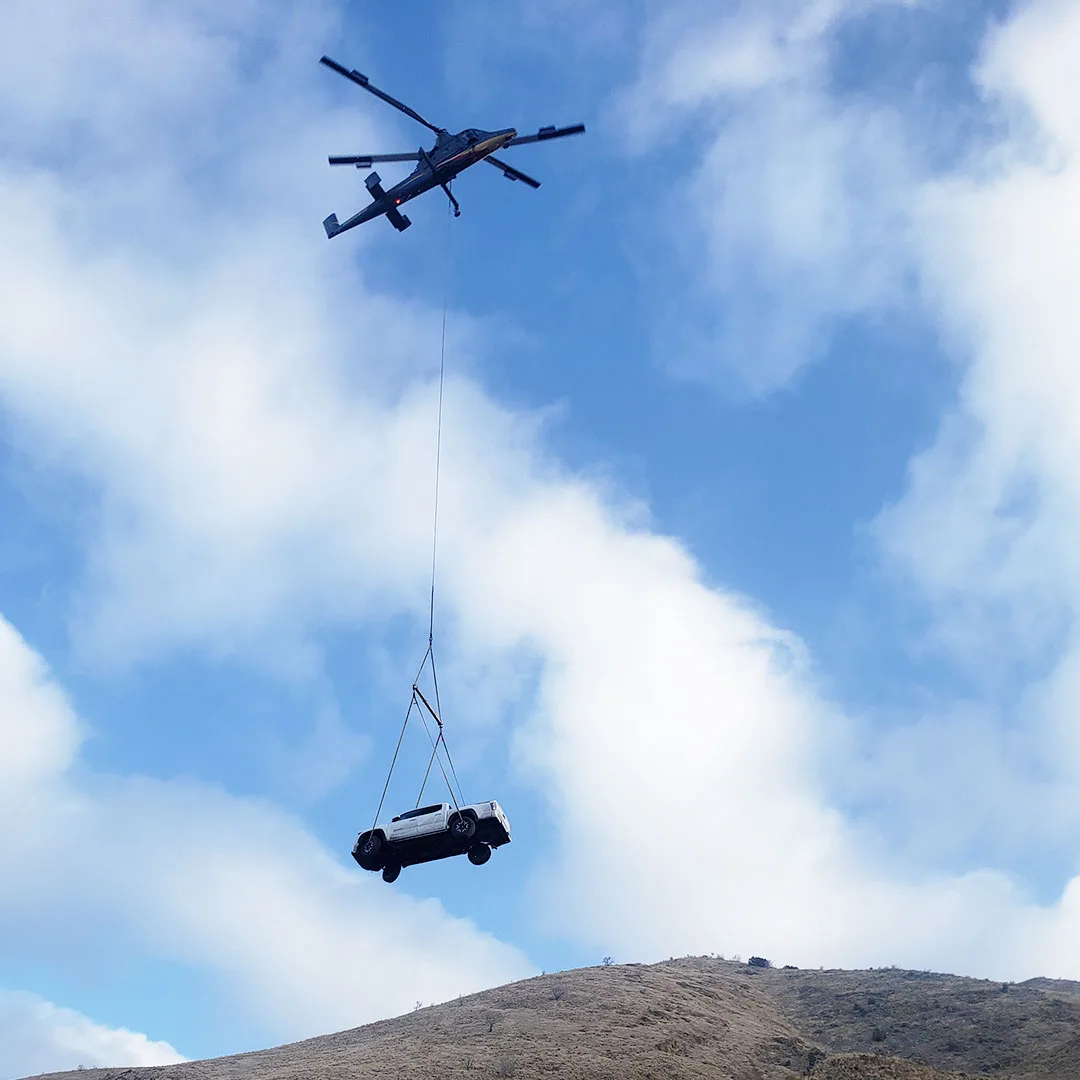
A successful aerial recovery mission using a Kaman K-MAX helicopter to extract and relocate a stranded Toyota Tacoma from a ravine.
The K-MAX is widely regarded as the most efficient helicopter for repetitive long-line missions. These operations involve lifting moderate loads repeatedly over short distances, such as logging, utility pole placement, or material transport in remote areas.
Several factors explain its dominance in this category:
- Fuel efficiency: The single engine design consumes less fuel per lift cycle
- Precision control: The intermeshing rotors provide exceptional stability during hover
- Cycle speed: Faster turnaround times between lifts increase productivity
- Lower operating costs: Reduced maintenance complexity compared to larger helicopters
Because long-line work often involves hundreds of repeated lifts per day, efficiency becomes more important than maximum capacity. The K-MAX thrives in this environment by minimizing downtime and maximizing lift frequency. Its stable hover control also improves safety when placing loads in tight or hazardous locations.
The aircraft has even been used in autonomous cargo operations for the U.S. military, demonstrating its reliability in repetitive logistics missions.
Skycrane Strength: Moving What Other Helicopters Cannot
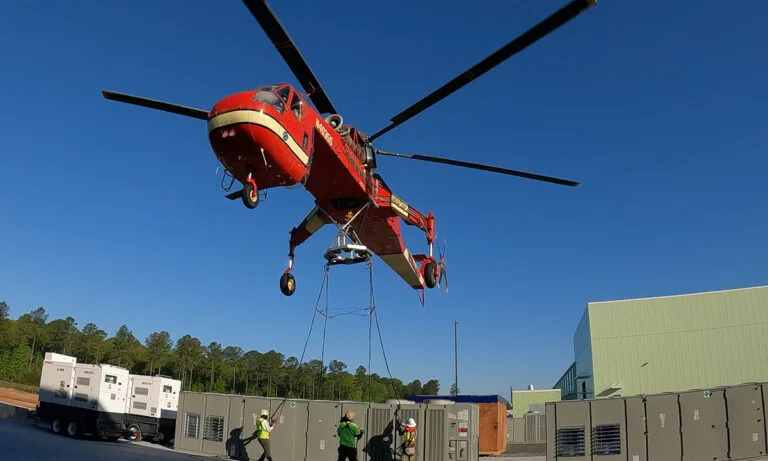
The Sikorsky S-64E helicopter hovering above a large HVAC unit prior to lifting.
While the K-MAX focuses on efficiency, the Skycrane is built for maximum lifting power. It is the preferred solution when a project requires moving extremely heavy or oversized components that cannot be broken down or staged in pieces.
Key advantages of the S-64 Skycrane include:
- Extreme lift capacity: Up to 25,000 lbs in a single operation depending on conditions
- Dual engine redundancy: Increased safety for high risk lifts
- Specialized attachments: Firefighting tanks and heavy lift rigging systems
- Reduced lift count: Fewer flights needed to complete large scale tasks
This makes the Skycrane ideal for:
- Setting large HVAC units on high rise buildings
- Installing transmission towers and infrastructure components
- Disaster recovery and debris removal
- Wildfire suppression using high capacity water tanks
The Skycrane’s open frame design provides the flight crew with direct visibility of the load from the cockpit, which improves placement precision during complex heavy lifts. Heavy external load operations typically require a crew of three, including two pilots and a load master or belly observer, to manage these high stakes lifts safely.
Skycrane vs K-MAX: Which Helicopter Fits Your Project
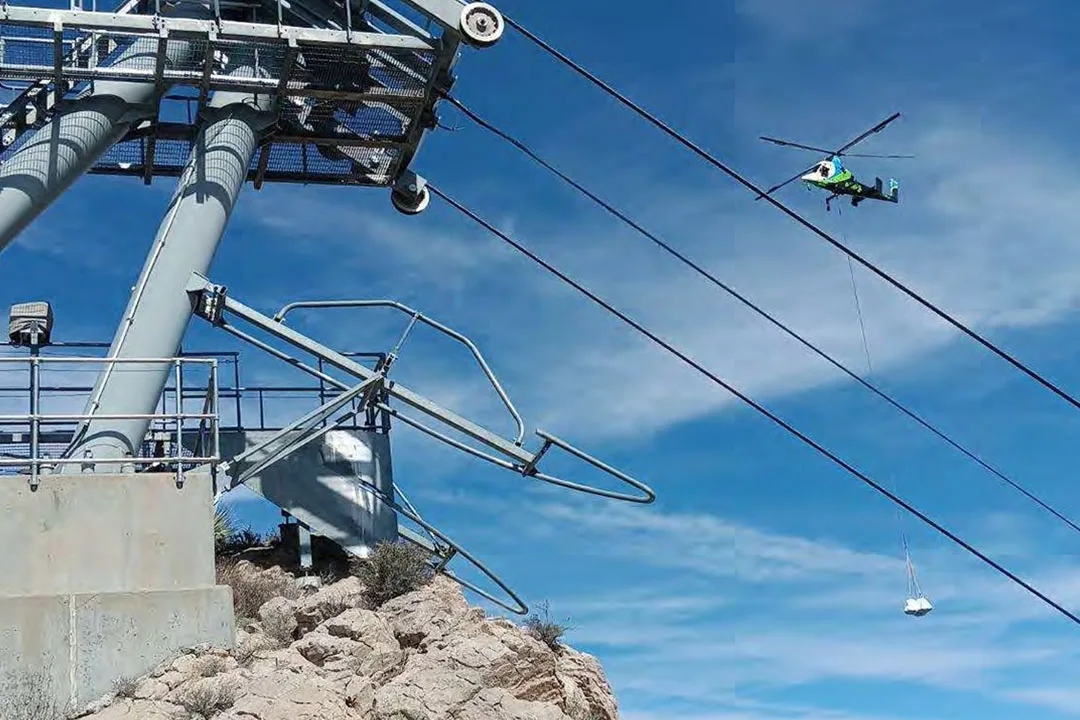
A K-MAX helicopter executes a long-line lift in a remote, mountainous location.
When evaluating the Sikorsky S-64 Skycrane vs K-MAX, the decision comes down to mission requirements rather than which aircraft is better overall. Cost is also a practical factor worth considering. The K-MAX carries lower operating costs per cycle due to its single engine and simpler maintenance profile, while the Skycrane commands a higher rate that reflects its heavy lift capability and larger crew requirement.
- Choose the K-MAX if:
- The job involves repetitive lifts under 6,000 lbs
- Efficiency and cost per cycle are critical
- Precision placement is required in tight areas
- Choose the Skycrane if:
- The load exceeds medium lift capabilities
- The project requires fewer but heavier lifts
- Infrastructure or large scale construction is involved
- Wildfire suppression or large scale disaster response is required
The Bottom Line for Lift Planning
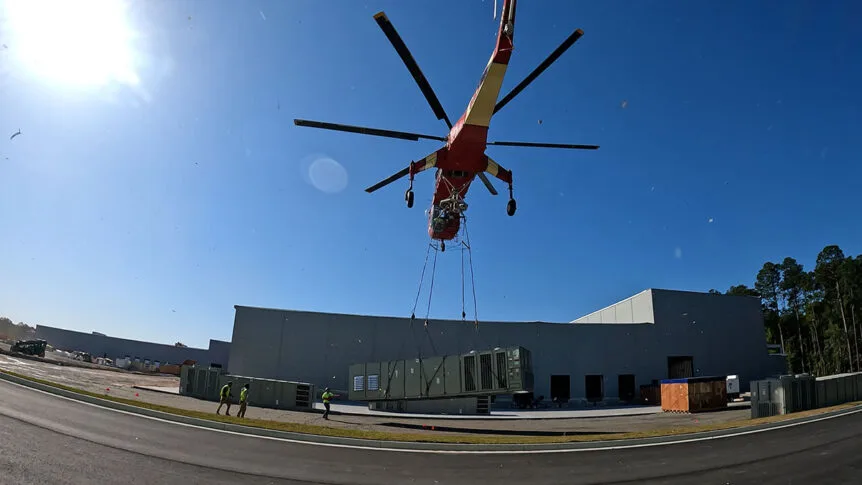
A Skycrane Helicopter begins lifting a massive rooftop HVAC unit off the ground to its destination on the roof.
The Sikorsky S-64 Skycrane vs K-MAX comparison is not about superiority but specialization. The Skycrane delivers unmatched heavy lift capability for infrastructure and large scale operations. The K-MAX delivers exceptional efficiency and precision for repetitive long-line missions. Matching the right aircraft to the right mission results in safer operations, lower costs, and more efficient project execution.
Skycrane vs K-MAX: Technical Specifications Breakdown
| Specification | Sikorsky S-64 Skycrane | Kaman K-MAX |
|---|---|---|
| Primary Role | Heavy lift and infrastructure work | Repetitive long-line lifting |
| Maximum Lift Capacity | Up to 25,000 lbs (conditions dependent) | 6,000 lbs |
| Engine Type | Twin turbine engines | Single turbine engine |
| Rotor System | Main rotor with tail rotor | Intermeshing rotors (synchropter) |
| Crew | Typically 3 (2 pilots and load master) | 1 pilot |
| Fuselage Design | Open skeletal frame for load straddling | Compact body with high visibility |
| Precision Control | High precision with direct load view | Excellent stability for long-line work |
| Fuel Efficiency | Lower due to size and twin engines | High for repeated lift cycles |
| Typical Use Cases | HVAC lifts, towers, heavy construction, firefighting | Logging, utilities, material transport |
| Key Advantage | Fewer lifts for large loads | Faster cycles for repeated lifts |