
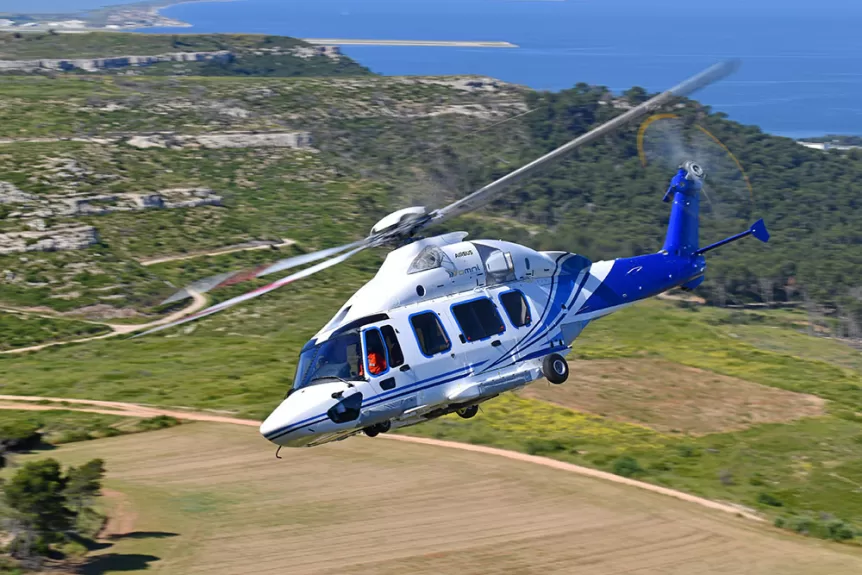
Helicopters play an essential role in missions where distance, access, and time matter. From offshore operations and emergency helicopter services to executive helicopter transport, aircraft range can determine which helicopter is practical for the mission.
However, helicopter range is not a single fixed number. Fuel configuration, payload, weather, altitude, reserve requirements, and mission profile can all affect how far an aircraft can actually travel. The helicopters below represent some of the leading civilian platforms designed for long-distance operations.
Table of Contents
- How Far Can a Helicopter Travel?
- What Determines a Helicopter’s Flight Range?
- 10. Bell 429
- 9. Leonardo AW169
- 8. Airbus H155
- 7. Sikorsky S-76
- 6. Airbus H160
- 5. Sikorsky S-92
- 4. Leonardo AW189
- 3. Airbus H225
- 2. Bell 525
- 1. Airbus H175
- Civilian Helicopter Range Comparison Chart
- Choosing the Right Helicopter for Long-Distance Missions
- When Range Matters
- Planning a Long-Distance Helicopter Mission?
- Longest-Range Civilian Helicopter FAQs
How Far Can a Helicopter Travel?
Many civilian helicopters can travel several hundred miles without refueling. Specialized medium and super-medium helicopters can travel considerably farther, with some manufacturers publishing maximum ranges exceeding 600 nautical miles under specific conditions.
Aircraft design, fuel capacity, payload, cruise speed, wind, altitude, reserve fuel requirements, and auxiliary fuel tanks all influence usable range. Operators therefore plan around the actual mission rather than relying only on a published maximum.
It is also important to distinguish between range and endurance. Range describes how far an aircraft can travel, while endurance describes how long it can remain airborne.
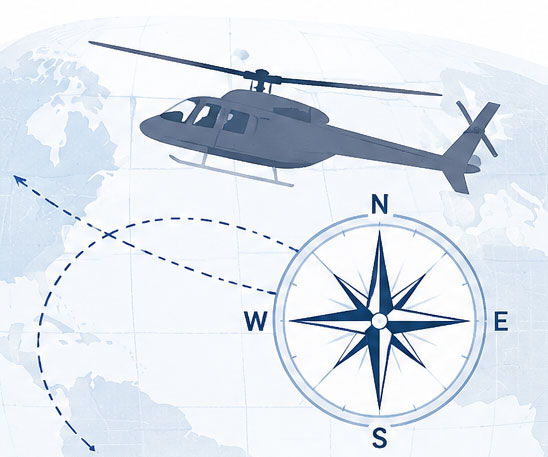
Nautical Miles vs. Statute Miles
Helicopter range is typically measured in nautical miles (nm) rather than standard U.S. statute miles.
- 1 nautical mile = 1.151 statute miles
- 100 nautical miles = approximately 115 statute miles
Throughout this guide, we include both measurements to make each helicopter’s published range easier to compare.
What Determines a Helicopter’s Flight Range?
The following aircraft are among the civilian helicopters with the greatest published ranges. Because manufacturers use different configurations and test conditions, the figures should be viewed as aircraft-performance benchmarks rather than guaranteed mission distances.
- Fuel capacity: More usable fuel can increase range, but fuel also adds weight.
- Fuel efficiency: Engine efficiency and aircraft design affect fuel consumption.
- Cruise speed: Maximum speed is not always the most fuel-efficient speed.
- Payload: Passengers, equipment, cargo, and external loads can reduce fuel available for the mission.
- Weather: Headwinds, temperature, and other atmospheric conditions affect performance.
- Auxiliary fuel: Additional tanks can substantially increase range on certain aircraft.
- Altitude: Operating altitude affects engine and rotor performance.
- Fuel reserves: Required reserves reduce the usable distance available for the planned flight.
For these reasons, two published range figures for the same helicopter may differ without either necessarily being incorrect. Configuration and test conditions matter.
10. Bell 429

Bell 429 | Photo: bellflight.com
The Bell 429 is a light twin-engine helicopter used for corporate transportation, emergency medical services, public safety, law enforcement, and energy missions. Bell publishes a 411-nautical-mile range under standard maximum gross weight conditions with standard fuel and no reserve. Its compact footprint and flexible cabin make it particularly useful when both distance and landing access matter.
- Range: 411 nautical miles (473 miles)
- Cruise Speed: 155 knots (178 mph)
- Altitude: 18,610-foot service ceiling
- Capacity: Up to 7 passengers + 1 pilot
9. Leonardo AW169

Leonardo AW169
The Leonardo AW169 is a light-intermediate helicopter used for emergency medical transport, offshore operations, law enforcement, utility work, and corporate transportation. Its combination of cabin flexibility and long-distance performance makes it useful for operators that need more capability without moving into a significantly larger aircraft.
- Range: 424 nautical miles (488 miles)
- Cruise Speed: 144 knots (166 mph)
- Altitude: 15,000-foot service ceiling
- Capacity: Up to 10 passengers + 1 or 2 pilots
8. Airbus H155
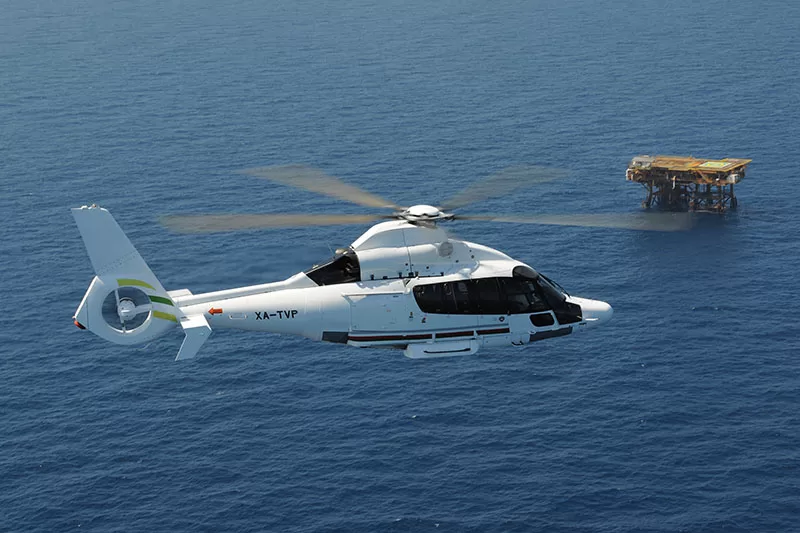
Airbus H155
The Airbus H155, formerly the Eurocopter EC155, was developed for passenger transportation, offshore missions, public services, and executive travel. Its spacious cabin, five-blade main rotor, and useful range helped establish it as a capable long-distance transport platform.
- Range: Approximately 463 nautical miles (533 miles)
- Cruise Speed: Approximately 151 knots (174 mph)
- Altitude: 15,000-foot service ceiling
- Capacity: Up to 13 passengers + 1 or 2 pilots
7. Sikorsky S-76D

Sikorsky S-76D
The Sikorsky S-76D has served in executive transportation, offshore support, emergency medical services, and search and rescue. With a published maximum range of 472 nautical miles (543 statute miles) under no-reserve conditions, the S-76D combines long-distance capability with the speed and versatility required for a variety of passenger and utility missions.
- Range: 472 nautical miles (543 miles), no reserve
- Cruise Speed: 155 knots (178 mph)
- Altitude: Certified operating envelope up to 15,000 feet
- Capacity: Up to 12 passengers + 2 pilots
6. Airbus H160

Airbus H160
The Airbus H160 is a modern medium twin-engine helicopter developed for offshore transportation, emergency medical services, search and rescue, public services, and private aviation. Airbus publishes a maximum range of 480 nautical miles with standard fuel tanks.
- Range: 480 nautical miles (552 miles)
- Recommended Cruise Speed: 138 knots (159 mph)
- Altitude: 20,000-foot maximum flight altitude
- Capacity: Up to 12 passengers + 1 or 2 pilots
5. Sikorsky S-92

Sikorsky S-92
The Sikorsky S-92 is closely associated with demanding offshore operations, search and rescue, and government transportation. Its large cabin, twin-engine configuration, and substantial range make it particularly valuable for extended overwater flights.
- Range: 547 nautical miles (629 miles), no reserve
- Cruise Speed: 151 knots (174 mph)
- Altitude: 15,000-foot service ceiling
- Capacity: Up to 19 passengers + 2 pilots
4. Leonardo AW189
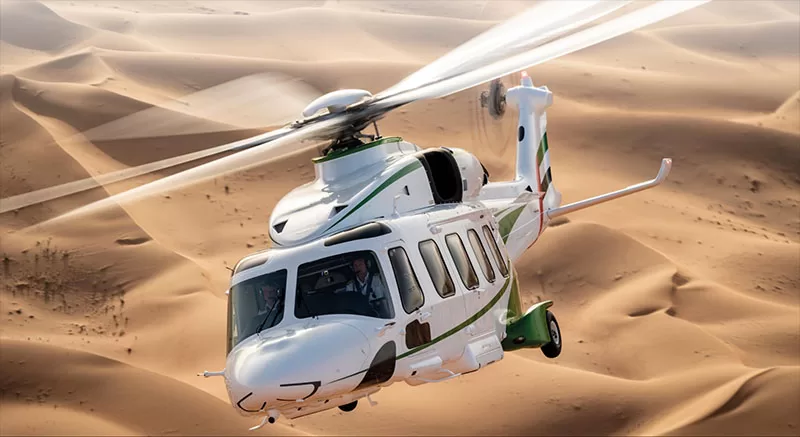
Leonardo AW189
The Leonardo AW189 is a super-medium helicopter developed for offshore transport, search and rescue, and energy-sector operations. Its auxiliary-fuel configurations demonstrate why aircraft configuration must be considered when comparing maximum helicopter range.
- Range: 563 nautical miles (648 miles) with auxiliary fuel, no reserve
- Cruise Speed: 159 knots (183 mph)
- Altitude: Up to 15,000 feet with applicable altitude-extension configuration
- Capacity: Up to 19 passengers + 1 or 2 pilots
3. Airbus H225
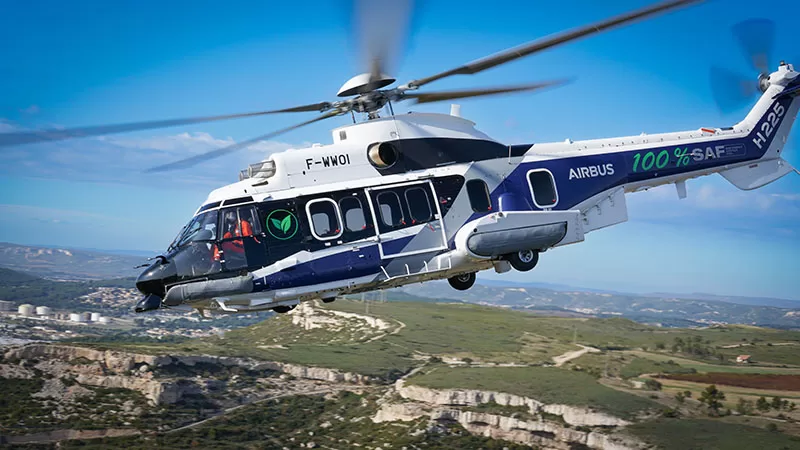
Airbus H225
The Airbus H225 combines long-range capability with substantial passenger and payload capacity. Airbus publishes 459 nautical miles with standard fuel and up to 610 nautical miles when additional fuel equipment is installed. This makes the H225 particularly relevant for offshore transportation and search and rescue.
- Range: 459 nautical miles standard, up to 610 nautical miles (702 miles) with additional fuel
- Recommended Cruise Speed: 142 knots (163 mph)
- Altitude: 20,000-foot maximum flight altitude
- Capacity: Up to 19 passengers + 1 or 2 pilots
2. Bell 525

Bell 525 Relentless
The Bell 525 is a super-medium helicopter designed for offshore energy, search and rescue, and corporate missions. Bell currently publishes a 619-nautical-mile maximum range at maximum gross weight, sea level, ISA conditions, standard fuel, and no reserve.
- Range: 619 nautical miles (712 miles)
- Cruise Speed: 160 knots (184 mph)
- Altitude: 12,000-foot initial service ceiling
- Capacity: 16 passengers + 2 pilots standard, up to 20 passengers in high-density seating
1. Airbus H175

Airbus H175
The Airbus H175 is a super-medium helicopter designed for missions where range, passenger capacity, payload, and operating efficiency must work together. Airbus currently publishes a maximum range of 626 nautical miles and endurance exceeding six hours.
- Range: 626 nautical miles (720 miles)
- Fast Cruise Speed: 155 knots (178 mph)
- Altitude: Approximately 20,000-foot service ceiling
- Capacity: Up to 18 passengers + 2 pilots
Civilian Helicopter Range Comparison Chart
| Aircraft | Maximum Range | Cruise Speed | Altitude | Passenger Capacity |
|---|---|---|---|---|
| 10. Bell 429 | 411 nm (473 mi) | 155 kt (178 mph) | 18,610 ft service ceiling | Up to 7 passengers |
| 9. Leonardo AW169 | 424 nm (488 mi) | 144 kt (166 mph) | 15,000 ft service ceiling | Up to 10 passengers |
| 8. Airbus H155 | Approx. 463 nm (533 mi) | Approx. 151 kt (174 mph) | 15,000 ft service ceiling | Up to 13 passengers |
| 7. Sikorsky S-76D | 472 nm (543 mi), no reserve | 155 kt (178 mph) | Up to 15,000 ft | Up to 12 passengers |
| 6. Airbus H160 | 480 nm (552 mi) | 138 kt (159 mph) recommended cruise | 20,000 ft maximum flight altitude | Up to 12 passengers |
| 5. Sikorsky S-92 | 547 nm (629 mi), no reserve | 151 kt (174 mph) | 15,000 ft service ceiling | Up to 19 passengers |
| 4. Leonardo AW189 | 563 nm (648 mi) with auxiliary fuel, no reserve | 159 kt (183 mph) | Up to 15,000 ft* | Up to 19 passengers |
| 3. Airbus H225 | 459 nm standard; up to 610 nm (702 mi) with additional fuel | 142 kt (163 mph) recommended cruise | 20,000 ft maximum flight altitude | Up to 19 passengers |
| 2. Bell 525 | 619 nm (712 mi) | 160 kt (184 mph) | 12,000 ft initial service ceiling | 16 standard; up to 20 high-density |
| 1. Airbus H175 | 626 nm (720 mi) | 155 kt (178 mph) fast cruise | Approx. 20,000 ft service ceiling | Up to 18 passengers |
Download Comparison Chart (PDF)
Published performance varies by aircraft configuration, fuel system, payload, altitude, weather, reserves, and mission profile. Values should not be treated as guaranteed operational range for a specific flight.
Choosing the Right Helicopter for Long-Distance Missions
The longest-range civilian helicopter is not automatically the best aircraft for every mission. Planning must also consider payload, landing-zone limitations, fuel availability, operating altitude, weather, flight time, aircraft availability, and cost.
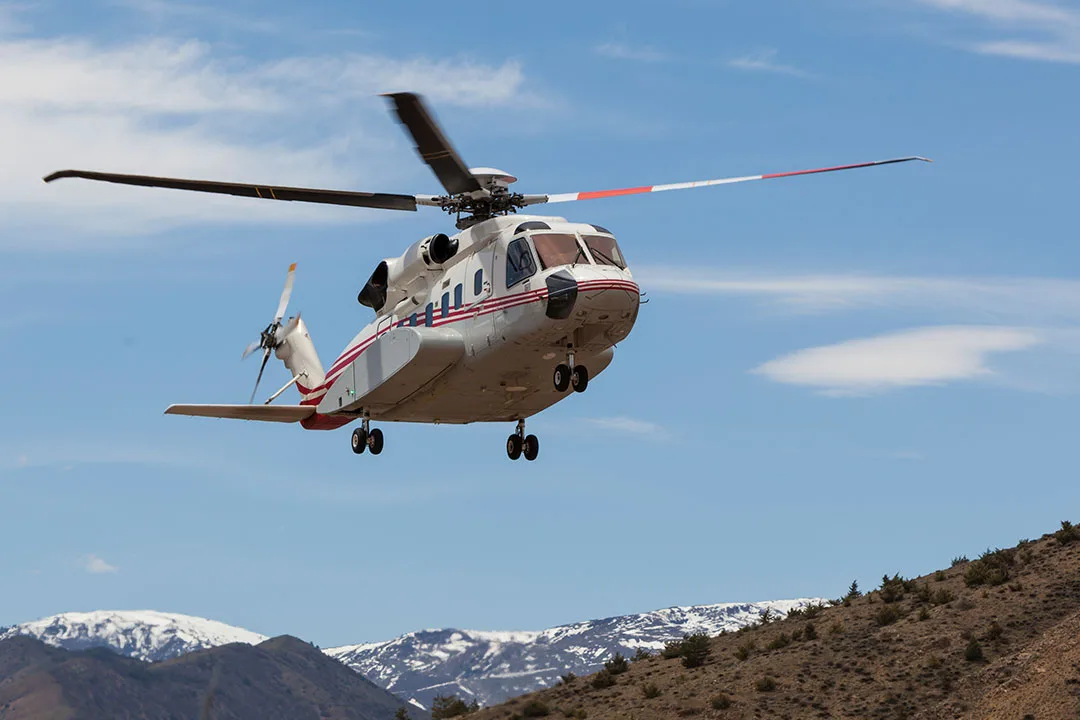
The Sikorsky S-92 combines long-range capability, passenger capacity, and twin-engine performance, making it well suited for extended offshore, remote-access, and long-distance missions.
Payload can be especially important for construction and utility projects. Additional fuel extends range but also adds weight, which can reduce the payload available for equipment or cargo. Similar tradeoffs influence heavy lift helicopter operations, HVAC installations, tower construction, pipeline projects, and other remote infrastructure work.
When Range Matters
Range becomes particularly important when helicopters must reach offshore platforms, remote utility infrastructure, isolated construction sites, emergency scenes, or destinations where convenient refueling is unavailable.
For offshore energy operations, greater range can expand the number of platforms reachable from a shore base. During emergency response, it may reduce the need for intermediate fuel stops. For executive helicopter travel, sufficient range can make point-to-point transportation practical without relying on major airports.
Successful mission planning ultimately balances range, payload, speed, safety, operating conditions, and mission objectives. Maximum published range is useful for comparing aircraft, but real-world performance must always be evaluated for the specific mission.
Planning a Long-Distance Helicopter Mission?
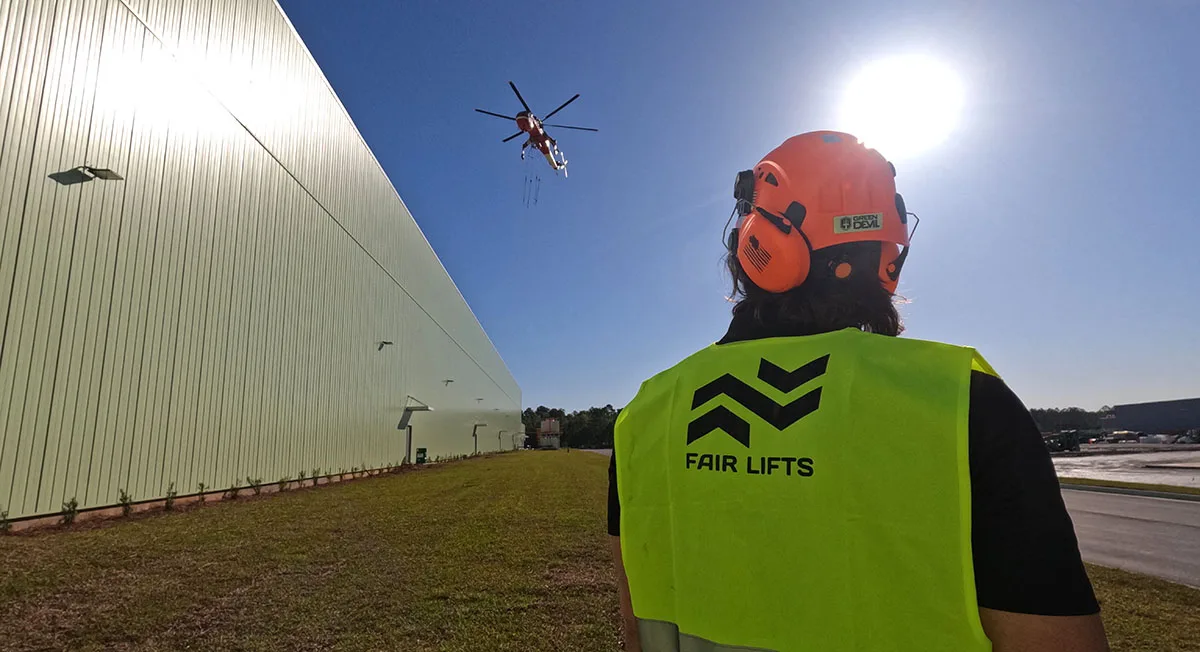
A Fair Lifts project manager oversees a Sikorsky S-64 Skycrane during a heavy lift operation at an active job site.
Selecting the right helicopter requires more than finding the largest published range number. Fair Lifts considers mission distance, payload, passenger requirements, landing areas, operating conditions, aircraft availability, and overall project requirements when coordinating helicopter services.
Whether the mission involves offshore operations, emergency response, remote infrastructure, utility work, or executive transportation, the goal is to match the aircraft to the mission rather than simply choosing the helicopter with the greatest theoretical range.
Contact Fair Lifts or call 1-800-318-8940 to discuss the requirements for your next helicopter mission.
Longest-Range Civilian Helicopter FAQs
How far can a helicopter fly without refueling?
Helicopter range varies widely by aircraft, fuel configuration, payload, weather, and reserve requirements. Many civilian helicopters can travel several hundred miles without refueling, while some long-range models have published ranges exceeding 600 nautical miles under specific conditions.
What helicopter has the longest range?
There is no single answer without considering fuel configuration and operating conditions. Among the civilian helicopters in this guide, the Airbus H175 has a published maximum range of 626 nautical miles with standard fuel. Some aircraft can travel farther with auxiliary fuel. For example, Leonardo publishes a range of up to 641 nautical miles for the AW139 with auxiliary fuel and no reserve.
Can a helicopter fly 500 miles?
Yes. Several civilian helicopters can fly 500 statute miles without refueling under suitable conditions. Aircraft such as the Airbus H160, Sikorsky S-92, Bell 525, and Airbus H175 have published ranges that exceed 500 statute miles.
Can a helicopter fly 1,000 miles?
A nonstop 1,000-mile flight is beyond the published range of most conventional civilian helicopters. However, helicopters can cover trips of 1,000 miles or more when the route includes planned fuel stops. Actual feasibility depends on the aircraft, fuel availability, weather, payload, reserve requirements, and route.
Does carrying a heavy load reduce helicopter range?
Yes. Payload and range are closely connected. More passengers, cargo, equipment, or an external load increase aircraft weight and can limit how much fuel can be carried. Operators must balance payload, fuel, distance, and required reserves when planning a mission.
How does auxiliary fuel affect helicopter range?
Auxiliary fuel tanks increase the amount of fuel an aircraft can carry and can significantly extend its maximum range. However, the additional fuel and tank equipment also add weight and may reduce available passenger or payload capacity. This is why standard-fuel and auxiliary-fuel range figures should not be treated as directly equivalent.
How do helicopter operators plan long-distance flights?
Long-distance helicopter flight planning considers more than the distance between two points. Operators evaluate aircraft range, payload, fuel reserves, weather, winds, operating altitude, landing locations, fuel stops, airspace, and alternate landing options. The final route and aircraft selection depend on the requirements and conditions of the individual mission.
Can Fair Lifts arrange a long-distance helicopter mission?
Yes. Fair Lifts can coordinate helicopter services for missions involving long-distance travel, including offshore operations, emergency response, remote project support, utility work, and executive helicopter transportation. Aircraft selection depends on factors such as distance, payload, passenger requirements, landing access, operating conditions, and aircraft availability. Contact Fair Lifts to discuss the requirements of a specific mission.