

Dry spreading drones are revolutionizing modern farming by enhancing precision, efficiency, and sustainability. This innovative approach involves the aerial application of seeds, fertilizers, and other granular materials using unmanned aerial vehicles (UAVs). Equipped with advanced sensors and GPS, these drones distribute inputs with pinpoint accuracy—maximizing crop yield while minimizing waste.
Understanding Dry Spreading with Agricultural Drones
Dry spreading refers to the aerial application of solid agricultural inputs—such as seeds, fertilizers, and cover crops—via drone. UAVs are fitted with specially designed hoppers and electronically controlled spreaders to ensure uniform distribution. This technique proves particularly effective in hard-to-reach areas where traditional machinery may compact soil or damage crops.
Key Advantages of Drone-Based Dry Spreading

XAG P100 drone performing precision dry spreading over a freshly tilled field, ensuring uniform seed distribution for optimal germination and crop establishment.
1. Enhanced Precision and Efficiency
Modern agricultural drones use Real-Time Kinematic (RTK) GPS systems to achieve centimeter-level accuracy. This ensures that materials are applied exactly where needed, eliminating gaps and overlaps. This targeted application results in better crop performance and reduced input costs.
2. Cost-Effectiveness
By minimizing labor and material waste, drone-based dry spreading lowers operational costs. Tasks that once required multiple laborers or heavy machinery can now be done faster and more affordably, increasing return on investment.
3. Environmental Sustainability
Dry spreading drones help protect the environment by reducing soil compaction and fossil fuel usage. Their accuracy also minimizes the risk of chemical runoff, supporting cleaner and more responsible agricultural practices.
4. Accessibility to Challenging Terrains
Drones can operate in areas inaccessible to traditional equipment—steep hills, wetlands, or fragmented fields—making them ideal for a variety of agricultural landscapes.
Applications of Dry Spreading with Drones
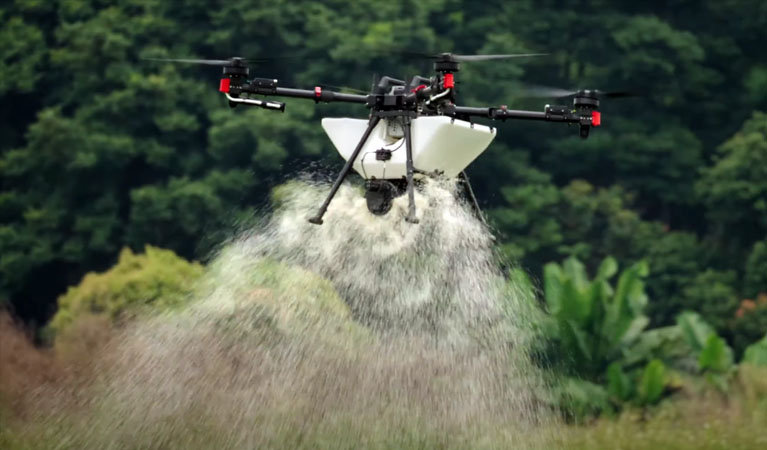
XAG P150 drone executing precision dry fertilizer spreading over a farm field, using GPS-guided paths for even coverage and reduced waste.
1. Fertilizer Application
Granular fertilizers can be evenly distributed with drones to ensure consistent nutrient access for crops. This not only improves plant health but also curbs input overuse.
2. Seeding Cover Crops
Drones excel at seeding cover crops, especially in no-till systems or post-harvest fields. According to Crop Fertility Services, drone seeding boosts soil fertility, controls erosion, and suppresses weeds—all without disturbing the existing crop canopy.
3. Pest and Weed Control
Drones can apply dry granular herbicides and pesticides with precision, targeting infested areas while reducing chemical exposure to the broader environment.
Technological Advancements in Agricultural Drones

A XAG P100 Pro mid-dry spread. | Photo: xa.com
The latest models, like the XAG P100 Pro HP, bring unprecedented capabilities to dry spreading. Designed for heavy-payload operations, the P100 Pro HP features a high-capacity spreader system that can handle large volumes of granular material with remarkable efficiency and precision. With intelligent flow control and multi-mode spreading options, this drone is optimized for a wide range of field conditions and application types.
Implementing Drone-Based Dry Spreading on Your Farm
- Assessment: Evaluate terrain, crop types, and target zones for application.
- Equipment Selection: Choose drones with appropriate payload capacity and spreader attachments.
- Training: Ensure your drone operators are certified and skilled in dry spreading applications.
- Compliance: Follow FAA and local regulations for agricultural UAV operations.
Advancing Farmland Efficiency with Drones
Dry spreading drones represent a leap forward in precision agriculture. Their ability to apply materials accurately and efficiently makes them a smart investment for modern farms. As the technology continues to evolve, early adopters stand to benefit from increased yields, lower costs, and more sustainable practices.
Call Fair Lifts for a Free Quote

Contact Fair Lifts today to learn more and request a free quote!
At Fair Lifts Unmanned Aerial Services, we proudly utilize the XAG P100 Pro HP for precision dry spreading of seeds, fertilizers, herbicides, and more. With its high-capacity hopper, intelligent application system, and unmatched efficiency, the P100 Pro HP sets a new standard for aerial granular distribution.
Whether you’re managing cover crops, restoring clear-cuts, or optimizing nutrient delivery, this advanced drone delivers reliable results with minimal input waste. For a free quote on your agricultural dry spreading project, call Fair Lifts today at 1-800-318-8940.