
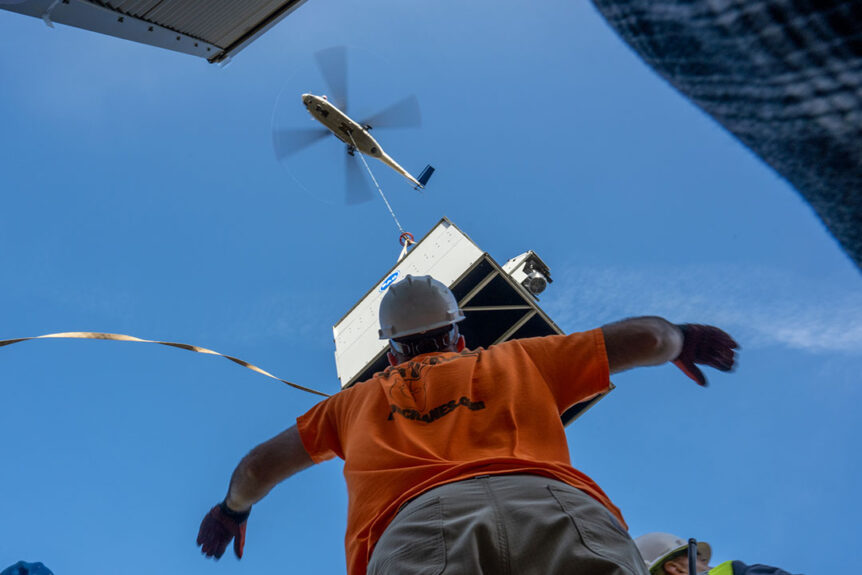
Helicopter crane operations represent one of the most advanced and efficient lifting solutions used in today’s construction, infrastructure, and utility industries. Rather than functioning as a ground-based machine, this type of aerial lift relies on a specially configured helicopter capable of transporting and positioning heavy external loads with remarkable precision. These aircraft are most often deployed when conventional cranes are impractical due to terrain, access limitations, or time constraints.
Helicopter lift services are commonly used for HVAC placement, electrical infrastructure upgrades, rooftop equipment replacement, utility construction, and emergency response projects where speed, accuracy, and minimal ground disruption are essential.
What Is a Helicopter Crane?
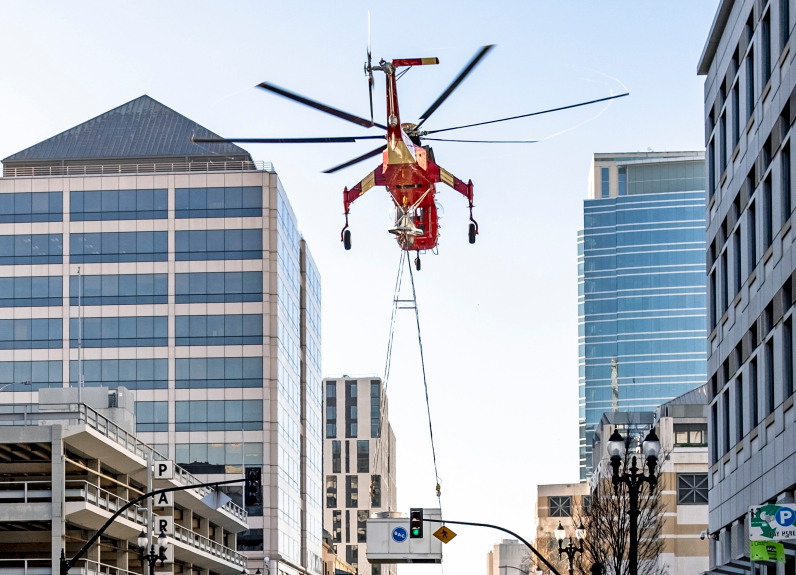
A Sikorsky Sky Crane helicopter carries a large air conditioning unit before dropping it onto Clay Street near 14th Street in downtown Oakland on Saturday Jan. 9, 2021. (Photo: Gabriel Tcruz)
A helicopter crane is a helicopter designed or modified for external load lifting. Instead of carrying cargo internally, these aircraft transport loads suspended beneath the fuselage using longlines, cargo hooks, and certified rigging systems. This setup allows the pilot to maintain continuous visual contact with the load, enabling precise placement in challenging environments.
Well-known heavy-lift helicopter models include the Kaman K-MAX and the Sikorsky S-64 Skycrane. The K-MAX, for instance, was purpose-built for external load work and can lift up to 6,000 pounds while maintaining exceptional stability and control.
How Helicopter Crane Lift Operations Work
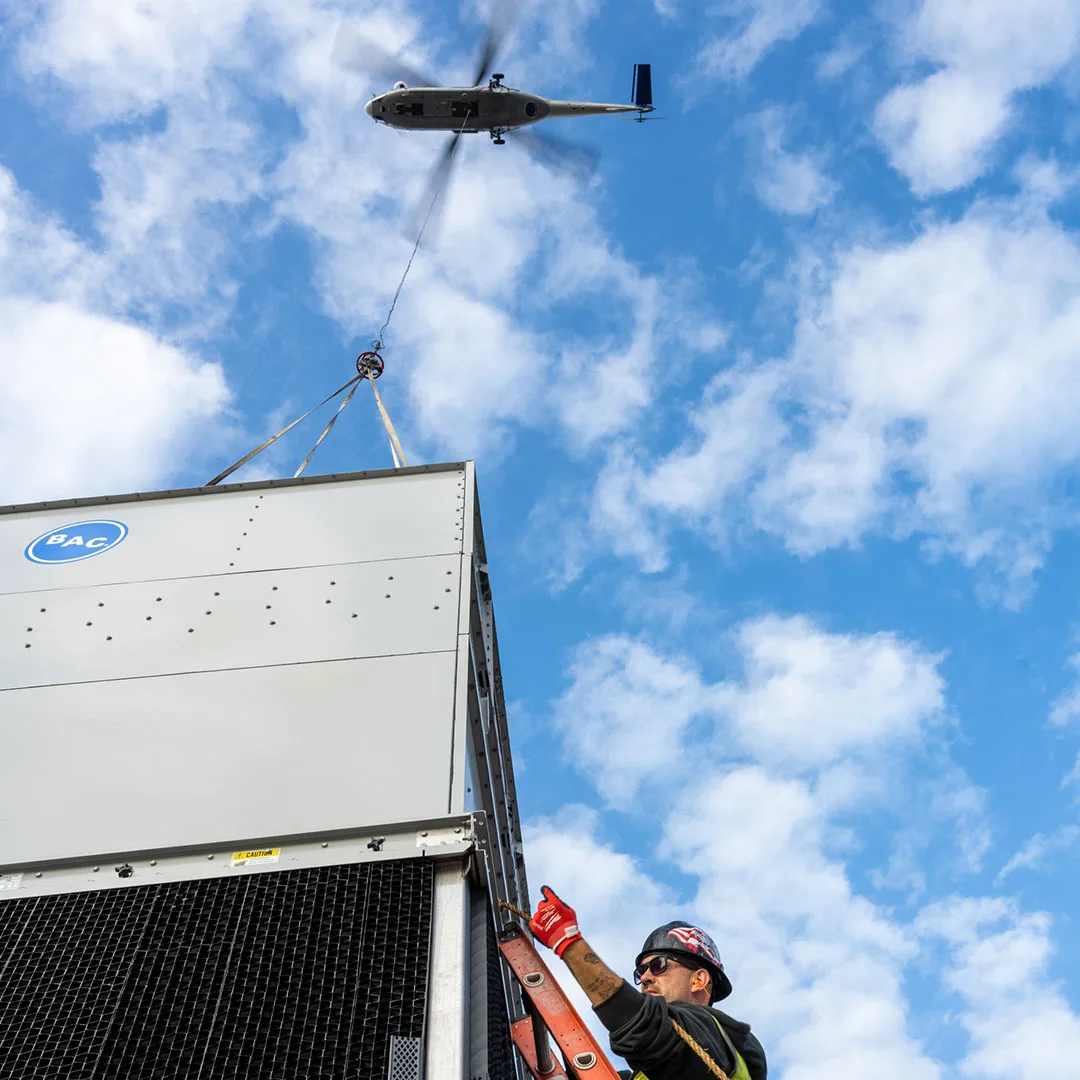
A helicopter crane lift crew member installs an HVAC rooftop unit.
Helicopter crane lift operations depend on close coordination between the pilot, ground crew, and rigging specialists. Loads are secured using FAA-approved cargo hook systems regulated under external load standards established by the Federal Aviation Administration (FAA).
Once connected, the aircraft lifts vertically to keep the load clear of obstacles. Pilots rely on visual references, mirrors, and sometimes camera systems to position equipment with extreme accuracy. Ground crews manage tag lines to control rotation and sway as the load is guided into place.
This aerial lifting method allows heavy equipment to be installed on rooftops, towers, and remote sites without the extensive setup or ground reinforcement required by traditional cranes.
Why Helicopter Cranes Are Used
Helicopter cranes are chosen when conventional lifting equipment presents logistical, environmental, or cost challenges. Their ability to operate without direct ground contact offers several key advantages:
- Access to confined or restricted locations
- Reduced disruption to traffic and surrounding operations
- Minimal ground footprint compared to large mobile cranes
- High-precision placement of sensitive equipment
- Significantly faster project timelines
In dense urban areas, aerial crane services can eliminate street closures and prolonged crane mobilization. In mountainous or remote regions, heavy-lift helicopters may be the only viable way to transport and install large components.
Common Applications of Helicopter Crane Services
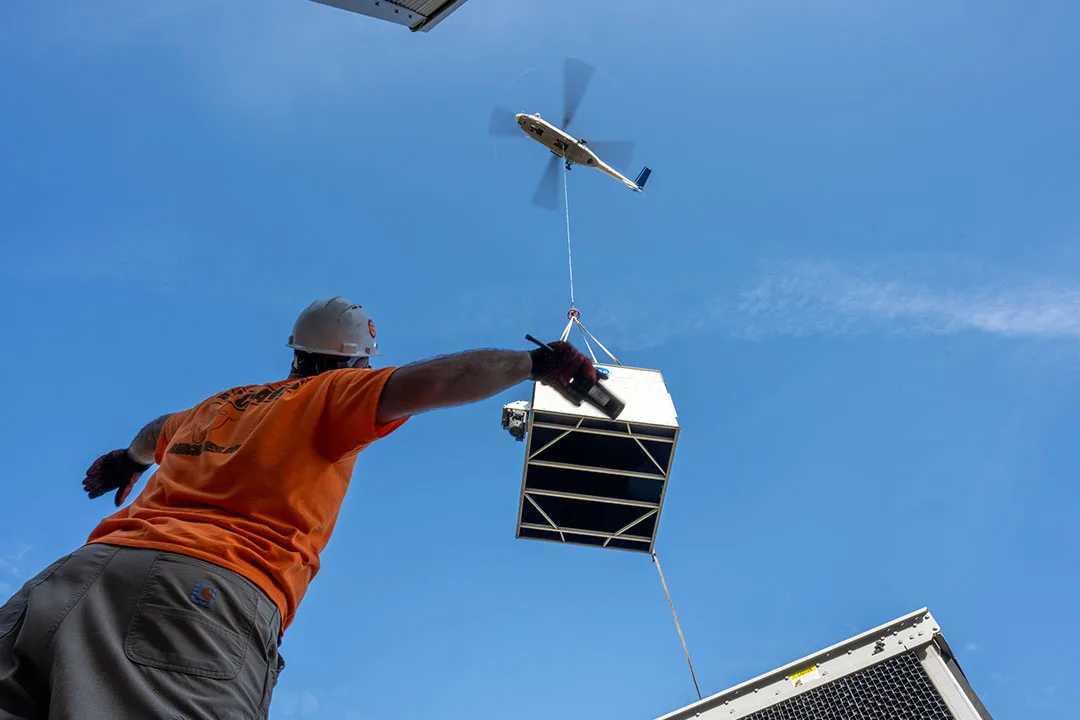
An HVAC unit being positioned into place by a helicopter crane.
Helicopter crane services support a wide range of industries. One of the most frequent applications is commercial HVAC installation and replacement. Using a helicopter allows old rooftop units to be removed and new systems installed in a fraction of the time required by ground-based cranes.
Additional applications include generator placement, cell tower construction, utility pole installation, industrial equipment relocation, and disaster recovery operations. The Sikorsky S-64 Skycrane, in particular, has a long history of use in firefighting and heavy construction due to its exceptional lifting capacity and flight stability.
Safety and Regulation in Helicopter Crane Operations
Helicopter crane operations are highly regulated and require detailed planning and compliance. Operators must adhere to FAA Part 133 regulations, which govern external load operations and define pilot qualifications, aircraft certification requirements, load calculations, and operational procedures.
Before each lift, teams conduct precise weight calculations, rigging inspections, and site assessments. Comprehensive safety briefings ensure that all personnel understand communication protocols, lift sequencing, and emergency procedures.
Helicopter Cranes vs. Traditional Cranes

A ground crane lifts an HVAC unit to a rooftop.
Traditional cranes rely on ground stability, counterweights, and structural reach. In contrast, helicopter crane systems depend on controlled flight and pilot visibility, allowing them to operate in locations where cranes cannot be transported or erected.
While weather conditions and airspace coordination must be carefully managed, aerial crane operations are often the most efficient solution when their benefits outweigh logistical complexity.
The Strategic Value of Helicopter Crane Lift Solutions
Demand for helicopter crane lift solutions continues to grow as commercial buildings, infrastructure projects, and energy systems become increasingly complex. Their ability to reduce downtime, avoid structural limitations, and deliver unmatched precision makes them an essential tool in modern construction.
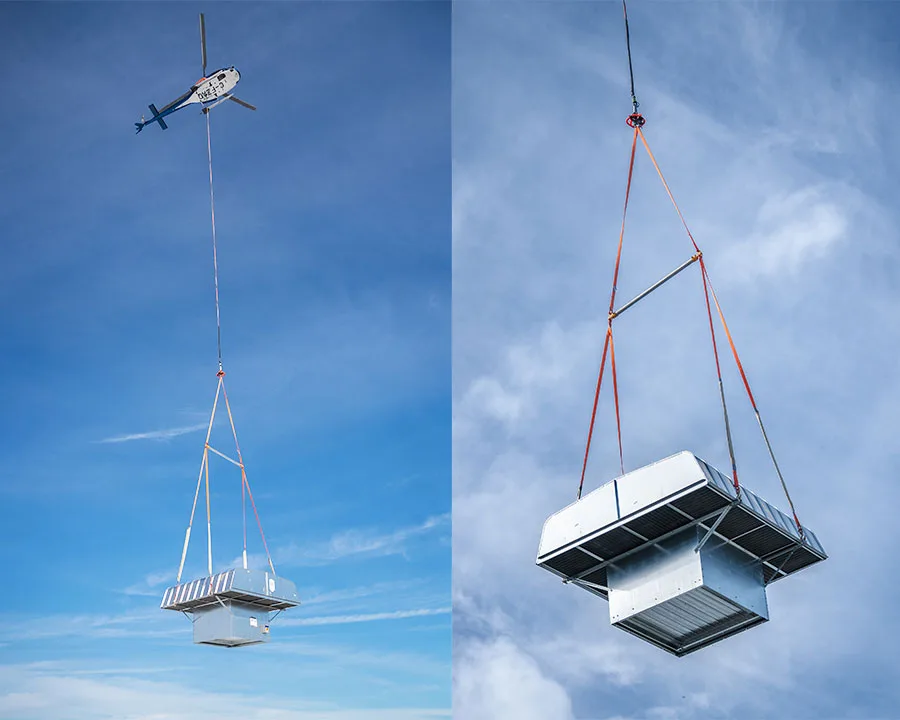
An HVAC Rooftop Unit hangs from a helicopter crane.
For projects involving rooftop equipment, limited-access sites, or time-sensitive installations, helicopter-based lifting solutions provide a proven and efficient alternative to conventional cranes. As aviation technology and operational expertise continue to advance, helicopter cranes remain a critical asset in specialized lift operations.
Work With Fair Lifts on Your Helicopter Crane Project
Fair Lifts delivers FAA-compliant helicopter crane lift solutions for complex, time-sensitive projects nationwide.
Contact Fair Lifts today or call our team directly at 1-800-318-8940 for immediate project guidance.